THIS WASN’T REBELLION WITH SHOUTS — IT WAS REBELLION WITH TRUTH. Johnny Cash was one of the pillars of the golden country generation of the late 1950s and early 1960s, yet he never stayed still inside a single mold. His music blended country with folk and gospel—minimal in melody, heavy with meaning. He sang about people on the margins: prisoners, the poor, the broken, souls society had pushed aside. His deep, weathered voice and steady, marching rhythm sounded like footsteps down a prison hall, creating music that felt cold on the surface yet filled with compassion beneath. It was rebellion without noise—no slogans, no shouting—only truth. For Johnny Cash, country music was never just entertainment. It was conscience. It was a moral question. A reminder that music can still stand with humanity—even when that humanity is found at the very bottom. – Country Music
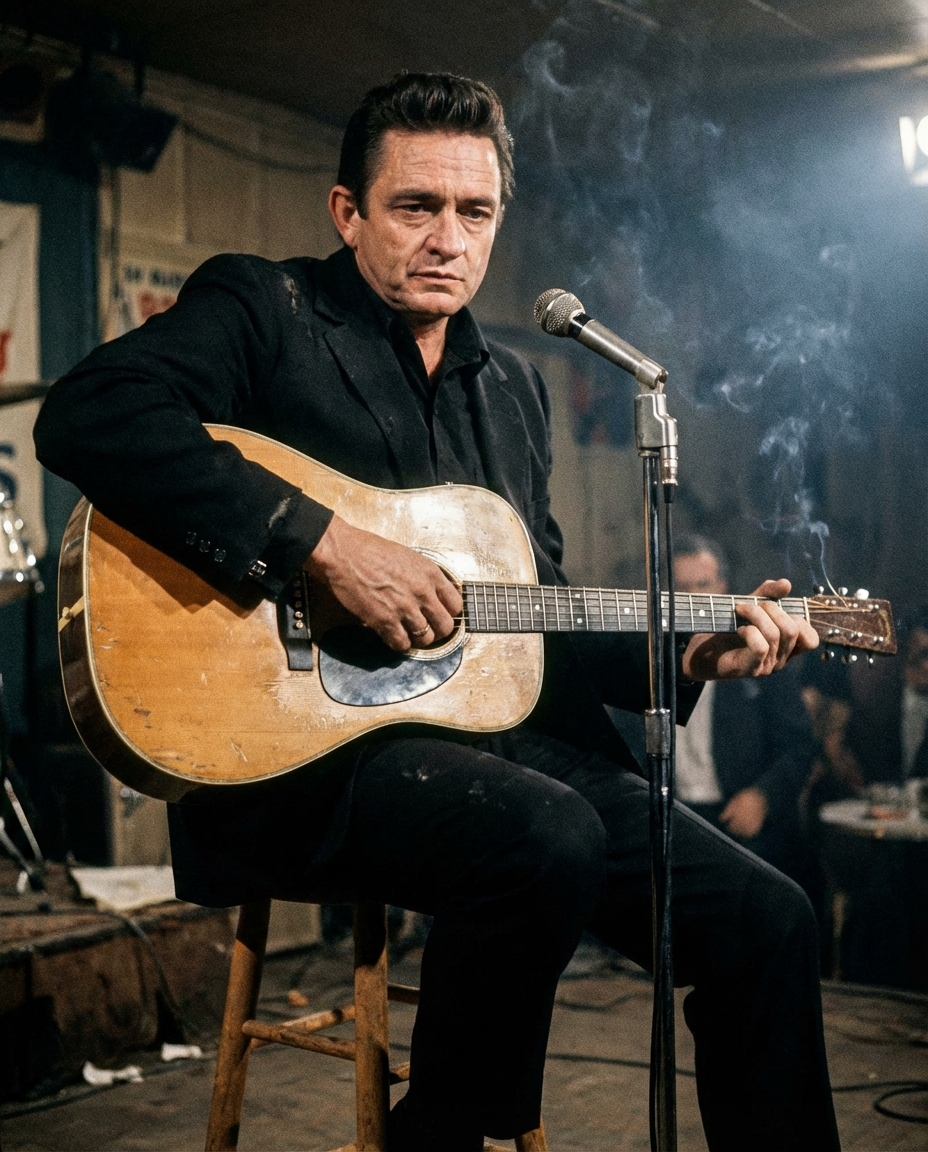
Johnny Cash stood at the center of country music’s golden age in the late 1950s and early 1960s, yet he never fully belonged to any single tradition. While others polished their sound to fit radio expectations, Johnny Cash carved a path that felt heavier, quieter, and more deliberate. His music did not chase applause. It waited for listeners to catch up.
At a time when country music often celebrated romance, rural pride, or simple pleasures, Johnny Cash turned his gaze elsewhere. He blended country with folk and gospel, stripping melodies down to their bones. The arrangements were sparse. The rhythms were steady, almost relentless. What mattered most were the words, and the people inside them.
Johnny Cash sang about prisoners staring at concrete walls, about workers worn down by long days and little reward, about men and women carrying shame, regret, and loneliness. These were not symbolic characters or moral lessons wrapped in metaphor. They felt real. Too real to ignore.
His voice did not ask for sympathy. It offered understanding.
There was something unmistakable about the way Johnny Cash sounded. His deep, weathered voice moved forward like footsteps down a prison hallway. Each beat landed with intention. Each pause felt considered. On the surface, the music could seem cold or restrained. But beneath that restraint lived compassion — a quiet insistence that the people society pushed aside still mattered.
This was not rebellion built on volume or outrage. Johnny Cash did not shout. He did not wave slogans. He did not lecture his audience. Instead, he told stories and trusted the truth inside them to do the work. That trust was radical.
When Johnny Cash sang about inmates, he did not excuse their crimes. He acknowledged their humanity. When he sang about the poor, he did not romanticize hardship. He documented it. His songs did not offer easy solutions. They asked listeners to sit with discomfort and recognize themselves in lives far removed from their own.
Country Music as Conscience
For Johnny Cash, country music was never just entertainment. It was a moral question. It was a mirror held up to the listener, asking not what was catchy, but what was true. He believed music could still stand with humanity, even when that humanity lived at the very bottom of society.
This belief placed him in a strange position. He was undeniably a star, yet his artistic loyalty often leaned toward people with no voice, no platform, and no audience beyond the walls surrounding them. That tension — between fame and empathy — became part of his identity.
Johnny Cash’s refusal to stay in one mold confused critics and executives alike. He moved freely between country, folk, gospel, and spoken-word storytelling. He recorded songs that challenged comfort rather than reinforcing it. And he did so without theatrics.
There was courage in that restraint. In choosing truth over polish, Johnny Cash accepted that some listeners would turn away. But those who stayed found something rare: music that respected their intelligence and their conscience.
A Legacy That Still Walks Beside Us
Decades later, Johnny Cash’s songs continue to surface in moments when people feel overlooked, judged, or forgotten. His voice appears in films, late-night radio, and quiet personal rituals not because it demands attention, but because it understands silence.
He proved that rebellion does not always need fire or fury. Sometimes rebellion sounds like a steady voice, telling an uncomfortable story, and refusing to look away. Sometimes it is simply the act of standing with people the world has decided not to see.
That is why Johnny Cash endures. Not as a symbol of defiance for its own sake, but as a reminder that music can still carry truth — and that truth, when spoken calmly and honestly, can be the most powerful rebellion of all.
Post navigation
“I didn’t sing to be polite — I sang to tell the truth. And Loretta Lynn never apologized for it.”
On September 24, 2017, the lights dimmed inside the Ryman Auditorium in Nashville, and a familiar figure stepped onto the stage. Loretta Lynn walked slowly, carefully. She looked smaller than many remembered. Tired, even. Her body no longer moved with the ease it once had, and there was no attempt to hide it. But the room didn’t shift with pity. It shifted with recognition.
This was Loretta Lynn. And she was exactly where she wanted to be.
That night would later be known as her final full concert. At the time, no announcement marked it as such. No farewell banners. No speeches about legacy. Just Loretta, a microphone, and a crowd leaning forward, sensing something important was happening even if they didn’t yet know what it was.
There were whispers before the show. Some said she was in pain. Some wondered why she hadn’t canceled, why she hadn’t chosen rest instead. Others knew better. Loretta Lynn had never been a woman who stepped aside when things got difficult. She had built an entire career on standing her ground, even when it made people uncomfortable.
When she began to sing, her voice wasn’t loud. It didn’t need to be. It carried something heavier than volume. It carried coal dust and kitchen tables. It carried long days, hard marriages, and choices that didn’t come with easy answers. Every word sounded lived-in. Not performed. Lived.
The Ryman felt still in a way that only happens when an audience realizes they are witnessing something honest. Applause came, but softer than usual. Some people cried without fully understanding why. Others simply listened, aware that this wasn’t a show designed to impress. It was a woman telling her story one last time, without dressing it up.
Loretta Lynn never softened her truth for comfort. She sang about women who felt trapped, angry, hopeful, and defiant long before it was fashionable to do so. She didn’t ask permission to say things out loud. And she didn’t apologize when those words rattled radio stations or living rooms. That same resolve stood quietly on the Ryman stage that night.
There were no dramatic gestures. No attempt to stretch the moment. Loretta sang as she always had — direct, grounded, and unafraid. If her body felt the weight of the years, her voice carried the weight of a life fully lived. She knew the songs. The songs knew her. They met in the middle, steady and unbent.
The audience didn’t realize they were hearing goodbye. Loretta did. And that knowledge didn’t make her sentimental. It made her precise. She sang like someone closing her own story, line by line, on her own terms. No spectacle. No regret. Just truth.
When the final notes faded, the applause lingered longer than usual. Not louder. Longer. As if no one wanted to be the first to break the spell. Loretta Lynn stood there, small against the stage that had held so many legends, and yet completely unmoved by its size. She had never needed a big stage to be heard.
Looking back now, that knowledge settles in differently. That night wasn’t about an ending. It was about consistency. About a woman who lived exactly as she sang — without apology, without polish, and without pretending to be anything other than who she was.
Loretta Lynn didn’t sing to be polite. She sang to tell the truth. And on that quiet September night in Nashville, she told it one last time, exactly the way she always had.