July 31st, 1964. A small Beechcraft went down in a thunderstorm outside Brentwood, Tennessee. Jim Reeves was at the controls. He was 40 years old. Mary searched for him for two days through the woods with the rescue crews. She wouldn’t go home. She wouldn’t eat. When they finally found the wreckage, she was the one who identified his wristwatch. For the next 35 years, Mary ran his estate from their house on Franklin Road. She released his unfinished recordings one by one, slowing the pace deliberately, as if rationing him out to the world. New duets were created by overdubbing his vocals onto Patsy Cline tracks years after both of them were gone. Mary died in 1999. The last record she approved came out the month before. Jim’s voice, clean as the day he sang it. – Country Music
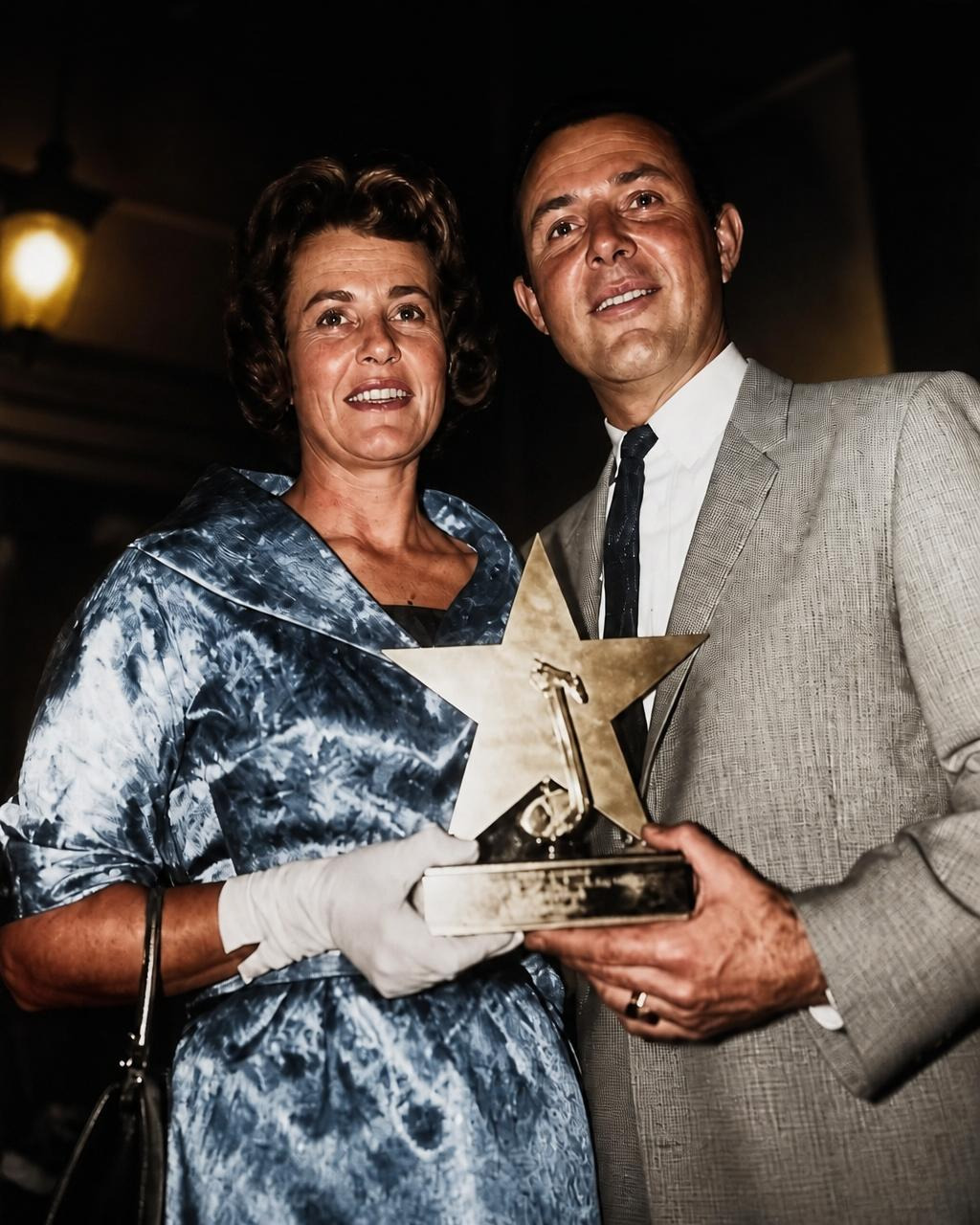
The Voice Mary Reeves Refused to Let Fade
July 31, 1964, began like an ordinary summer day in Tennessee, but by evening, country music had entered one of its most heartbreaking chapters. A small Beechcraft airplane went down during a thunderstorm outside Brentwood, Tennessee. At the controls was Jim Reeves, the smooth-voiced country singer whose calm, elegant style had already made him one of the most beloved performers of his time.
Jim Reeves was only 40 years old.
For fans, the news was shocking. For Mary Reeves, it was something deeper than shock. It was the sudden disappearance of the man she loved, the man whose voice had filled concert halls, radio stations, and quiet rooms all over the world. But before the world could begin grieving, Mary Reeves was still searching.
The Two Days Mary Reeves Would Not Leave
After the crash, rescue crews moved through the wooded area near Brentwood, searching through rain, mud, and broken trees. Mary Reeves joined them and refused to go home. She would not rest. She would not eat. She stayed close to the search because leaving meant accepting something she was not ready to accept.
For two days, the woods held its silence.
When the wreckage was finally found, Mary Reeves faced the moment no wife should ever have to face. She helped identify Jim Reeves by his wristwatch. It was a small object, ordinary in every other setting, but in that moment, it became the final proof that the search was over.
Sometimes grief does not arrive all at once. Sometimes it waits in the trees, in the rain, in the stillness after a voice has gone quiet.
A House on Franklin Road Became a Living Archive
After Jim Reeves was gone, Mary Reeves did not let his story collapse into memory. From their house on Franklin Road, Mary Reeves began the long, careful work of protecting Jim Reeves’ legacy. For the next 35 years, Mary Reeves ran his estate with unusual devotion and discipline.
Jim Reeves had left behind recordings, unfinished vocals, studio fragments, and songs that still carried the warmth of his voice. Mary Reeves understood something that many people around her may not have fully grasped at first: Jim Reeves was gone, but Jim Reeves’ voice still had a future.
Mary Reeves did not release everything at once. Mary Reeves moved slowly. One recording at a time. One project at a time. It was almost as if Mary Reeves was rationing Jim Reeves back to the world, making sure listeners never forgot the sound that had once felt so effortless and alive.
The Voice That Kept Returning
There was something haunting and beautiful about hearing new Jim Reeves recordings after 1964. Fans knew Jim Reeves was no longer here, yet the voice came through the speakers clean, steady, and unmistakable. It carried the same polish, the same warmth, the same gentle authority that had made songs like “He’ll Have to Go” feel personal to millions of listeners.
Over the years, new duets were also created by pairing Jim Reeves’ vocals with recordings from Patsy Cline, another country music legend whose life had ended too soon. These posthumous recordings gave listeners something both touching and unusual: two voices from the past meeting again through the hands of producers, musicians, and the careful guardianship of legacy.
Some fans heard those songs as gifts. Others heard them as echoes. But almost everyone understood why they mattered. Jim Reeves had not been just a star. Jim Reeves had been a presence. His voice made sadness sound dignified and love sound calm. Mary Reeves seemed determined that the world would not lose that presence too quickly.
Mary Reeves’ Final Gift
Mary Reeves died in 1999, after spending more than three decades keeping Jim Reeves’ music alive. By then, generations of listeners had discovered Jim Reeves not only as a singer from the past, but as an artist whose sound could still feel strangely fresh. His recordings crossed borders, reached new audiences, and remained part of country music’s wider memory.
The last record Mary Reeves approved was released the month before Mary Reeves died. That detail feels almost impossible to separate from the larger story. After all those years of careful decisions, guarded tapes, estate work, and quiet devotion, Mary Reeves gave the world one more piece of Jim Reeves.
And there it was again: Jim Reeves’ voice, clean as the day Jim Reeves sang it.
In the end, Mary Reeves did more than preserve recordings. Mary Reeves preserved a feeling. Mary Reeves held on to the sound of a man who left too suddenly and made sure that, long after the crash, long after the search, and long after the house on Franklin Road became quiet, Jim Reeves could still be heard.
Some love stories end with goodbye. Mary Reeves and Jim Reeves left behind something different: a voice that never fully disappeared.
Post navigation
The Quiet Song Keith Urban Wrote for Nicole Kidman
Keith Urban tells the story sometimes with a small laugh, as if the memory still catches him off guard. It is not the kind of story built for headlines. There was no stage, no spotlight, no cheering crowd, and no camera waiting to turn the moment into something public.
It happened during lockdown, on one of those long nights when the world felt strangely still. Nicole Kidman could not sleep. The day had been heavy. She had carried the emotional weight of a difficult scene, the kind that follows an actor home even after the lights are turned off and the costume is put away.
Keith Urban noticed. After years of marriage, silence can become its own language. Keith Urban did not need Nicole Kidman to explain everything. Keith Urban simply reached for his guitar.
According to the way Keith Urban shares it, the song had been sitting unfinished for months. A melody here. A line there. Something personal enough that Keith Urban had never quite known what to do with it.
That night, sitting at the foot of the bed, Keith Urban began to play.
Nicole Kidman listened quietly. No audience. No applause. Just the soft sound of guitar strings in a room where two people had spent years learning how to stand beside each other through bright seasons and difficult ones.
“Some songs aren’t for the world. Some songs are just for one person, and that’s enough.”
That sentence, whether spoken with a smile or a little embarrassment, says almost everything about the moment. Keith Urban has spent much of his life giving songs to strangers. Songs that fill arenas. Songs that ride through radio stations, playlists, and long highway drives. But this one was different.
This one belonged to Nicole Kidman.
The Beauty of Something Unreleased
Fans often wonder about unreleased songs. What did the melody sound like? Was it gentle? Was it sad? Did it carry the warmth of a love letter or the quiet honesty of a confession?
Maybe the mystery is part of why the story feels so touching. Not every beautiful thing needs to be shared. Not every private moment has to become content, promotion, or proof. Sometimes the deepest kind of love is not announced. It is played softly in the dark for the one person who needed to hear it.
Nicole Kidman’s response made the story even more memorable. Nicole Kidman told Keith Urban that Nicole Kidman had been waiting fifteen years to hear Keith Urban sing something only Nicole Kidman would ever know.
There is something deeply human in that line. After all the public appearances, red carpets, interviews, award shows, and songs known by millions, Nicole Kidman was not asking for a grand gesture. Nicole Kidman was asking for something private. Something that could not be streamed, purchased, or replayed by anyone else.
When Love Sounds Like a Whisper
Keith Urban and Nicole Kidman have lived much of their love story in public, but this moment feels powerful because it belongs to the quiet side of marriage. The side no audience sees. The side made of tired nights, small acts of care, and knowing when words are not enough.
Keith Urban did not need a perfect song. Nicole Kidman did not need a polished performance. What mattered was that Keith Urban saw Nicole Kidman’s exhaustion and answered it with the language Keith Urban knew best.
Music, in that room, was not a career. Music was comfort.
That is why the story stays with people. It reminds us that the most meaningful songs are not always the famous ones. Sometimes the song that matters most is the one nobody else will ever hear.
A Love Story Hidden in One Unfinished Melody
Maybe the song will never have a title. Maybe Keith Urban will never release it. Maybe it will remain exactly where it began, tucked inside a private memory between Keith Urban and Nicole Kidman.
And maybe that is the reason it feels so special.
In a world that constantly asks people to share everything, Keith Urban and Nicole Kidman’s quiet lockdown moment suggests something softer: some memories are more beautiful when they are protected.
One unfinished song became a finished promise. Not to the world. Not to the fans. Just to Nicole Kidman.
And sometimes, one person is more than enough.