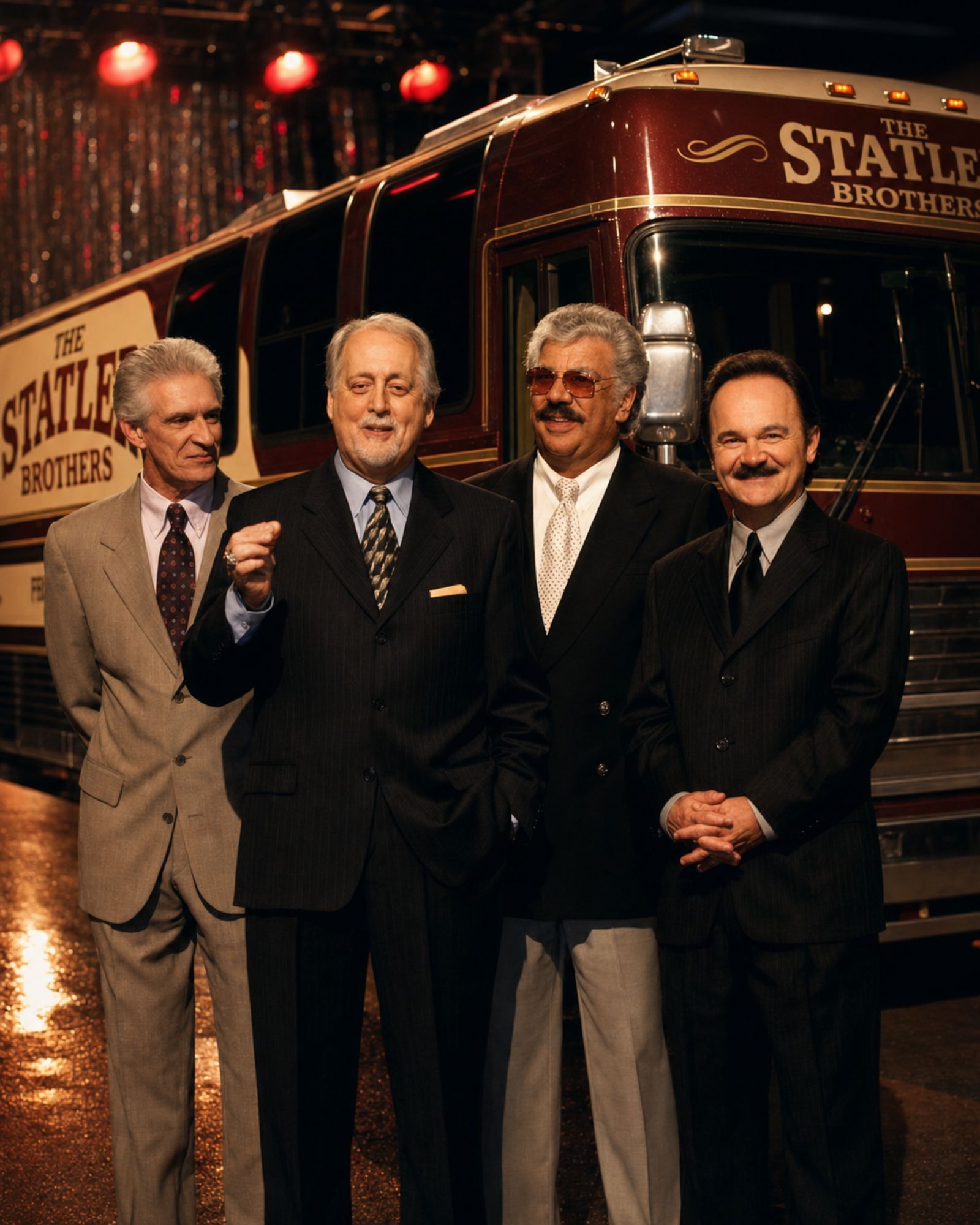
24 YEARS CANNOT ERASE THAT HAUNTING HARMONY THE STATLER BROTHERS October 26, 2002. Salem Civic Center, Virginia. 10,000 people stood one last time. Four men from a tiny town called Staunton. None of them named Statler — they got the name from a tissue box in a hotel room. But those four voices together? More real than blood. Johnny Cash hired them in 1964 WITHOUT hearing them sing. He just knew. They stayed with Cash for 8 years. Sang on At Folsom Prison. Then built their own empire. 3 Grammys. 9 CMA Vocal Group of the Year — 6 consecutive. No country group has ever matched that. Kurt Vonnegut called them “America’s Poets.” Country Music Hall of Fame. Gospel Music Hall of Fame. “Flowers on the Wall.” “Class of ’57.” “Elizabeth.” Then in 2002, they said goodbye. No comeback. No reunion. When the Statler Brothers said farewell, they meant it. Harold Reid passed in 2020. Lew DeWitt in 1990. Two of the four voices are gone forever. 24 years later, hundreds of country groups exist. None sound like this. Not because they lack talent — because this harmony took 47 years to build. No software. No Auto-Tune. No shortcut. Just four boys from a Virginia church choir who became irreplaceable. – Country Music
The Night the Music Stopped, Yet Never Really Did
On October 26, 2002, the Salem Civic Center in Virginia held something more than a concert. Ten thousand people stood together for one last goodbye to The Statler Brothers, a group that had spent decades shaping country music with voices so tightly woven together that they sounded almost impossible. When the final notes faded, the crowd knew they had witnessed the end of an era.
But endings have a strange habit of lingering. Even 24 years later, the sound of The Statler Brothers still reaches across time. Their music still feels alive, still warm, still unsettling in the best way. It is the kind of harmony that makes people pause, listen, and remember where they were the first time they heard it.
From Staunton to Stardom
The story began in a small Virginia town called Staunton. None of the four men were actually named Statler. The name came from a tissue box in a hotel room, a quirky detail that somehow fit a group built on personality, charm, and something bigger than luck. Don Reid, Harold Reid, Phil Balsley, and Lew DeWitt grew from church choir roots into one of the most admired vocal groups in American music.
Their rise was not instant, but it was unforgettable. In 1964, Johnny Cash hired them without even hearing them sing. He simply believed they belonged beside him. That instinct proved right. For eight years, The Statler Brothers worked with Johnny Cash and sang on landmark performances, including At Folsom Prison. They were not just background voices. They were a steady, rich presence that helped define an era.
Building an Empire on Harmony
After their years with Johnny Cash, The Statler Brothers built a legacy of their own. They went from trusted collaborators to headliners, releasing songs that still carry emotional weight today. “Flowers on the Wall” became one of their signature hits, followed by favorites like “Class of ’57” and “Elizabeth.” Their music mixed humor, heartbreak, faith, and storytelling in a way that felt deeply human.
The awards followed, but the real achievement was harder to measure. They won 3 Grammys and earned 9 CMA Vocal Group of the Year awards, including an astonishing 6 in a row. No country group has matched that record. They were inducted into the Country Music Hall of Fame and the Gospel Music Hall of Fame, proof that their reach went far beyond one genre.
“America’s Poets.” That is what Kurt Vonnegut called them, and the phrase fits because The Statler Brothers did more than sing. They told stories that felt lived-in and true.
Why Their Sound Still Matters
In an age of polished production, software, and endless studio tricks, The Statler Brothers remind listeners of something rare: true vocal harmony has to be earned. It cannot be rushed. It cannot be faked. Their sound came from years of singing together, breathing together, and learning how to blend as one while still letting each voice keep its identity.
That is why their music still cuts through the noise. It carries patience. It carries discipline. It carries the feeling of four men from a church choir making something larger than themselves. Even now, hundreds of country groups exist, but very few can touch the emotional precision The Statler Brothers created.
A Farewell That Meant Farewell
When The Statler Brothers retired in 2002, they did not leave room for a flashy reunion or a half-hearted comeback. They meant goodbye. That choice made the moment even more powerful. Fans were not simply watching a tour end; they were witnessing the closing of a chapter that would never reopen in the same way.
Time has made that goodbye even more poignant. Lew DeWitt passed away in 1990, and Harold Reid passed in 2020. Two of the four voices are now gone forever, which makes the surviving recordings feel even more precious. Every song becomes a kind of time capsule, preserving a sound no studio can recreate and no modern group can fully replace.
The Harmony That Refuses to Fade
Twenty-four years later, The Statler Brothers remain more than a memory. They are a standard. They are proof that great music can come from humble places and leave a mark that outlasts trends, technology, and even the people who made it.
Four boys from a Virginia church choir became one of the most celebrated vocal groups in American history. They never needed hype. They never needed gimmicks. They only needed each other, and the result was a harmony so haunting that time has never been able to erase it.
The Statler Brothers may have said goodbye in Salem, Virginia, but the echo of that farewell still lives on in every note they left behind.
Post navigation
Kris Kristofferson built a life that looked, from the outside, like the kind of country music legend people dream about. He wrote songs that felt timeless. He stood beside Johnny Cash, Willie Nelson, and Waylon Jennings. He won major awards, earned respect across generations, and became one of the most admired voices in American music.
But behind the fame, behind the concerts and the classics, there was one regret that stayed with him. It was not about a missed hit, a bad review, or a career decision. It was something much more personal, and much harder to fix once time had passed.
“The one thing I regret is missing the time with my older children when they were young.”
A life spent chasing the next song
Before Kris Kristofferson became a star, he was a man chasing a future he could barely see. Nashville was not instantly kind to him. He worked, waited, failed, tried again, and kept going. He believed in the long road because he had no other choice.
That kind of determination made him one of the greats. It also took a toll. While he was chasing songs and building a career, life at home was moving on without him. His first family bore the weight of that distance.
He was not a villain in his own story. He was a man divided between ambition and responsibility, between the promise of tomorrow and the needs of today. And as the years passed, the cost of that choice became impossible to ignore.
“All I had were bills, child support, and grief.”
Those are not the words of a man trying to make himself look better. They sound like someone looking straight at the truth. Fame did not erase the ache. Success did not rewrite the past. He could sing about heartbreak, but he had to live with a version of it that no lyric could fully contain.
Success came, but time kept moving
Kris Kristofferson eventually became exactly what country music fans know him as today: a songwriter of rare depth, a performer with a weathered voice and an honest face, and a figure who seemed to carry the weight of real life in every line he sang.
He wrote “Help Me Make It Through the Night” and other songs that still reach people because they sound like truth. He crossed paths with legends and stood among them as an equal. He found recognition in ways many artists never do.
But there is a quiet sadness in the idea that success can arrive just as life’s most fragile moments are slipping away. By the time he understood what was missing, the years with his older children had already gone by.
That is what makes his regret so human. It was not dramatic. It was ordinary in the most painful way possible. He simply wished he had been there more when it mattered most.
A second chance as an older father
Life did not end the story there. Kris Kristofferson later had more children, and with them came a different version of fatherhood. He grew older, slower, and more aware of what his presence meant. He had already learned, in the hardest way, that time is not something you can store up for later.
With age came clarity. With clarity came a new chance to be the kind of father he had once struggled to be. He understood the value of ordinary moments: the conversations, the listening, the showing up.
“I think I’m a much better father as an older man than I was with my first kids.”
That honesty matters because it shows growth without pretending the past never happened. He did not erase his regrets. He carried them. But he also tried to become better because of them.
Some songs are lived, not written
Kris Kristofferson’s story reminds us that even the most successful lives can hold private regrets that never make it into the spotlight. People remember the songs, the awards, the performances, and the legend. But the man himself knew that the deepest chapters were not always the ones on a stage.
His regret was simple and devastating: he wished he had been more present for his older children when they were young. That kind of truth does not sound like a catchy chorus. It sounds like life.
And maybe that is why it stays with people. Because so many of us understand what it means to look back and wonder if we gave enough attention to the people who needed us most.
Have you ever realized too late that the people who needed you most were the ones you walked past?
Kris Kristofferson could write songs that lasted for generations. But this regret was one he could never fully turn into music. It was too real, too personal, and too tied to the passage of time. In the end, that may be why it feels so memorable: because it was never just about fame. It was about family, loss, growth, and the quiet wish to do better before the moment is gone.