17 NUMBER-ONE HITS, 56 CHARTED SONGS — AND COUNTRY MUSIC STILL CALLS HIM “THE QUIET ONE.” Don Williams never smashed a guitar. Never got banned from a stage. Never made headlines for anything louder than a whisper. And maybe that’s why Nashville forgot how dominant he really was. From 1974 to 1991, he put 45 songs in the Top 10 — more consistently than most outlaws, more quietly than any legend has a right to be. “I Believe in You.” “Tulsa Time.” “Good Ole Boys Like Me.” Eric Clapton covered him. The CMA named him Male Vocalist of the Year. Fans across Africa and Europe worshipped a man most Americans couldn’t pick out of a lineup. They called him the Gentle Giant. But gentle doesn’t mean small. So why does country music celebrate its rebels and forget the man who never needed to raise his voice to fill every room he walked into? – Country Music
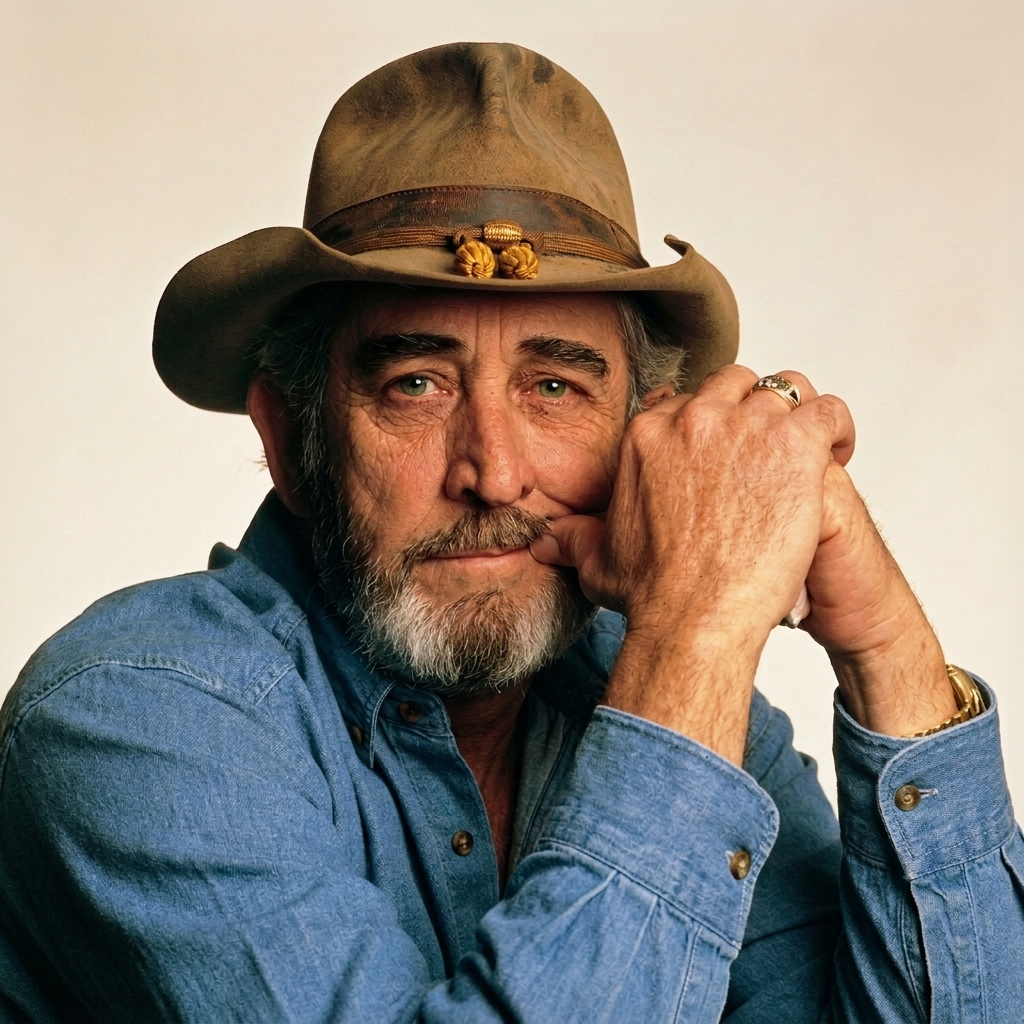
Country music has always loved a little danger in its legends. The wild entrance. The public feud. The shattered hotel lamp. The outlaw image became so powerful that, over time, it started to feel like part of the job description. If an artist was not making noise offstage, many people assumed the music must not have been loud enough either.
Then there was Don Williams.
Don Williams never seemed interested in competing for attention. Don Williams did not need a scandal to stay relevant or a dramatic reinvention to keep audiences listening. Don Williams simply walked onto a stage, stood still, and sang as if the room already belonged to the song. And somehow, it always did.
That kind of calm can be misleading. It can make greatness look easy, and when greatness looks easy, people often forget how rare it is. But the numbers tell the story clearly. Between the mid-1970s and the early 1990s, Don Williams built one of the most reliable hit-making careers country music has ever seen. Seventeen number-one songs. Dozens of Top 10 records. Fifty-six charted singles. That is not a quiet career. That is domination delivered in a soft voice.
The Power of Never Forcing It
There was something almost stubborn about the way Don Williams carried himself. At a time when bigger personalities often won the spotlight, Don Williams leaned in the opposite direction. The voice was warm, deep, and unhurried. The stage presence was calm. The phrasing was gentle, but never weak. Don Williams sang the way a trusted friend talks late at night: directly, clearly, without showing off.
That style became the signature. Songs like I Believe in You, Tulsa Time, and Good Ole Boys Like Me did not explode out of the speakers. They settled in. They stayed. They became part of people’s lives because Don Williams understood something many performers never fully learn: being understated is not the same as being forgettable.
In fact, Don Williams often sounded stronger because Don Williams refused to push. There was confidence in that restraint. Don Williams did not chase emotion; Don Williams let emotion come to the listener naturally. And that made the songs feel honest.
The Gentle Giant Was Never Small
The nickname “Gentle Giant” fit Don Williams perfectly, but it may also have softened the public memory of just how commanding Don Williams really was. Gentle sounds modest. Gentle sounds secondary. Yet nothing about the career was small.
The Country Music Association named Don Williams Male Vocalist of the Year. Major artists admired the songwriting choices and the delivery. Even outside country music, the influence traveled. Eric Clapton covered Tulsa Time, introducing the song to another audience and confirming what country fans already knew: Don Williams had a sound so solid it could cross stylistic lines without losing its soul.
And while some American listeners treated Don Williams as a familiar but quiet presence, audiences overseas often saw something bigger. In parts of Africa and Europe, Don Williams was not just respected. Don Williams was adored. Crowds connected with the steadiness, the humanity, and the emotional clarity in the music. Fame did not have to be flashy to travel. It only had to be real.
Why Country Music Sometimes Overlooks Don Williams
The strange thing about music history is that it often rewards the most dramatic story, not always the most consistent one. Rebels are easy to remember because their lives come with headlines attached. Don Williams left a different kind of legacy. No wreckage. No endless controversy. No mythology built from chaos.
Just songs. Great songs, year after year.
That can make an artist seem less legendary than artists surrounded by noise. But it should do the opposite. Holding a genre’s attention without depending on spectacle is one of the hardest things any performer can do. Don Williams did it for years.
Don Williams did not need to raise his voice to become unforgettable. Don Williams only needed the truth in the song and the patience to let it land.
The Silence That Still Echoes
Maybe that is why Don Williams still matters. In a world that keeps getting louder, the music feels even more powerful. Don Williams reminds listeners that authority does not always announce itself. Sometimes it arrives quietly, stands still, and changes the room anyway.
Country music should remember its rebels. But country music should also remember the man who proved that calm could be commanding, that softness could be strong, and that consistency could be every bit as legendary as chaos.
Seventeen number-one hits. Fifty-six charted songs. A voice recognized around the world. That is not the story of a background figure. That is the story of one of country music’s most complete artists.
Don Williams may have been called “the quiet one.” But there was nothing small about the silence Don Williams left behind.
Post navigation
Some legends get remembered for a whole body of work. Others get trapped inside a single moment. George Jones, somehow, became both.
For many listeners, George Jones begins and ends with “He Stopped Loving Her Today.” It is the song people reach for when they want to describe heartbreak in its purest, most devastating form. It brought George Jones back into the center of country music in 1980. It reminded radio, critics, and audiences that a voice like that does not come around often. It saved a career that had been slipping under the weight of missed shows, bad decisions, and years of chaos.
But the song also did something unfair. It made millions of people believe that George Jones was only one masterpiece and one cautionary tale.
That version of George Jones is too small. It leaves out the years before the comeback, the hits before the redemption, and the art before the myth. It reduces a giant to a headline. A sad song. A wild story. A nickname.
The George Jones Story Started Long Before 1980
By the time “He Stopped Loving Her Today” changed everything, George Jones had already spent decades building one of the deepest catalogs in country music. This was not a fading singer who suddenly stumbled into greatness. This was a man who had already done the work, already carried the genre, already cut songs that became part of country music’s foundation.
“White Lightning” had fire and swagger. “She Thinks I Still Care” carried wounded pride with almost unbearable precision. “The Race Is On” moved with wit, rhythm, and ache. “The Grand Tour” turned an empty house into one of the saddest rooms in country music history.
Those records were not warm-up acts for the song that came later. They were proof that George Jones had already mastered the impossible trick of sounding raw and polished at the same time. He could sound like he was barely holding himself together while hitting every emotional note exactly where it belonged.
A Voice People in Music Never Forgot
Other singers heard it immediately. George Jones did not just impress fans. George Jones stunned peers. The kind of peers who knew how hard it was to make a song feel effortless.
Frank Sinatra famously admired George Jones. Merle Haggard compared that voice to a Stradivarius, which may be one of the most accurate compliments ever given to a country singer. A Stradivarius is not loud for the sake of being loud. It is valuable because of tone, control, and something that cannot quite be explained. That description fits George Jones perfectly.
George Jones did not sing at a song. George Jones entered it. George Jones found the bruise inside the lyric and pressed right on it. Even simple lines could sound lived-in. Even familiar feelings could sound newly broken.
The Myth Nearly Swallowed the Music
Of course, George Jones also gave the world plenty of chaos to remember. The drinking. The cancellations. The nickname “No Show Jones.” The now-legendary lawn mower story that became larger than life because it felt exactly like the kind of reckless, tragic comedy people expected from George Jones at his worst.
That story followed him everywhere. So did the wreckage behind it.
And that is where things became cruel. Because once the public finds a good story, it often stops listening for a better one. George Jones became easy to summarize: a brilliant mess, a broken man, a singer saved by one final masterpiece. It is tidy. It is dramatic. It is also incomplete.
The truth is that George Jones had already given country music far too much to be remembered so narrowly. The trouble was real. The collapse was real. But so was the greatness that came before it.
More Than One Song, More Than One Life
“He Stopped Loving Her Today” deserves every bit of its reputation. It is not overrated. It is not overpraised. If anything, it is exactly what people say it is: one of the greatest country recordings ever made.
But George Jones deserves more than to be introduced as the man who sang that song. George Jones deserves to be remembered as an artist who kept finding new shades of sorrow, tenderness, humor, and regret across six decades of recordings. George Jones deserves to be heard as more than a symbol of collapse and comeback.
That may be the real tragedy of fame. Not that people forget you completely, but that they remember only the easiest version of you.
George Jones was never just the man in the saddest song. George Jones was never just the cautionary tale on the lawn mower. George Jones was a lifetime of records, a mountain of influence, and a voice that could make almost anyone stop what they were doing and listen.
Maybe the world showed up for one song. But George Jones gave it a whole life.
George Jones did not need one masterpiece to become immortal. George Jones had been building immortality for years. Most people just arrived late.