A Metal Water Bottle. Ten Days. And a 12-Year-Old Girl Who Never Came Home. – Daily News
It started in a hallway.
Between classes. Between bells. Between the ordinary noise of lockers slamming and sneakers squeaking against polished floors.
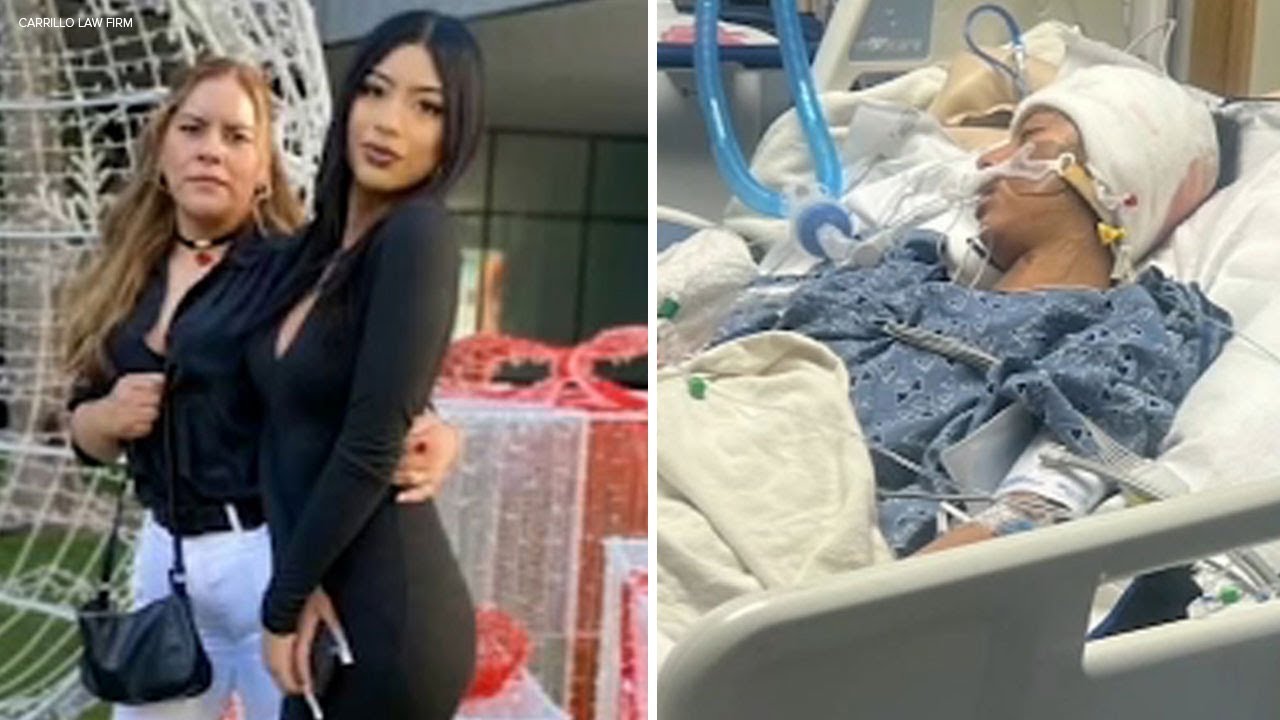
Khimberly was 12 years old.
She should have been worrying about homework, volleyball practice, what song to play next on her phone. She should have been texting friends and rolling her eyes at teachers. She should have been going home that afternoon and complaining about school lunch.
Instead, according to her family, another 12-year-old girl picked up a metal water bottle and threw it at her head.
One throw.
One sound.
One impact that no one imagined would echo for the next ten days — and beyond.
Her mother, Elma Chuquipa, says Khimberly was hit in the hallway at school. The bottle was metal. Heavy. Not a plastic toy but the kind designed to keep drinks cold all day — solid, reusable, durable.
It struck her head.

She was taken to the emergency room.
Doctors examined her and sent her home.
That part has become one of the most painful questions in the story.
Sent home.
Because what looks like “just a hit” isn’t always just a hit.
For several days, Khimberly was still Khimberly. Or at least she tried to be. Headaches. Maybe dizziness. Maybe things she didn’t fully explain because 12-year-olds don’t always know how to describe what’s wrong inside their own skulls.
Then she collapsed.
Suddenly, terrifyingly, without warning that anyone understood in time.
She was rushed back to the hospital.
This time, doctors found a brain hemorrhage.

Bleeding inside her head.
The kind of injury that can hide quietly before it explodes into crisis.
And this time, she did not come home.
The Los Angeles Police Department is investigating her death as a homicide.
That word — homicide — has torn through the community like a second impact.
Because when people hear “homicide,” they imagine intent. They imagine planning. They imagine adults.
But here, the accused is another 12-year-old.

Two children.
One alive.
One gone.
And a metal water bottle sitting at the center of it all.
Outside the school, flowers now line the sidewalk. Posters taped to fences read “Justice for Khimberly.” Candles flicker in the evening air. Parents hold their children a little tighter.
At a protest held outside the campus, mourners demanded answers.
How did this happen?
Why wasn’t it prevented?
Why wasn’t it caught sooner?
Reseda High School serves grades 6 through 12. Middle school and high school students share space. Share hallways. Share conflict.
The school district released a statement expressing deep sadness and condolences. Counseling services were offered. Support resources were promised.
But grief does not read statements.
Grief does not wait for investigations.
Grief sits at the kitchen table and stares at an empty chair.
Khimberly’s family describes her as the baby of the household — the light, the laughter, the music always playing somewhere nearby. She loved volleyball. She loved her two dogs. She loved walks. She had dreams — the kind that feel endless at 12.
Her GoFundMe page has raised thousands of dollars to help with medical bills and funeral costs.
Medical bills.
Funeral costs.
For a child who should still be asking for extra screen time.
The controversy has begun to swell around questions no one wants to ask out loud.
Was this bullying?
Was it a single impulsive act?
Had there been previous conflict?
Did the school know?
Should metal water bottles be treated as potential weapons?
And perhaps most painfully — could this have been prevented?
In classrooms across the country, metal water bottles are everywhere. They’re trendy. They’re reusable. They’re part of daily life.
But in the wrong moment, in the wrong hands, they are heavy objects thrown with force.
Experts will argue about intent. About whether the other child understood the risk. About whether this was an accident that spiraled into tragedy.
But for Khimberly’s mother, those distinctions do not change the outcome.
Her daughter is gone.
Ten days.
That’s all it took.
Ten days between a hallway altercation and a funeral.
The timeline has become a point of outrage for some.
Why was she sent home after the first ER visit?
Were scans performed?
Were warning signs missed?
Did anyone tell the family what to watch for?
Brain injuries can be deceptive. Symptoms can be delayed. Hemorrhages can evolve.
Medical professionals caution against rushing to conclusions without full records.
But parents see something else: a child who walked into a hospital and walked out — only to return and never leave again.
On social media, debates rage.
Some demand criminal charges against the other student.
Others caution against demonizing a 12-year-old child whose brain is still developing.
Some call for stricter anti-bullying policies.
Others question whether labeling everything as “bullying” oversimplifies complex peer conflict.
And in the middle of it all is a mother who buried her daughter.
At the vigil, candles flickered as friends shared stories.
“She loved music.”
“She always smiled.”
“She wanted to try out for volleyball again next season.”
Her classmates are left to process something few middle schoolers are prepared to face: mortality. Consequence. The weight of a single action.
Grief counselors walk hallways now.
Teachers struggle to balance lesson plans with tears.
Parents who once dismissed hallway scuffles as “kids being kids” are reconsidering.
Because this time, it wasn’t just a bruise.
It was fatal.
The word “homicide” remains under investigation.
Police have not released additional details.
And perhaps they won’t for some time, given the ages involved.
But one truth sits heavier than all legal language:
A 12-year-old girl is dead.
And it began with something thrown in a hallway.
Khimberly’s mother says her daughter brought light and joy into their lives.
That light was not meant to flicker out at 12.
Now the community faces uncomfortable questions about how schools handle violence, how seriously head injuries are treated, and how quickly childhood conflict can escalate into irreversible tragedy.
This story is not just about one hallway.
It is about the fragile line between “it’s just kids” and “this is serious.”
It is about how quickly that line can disappear.
Some will argue this was unforeseeable.
Others will say warning signs are always visible in hindsight.
But hindsight does not change hospital rooms.
It does not change funeral services.
It does not change the silence in a bedroom that once held music and dreams.
Ten days.
That’s all it took for a thrown object to become a homicide investigation.
For a mother to create a fundraiser instead of planning a birthday.
For a school to become a protest site.
For a community to ask: How do we protect our children — not just from strangers, but from each other?
And for one family, the question will echo long after the candles burn out:
How could something so ordinary become something so final?
The mud swallowed Lara’s knees the second she stepped into the back pen.
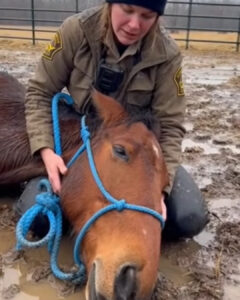
Cold water surged through her uniform, soaking fabric, biting skin. The smell hit next — rot, ammonia, neglect thick enough to taste. It clung to the air and coated the back of her throat.
But she didn’t hesitate.
Because the mare couldn’t.
The horse lay twisted in the muck, half-submerged, her chest barely rising. Her nostrils were crusted with dried discharge and mud. Each breath came as a weak rasp, thin and uneven, like something scraping against the inside of her ribs.
Her eyes were half-open but unfocused.
Too tired to panic.
The vet’s voice cut across the pen, sharp and urgent. “Hypothermic shock. We have to keep her fighting. Now.”
Lara was already moving.
She slid the rest of the way down into the mud, ignoring the cold that soaked through to her bones. She reached for the mare’s head — heavy, so much heavier than it looked — and gently lifted it from the filth before it could sink deeper.
The mare released a long, shuddering sigh as her cheek settled into Lara’s lap.
It wasn’t dramatic.
It wasn’t loud.
It was the sound of something exhausted.
“Hey, girl,” Lara whispered, her voice cracking despite herself.
Tears cut clean tracks through the dirt on her face. She brushed mud from the mare’s lashes with trembling fingers.
“I know,” she murmured. “I know it hurts.”
The mare’s ribs showed sharply beneath soaked hide. Her hip bones jutted through skin stretched too thin. Neglect had carved her down to something fragile, something almost unrecognizable from the animal she once must have been.
The mud beneath them was icy, sucking at Lara’s boots and knees. She could feel the water seeping deeper into her clothes, numbing her legs.
But she didn’t move.
She slid one hand beneath the mare’s jaw to keep it lifted, the other stroking gently along the side of her face.
“Just lean on me,” she whispered slowly. “I’ve got you. Breathe for me.”
The mare’s eyelids fluttered faintly.
Her breath hitched — then rasped again.
The rescue team moved quickly around them. A blanket was dragged through the muck. IV supplies were unpacked. Someone radioed for the transport truck.
The vet knelt near the mare’s shoulder, checking pulse.
“Still there,” he said, tight but hopeful. “Weak. Very weak.”
Lara bent closer, pressing her forehead lightly against the mare’s muddy brow.
“You’re not alone anymore,” she said. “Stay with me.”
The mare’s body trembled — shock does that. Hypothermia steals heat slowly and without mercy. Malnutrition weakens the heart until even standing becomes impossible.
This mare hadn’t just fallen.
She had collapsed into exhaustion.
Her body gave another long, fragile sigh against Lara’s lap. For a moment, the breathing slowed so much that everything around them seemed to stop.
Even the wind.
“Don’t you quit,” Lara whispered, her voice barely audible. “Not now.”
She began matching her breathing to the mare’s.
Inhale.
Exhale.
Slow. Steady.
“Breathe with me,” she said softly.
A catheter slid into place along the mare’s neck. The first drops of warmed fluids began their quiet descent through the line.
Life measured in droplets.
The mare’s breathing faltered once — just for a second.
Lara’s heart slammed into her ribs.
Then came a shallow inhale.
A weak exhale.
Still there.
“There you go,” Lara breathed. “Good girl.”
The distant rumble of a truck engine rolled across the property, growing closer. Help was coming. But the moment between now and then felt endless.
Mud clung to Lara’s sleeves. Her badge was nearly obscured beneath brown streaks. Cold water pooled beneath her knees.
None of it mattered.
The mare shifted slightly, pressing her head heavier into Lara’s lap as if she understood that this was solid ground.
That small movement shattered something inside Lara.
“You don’t have to be brave anymore,” she whispered. “We’re here.”
The team worked to slide straps beneath the mare’s body, careful not to startle her. Every movement was slow, deliberate, respectful.
The mare didn’t fight.
She didn’t thrash.
She simply rested.
The kind of rest that comes when there’s nothing left to resist.
Lara kept one arm wrapped protectively around her neck, shielding her from the cold wind. Her other hand stayed steady beneath the mare’s jaw, holding her face just above the waterline.
“Stay with me,” she repeated.
Time stretched thin.
The sky remained gray and unforgiving. Steam rose faintly from the mud where the warmed fluids began to work their quiet miracle.
Gradually — almost imperceptibly — the mare’s pulse strengthened beneath the vet’s fingers.
Not strong.
But stronger.
“She’s responding,” he said quietly.
Lara nodded, unable to trust her voice.
When the truck backed into position, its engine humming low, the team prepared to lift. Straps tightened carefully beneath the mare’s thin frame.
“Easy,” Lara murmured. “We’re going to move you.”
As they lifted, the mare groaned faintly — not in panic, but in effort. Her body swayed, fragile and unsteady.
But she did not fight.
She had her head in someone’s lap.
And that seemed to be enough.
Even as the mare was eased onto the rescue board, Lara stayed close, one hand resting against her cheek.
“You’re going to make it,” she whispered.
No one could promise that.
The infection was severe. Shock had done its damage. Recovery would be slow, uncertain, fragile.
But something had shifted in that pen.
A life that had been left to sink into filth had been given something different.
Warmth.
Contact.
A voice saying, “I’m here.”
As the truck doors closed gently, Lara stood slowly, legs numb and soaked, uniform ruined beyond saving.
She didn’t care.
Because when that mare had settled her head into her lap and released that long, trembling sigh, it hadn’t been surrender.
It had been trust.
Later, people would talk about the rescue.
They would say the deputy slid into freezing mud without hesitation.
They would say she cried.
They would say she held the horse like a child.
All of that was true.
But what mattered most was quieter than that.
In the cold muck of a forgotten pen, breath had synced with breath.
Hope had arrived not in sirens or lights —
But in arms willing to hold.
And sometimes, when life hangs by the thinnest thread, that is enough to keep it from breaking.