JOHNNY CASH’S FIRST SONG IN 1955 WAS ABOUT A TRAIN. HIS LAST SONG IN 2003 WAS ABOUT A TRAIN. BUT THIS TIME, THE TRAIN WASN’T TAKING HIM HOME — IT WAS TAKING HIM TO GOD. When June Carter died in May 2003, Cash called producer Rick Rubin the very next day and said: “You have to keep me working, because I will die if I don’t have something to do.” So he kept recording — blind, wheelchair-bound, sobbing for his wife every single day. He had her face painted on his elevator doors so he could still see her. In four months, he recorded 60 songs. The very last one, taped on August 21st, was called “Engine 143” — about an engineer racing toward the station who crashes and dies. The final words of the song: “Nearer my God to thee.” Twenty-two days later, Johnny Cash was gone. His first recording in 1955 had been “Hey Porter” — a man on a train heading home to Tennessee. His last was a man on a train heading home to God. – Country Music
In 1955, Johnny Cash introduced himself to the world with a song built on motion, distance, and longing. The song was “Hey Porter,” and it carried the sound of rails, wheels, and a restless man getting closer to home. It was young, eager, and full of dust-road energy. Johnny Cash sounded like someone looking out a train window, watching Tennessee come back into view.
Nearly five decades later, the image returned.
But by then, everything had changed.
In 2003, Johnny Cash was no longer the hungry young artist chasing a future. Johnny Cash was an aging legend carrying grief that had settled into every room of his life. When June Carter died in May of that year, the loss did not arrive quietly. It took the air out of the house. It changed the rhythm of his days. It left a silence that even music could not fully fill.
A Man Who Needed to Keep Singing
According to the story often told from that painful season, Johnny Cash reached out to producer Rick Rubin almost immediately after June Carter’s death and made one thing clear: Johnny Cash needed work. Not as a distraction. Not as a career move. Johnny Cash needed it for survival.
“You have to keep me working, because I will die if I don’t have something to do.”
That sentence says almost everything about who Johnny Cash was in his final chapter. Music was not decoration in Johnny Cash’s life. Music was structure. It was routine. It was prayer. It was how Johnny Cash carried sorrow without collapsing under it.
So the sessions continued.
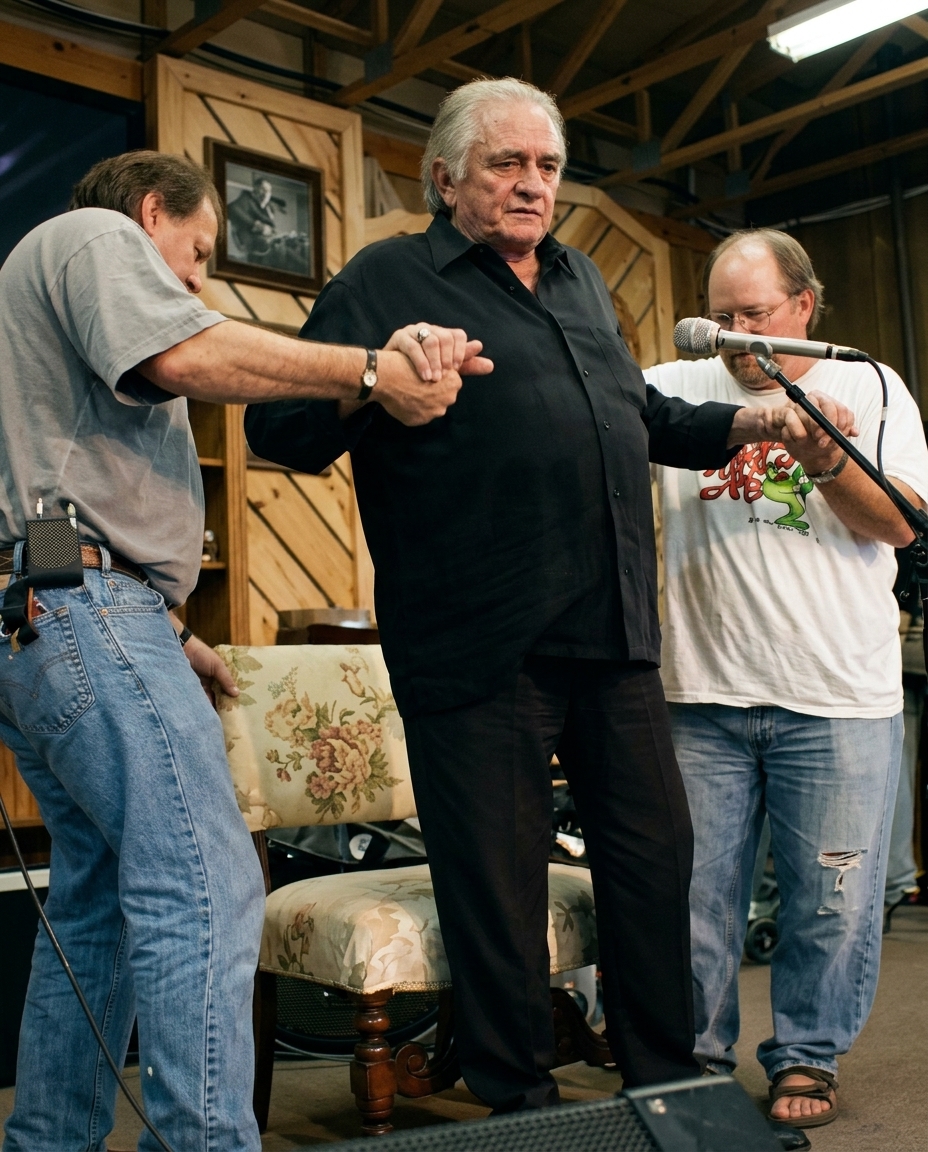
Johnny Cash was frail. Johnny Cash was grieving. Some days, even basic movement took effort. But the recordings kept coming. Song after song, line after line, Johnny Cash pushed forward through tears, memory, and physical pain. There is something deeply moving about that image: an old man, heartbroken and exhausted, still stepping up to the microphone because it was the one place where he could still reach beyond the ache.
The Presence of June Carter
Even after June Carter was gone, June Carter was still everywhere in Johnny Cash’s world. One detail from that time feels especially unforgettable. Johnny Cash reportedly had June Carter’s face painted on the elevator doors in his home so that every time the doors opened or closed, Johnny Cash could still look at her. It was not grand or theatrical. It was intimate. Personal. The kind of choice a grieving husband makes when ordinary life suddenly feels unbearable.
That image helps explain the emotional atmosphere surrounding the final recordings. These were not simply songs being archived for another album. These were moments of endurance. Every lyric carried the weight of someone trying to stay connected to life by continuing the work that had always defined him.
The Last Train Song
Among those final recordings was “Engine 143,” a tragic old ballad about an engineer racing toward the station, knowing danger is close and death may be near. It was a train song again, just like the one that began Johnny Cash’s recording journey all those years earlier. But this time the feeling was different. There was no youthful excitement. No bright return on the horizon. The motion in “Engine 143” feels heavier, darker, and more final.
That is what makes the story so powerful. Johnny Cash began with a train carrying a man home to Tennessee. Johnny Cash ended with a train carrying a soul toward eternity.
And then there are the final words often remembered from that last recording:
“Nearer my God to thee.”
It is hard to hear that phrase without feeling the full circle of Johnny Cash’s life. Not just the fame, not just the records, not just the legend, but the deeper current underneath it all: faith, loss, repentance, longing, and the stubborn hope that there is still mercy waiting at the end of the line.
A Beginning and an Ending Joined by the Same Image
Twenty-two days after that final session, Johnny Cash was gone.
That timing is one reason this story continues to stay with people. It feels almost too precise, too haunting, too perfect in structure. A first song in 1955 about a train carrying a man toward home. A final song in 2003 about a fatal train ride ending with a cry to God. Whether people hear it as fate, symbolism, or simply the mysterious poetry of a life in music, the emotional truth remains the same.
Johnny Cash spent his final days doing what Johnny Cash had always done: singing through darkness. And in the end, the train returned one last time.
Only now, it was not headed toward Tennessee.
It was headed somewhere beyond the tracks.
Post navigation
For a long time, Waylon Jennings represented something larger than music. Waylon Jennings stood for defiance. Waylon Jennings stood for the artist who pushed back when Nashville wanted neat answers, polished edges, and songs that fit inside a safe little box. That image became part of country music history: the outlaw with the rough voice, the restless spirit, and the stubborn refusal to become anything other than himself.
But by 1994, something deeper had taken root in Waylon Jennings. The fire was still there, but it no longer looked like rebellion for rebellion’s sake. It looked steadier. Wiser. More grounded. The man who had once lived at full speed had begun to value something quieter, and maybe stronger than all the noise that came before.
That was what made the moment in Nashville so unforgettable.
In that city, the same city where Waylon Jennings once challenged the machinery of country music, Waylon Jennings and Jessi Colter quietly reaffirmed their vows. There was no grand spectacle wrapped around it. No need for a dramatic production. The power of the moment came from what it represented. This was not a young couple swept up in romance and possibility. This was a man and a woman who had already been tested by time, fame, struggle, pressure, and the weight of a life lived publicly and privately all at once.
A Different Kind of Strength
By then, fans were seeing a different side of Waylon Jennings. The edge that had once been so tied to chaos had softened into something more meaningful. Waylon Jennings was sober. Waylon Jennings was calmer. Waylon Jennings seemed to understand that surviving was its own kind of victory. For many people who had followed the twists and turns of his life, that change spoke louder than any headline ever could.
And beside him stood Jessi Colter, the woman who had not just shared the spotlight with Waylon Jennings, but shared the storms too. Their love had never been a simple fairy tale. It had been real, and that made it more powerful. It had endured the kind of years that could break many couples apart. Instead, it brought them to a moment of renewal.
Sometimes love looks most beautiful not at the beginning, but after everything it has survived.
The Meaning of Nashville
The setting mattered. Nashville was not just another city on the map. Nashville was the place where Waylon Jennings had once pushed against the rules, where the fight for artistic freedom became part of his identity. But it was also the place where he found Jessi Colter, and with Jessi Colter, something more lasting than conflict. Holding that vow renewal there gave the moment a kind of quiet symbolism that country music fans still feel today.
It was as if Waylon Jennings had come full circle. The city that once represented resistance now also represented peace. The outlaw had not disappeared. The outlaw had simply grown older, deeper, and more certain about what mattered.
Shooter Jennings Watched It Happen
Adding even more emotion to the moment was the presence of their son, Shooter Jennings, who was still a teenager at the time. At around fifteen years old, Shooter Jennings was old enough to understand that what he was seeing was not ordinary. His parents were not simply repeating words. Waylon Jennings and Jessi Colter were honoring a life they had built together after years of hardship, healing, and endurance.
For a son to witness that kind of moment had to mean something lasting. It was not just a family memory. It was a lesson in what commitment can look like after the applause fades and after the hardest years have already passed.
More Than an Outlaw Story
That day in 1994 revealed something many fans may not have expected. The most moving chapter of Waylon Jennings’ life was not only about rebellion, road stories, or challenging the system. It was also about redemption. It was about becoming a man who had fought his battles and learned the value of peace. It was about understanding that love, family, and stability were not signs of surrender. They were signs of victory.
Waylon Jennings will always be remembered as one of the defining voices of Outlaw Country. But moments like this remind us that the story did not end with defiance. It matured into something richer. In Nashville, with Jessi Colter beside him and Shooter Jennings watching nearby, Waylon Jennings showed that sometimes the strongest thing an outlaw can do is come home to the life that truly matters.
Did Waylon Jennings’ later journey change the way you see the Outlaw Country legend?