“A Playground, A Gunshot, and a Child Lost Forever”. – Daily News
The sun rose quietly on New Year’s Day, indifferent to the grief that had already begun to take shape. Morning light spilled across streets and sidewalks, carrying with it the promise of a fresh start, a clean page on the calendar. For most families, it was a day meant for rest, laughter, and hope.

For one family, it would become a day they could never escape.
By the afternoon, the laughter that once floated near a neighborhood playground had vanished. The swings stood still. The ground where children had run freely would soon be marked not by footprints, but by mourning.
QueenEr’Re Reed was only eleven years old.
She was still a child in every sense of the word—an age filled with half-formed dreams, favorite songs, inside jokes, and plans that had not yet learned how fragile they were. She should have been worrying about school assignments, friends, and what came next in a life that felt endless.
Instead, her life ended before the day was over.

On that New Year’s Day, QueenEr’Re was doing exactly what children are meant to do. She was outside, surrounded by family, cousins, and the comfort of familiar faces. It was ordinary. It was safe. It was the kind of moment no one thinks twice about because nothing bad is supposed to happen there.
No one could have known those ordinary moments would be her last.
The gunshots came without warning.
One second there was noise, movement, life. The next, chaos ripped through the air, shattering everything it touched. Innocence disappeared in an instant. A playground—meant for scraped knees and laughter—became a place of terror.

Emergency responders arrived quickly, their sirens slicing through the stunned silence. QueenEr’Re was rushed to the hospital, hope clinging desperately to every breath she took. For a moment, people dared to believe. They prayed. They waited. They refused to imagine the unthinkable.
But hope was not enough.
QueenEr’Re did not survive.
An eleven-year-old girl was gone. A family lost their child. A future vanished.
The next day, grief settled over the Reed family like a weight too heavy to move. Their home, once filled with the sounds of a growing child, became painfully quiet. Every room held reminders of her presence—things she touched, things she loved, things she would never return to.
Her family spoke first of her smile.
They said it lit up rooms without effort, that her laughter carried warmth even on the coldest days. QueenEr’Re was joy—unfiltered and generous. She was a daughter who loved deeply, a cousin who played fiercely, a child whose presence made others feel safe.
Photographs shared by loved ones told the story words struggled to capture. A bright-eyed girl. A future wide open. Curiosity and confidence shining through every image.
Those photos became both comfort and torment.

The loss rippled outward almost immediately. The community felt it before anyone had time to explain it. Neighbors gathered near the playground, standing together in silence. Candles appeared where children once ran. Some people cried openly. Others stood frozen, unsure how to process the cruelty of it all.
Parents held their children closer than usual.
One question echoed again and again: How did this happen?
Local leaders addressed the tragedy as the investigation began. Words like “senseless” and “heartbreaking” were spoken with visible exhaustion—phrases used too often, yet never any less true. “No child should ever lose their life to gun violence,” one official said, his voice heavy with grief.
For QueenEr’Re’s family, words offered no relief.
No statement could fill the hollow space she left behind. Grief does not listen to reason. It does not respond to explanations. It simply exists—raw, relentless, and unforgiving.
Her mother’s pain was etched into every breath she took. She spoke through tears, trying to understand how a place meant for play had become a place of death. A mother’s worst nightmare had unfolded in the open, without mercy.

Family members described the moment they received the news as unreal. Time slowed, then fractured completely. The world stopped making sense. Thoughts turned to birthdays that would never be celebrated, milestones that would never be reached, a life frozen forever at eleven.
In the days that followed, the playground stood eerily quiet. Police tape fluttered in the winter air, a cruel reminder of what had happened. Children passed by with confused expressions, sensing something was wrong even if they couldn’t explain it.
Vigils formed almost immediately.
People who had never met QueenEr’Re came carrying candles and flowers. Prayers were whispered into the cold night—prayers for justice, for healing, for peace. Grief did not ask for permission. It crossed boundaries and united strangers.

Teachers at QueenEr’Re’s school faced an impossible task. They had to explain death to children too young to understand it. An empty desk became a symbol too heavy for words. Friends asked when she was coming back. Some waited, convinced there had been a mistake.
Reality arrived slowly—and painfully.
QueenEr’Re’s life, though heartbreakingly short, left a deep and lasting mark. Her name became a reminder of what is lost when violence enters places meant to be safe. Her story joined countless others calling for a world where children are allowed to grow up.
As investigators worked, the community waited. Justice felt necessary, but never enough. Nothing could undo what had already been done.
The Reed family focused on honoring their daughter—not as a headline, not as a statistic, but as a person. They spoke of her kindness, her humor, her dreams. They wanted the world to know who she was, not just how she died.
Memorials continued to grow. Stuffed animals. Handwritten notes. Balloons swaying gently in the winter air. Each candle represented shared heartbreak. Each flower carried a promise not to forget.

New Year’s Day will never feel the same again.
What once symbolized hope now carries unbearable sorrow. The calendar itself became a reminder of loss. And yet, even in grief, moments of unity emerged. Neighbors leaned on one another. Community became both shield and lifeline.
QueenEr’Re Reed was more than a victim.

She was a child who mattered.
A life that should have continued.
And as the candles burned low and the playground slowly reopened, one truth remained unchanged: an eleven-year-old girl was gone—and the world is poorer because of it.
The lights above the operating table were too bright, too white, turning everything into sharp edges and shadows. Lawson stood frozen at Titan’s side, one gloved hand pressed hard against the German Shepherd’s flank, feeling warmth where it shouldn’t be, feeling life slipping through his fingers.
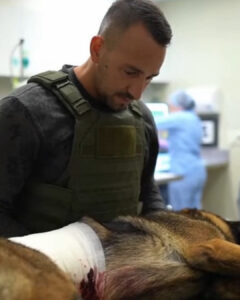
The sirens were gone now. The chaos of the drive was over. What remained was this room, this smell of antiseptic and metal, and the unbearable weight of his tactical vest still strapped to his chest because he hadn’t even thought to take it off.
Titan lay on the table, his powerful body unnaturally still.
Hours earlier, he had been unstoppable.
Titan had always moved like certainty itself—ears alert, muscles coiled, eyes locked forward. A dog bred for danger, trained for it, willing to run toward what others fled. Lawson had trusted him with his life more times than he could count. Tonight was supposed to be no different.
Until the knife.
It came fast, hidden in panic and darkness, meant for Lawson but finding Titan instead. The sound Titan made then was something Lawson would never forget—not a bark, not a growl, but a short, shocked whimper that didn’t belong to a dog so strong.
Lawson had dropped beside him instantly, hands slick with blood, pressing hard, shouting for medics even as his own vision narrowed. Titan’s eyes had found his, wide but still focused, still working.
“I’ve got you,” Lawson had said then, voice raw. “Stay with me.”
Now, under the surgery lights, those words felt smaller. Fragile.
Vets moved quickly around them, voices calm, efficient, practiced. Instruments clinked. Orders were given. Someone gently tried to guide Lawson back.
“Sir, we need space.”
He didn’t move.
His hand stayed buried in Titan’s fur, fingers trembling now that adrenaline had nowhere to go. Titan’s breathing was shallow, uneven. Each rise of his chest felt like a question mark.
Lawson leaned closer, lowering his voice until it was just for Titan.
“Hey… hey, buddy.”
Titan’s ear twitched. Barely. But it was enough.
“You don’t quit on me,” Lawson whispered, the words breaking as they left him. “Not today. You hear me? Not today.”
The room faded at the edges. Lawson was back in all the other moments—the quiet ones no one ever filmed or celebrated. Early mornings when Titan sat patiently while Lawson tied his boots. Long nights when Titan rested his head on Lawson’s knee during paperwork. The way Titan always checked back, just once, before entering a room first.
Trust, absolute and unspoken.
Titan whimpered softly as the vets worked, a sound that cut deeper than any scream. Lawson felt it in his chest, like pressure, like something collapsing inward.
“I’m here,” he murmured. “I’m right here.”
Hours passed without shape or meaning. Time became measured only by Titan’s breathing and the steady beep of machines. Lawson didn’t sit. Didn’t pace. He stood rooted, as if moving even an inch might somehow pull Titan farther away.
His vest grew heavier with every minute, straps digging into his shoulders, the weight mirroring the fear pressing down on him. He welcomed the discomfort. It felt like penance.
At one point, the room fell quieter. The urgency shifted into something tense and delicate. A vet glanced up at Lawson, eyes unreadable.
Lawson swallowed hard.
“Please,” he said, barely louder than breath.
Titan’s chest rose. Fell.
Then—slowly, faintly—his tail thumped once against the table.
Lawson sucked in a sharp breath, the sound halfway to a sob. His knees nearly gave out. He dropped his forehead closer to Titan’s neck, pressing his face into the coarse fur, not caring who saw.
“That’s it,” he whispered urgently. “That’s my boy. That’s you.”
Titan’s breathing deepened, still labored but steadier now. Lawson felt the rhythm of it through his hand, felt his own chest unconsciously matching it, breath for breath, like they had done a hundred times before on cold nights and long watches.
The metal cold of the table seeped into Lawson’s arms, but he didn’t pull away. Tears slid freely now, darkening Titan’s fur. Lawson didn’t bother to wipe them.
“I’m here,” he kept saying, over and over, as if the words themselves were a lifeline. “I’m right here. You’re not alone.”
The vets continued their work, quieter now, movements careful. One of them nodded slightly, not smiling, not promising—but acknowledging something important had shifted.
Titan was still fighting.
Lawson stayed close, hand steady, heart aching with a love he had never learned how to explain to anyone else. Titan wasn’t just a partner. He wasn’t just a K-9.
He was the one who ran first.
The one who guarded last.
The one who never questioned orders or fear or pain—only trust.
When Titan finally settled, exhaustion overtaking him, Lawson remained where he was. He rested his palm flat against Titan’s side, feeling the warmth, the life still there.
Outside, the world kept moving. Radios crackled somewhere distant. Doors opened and closed. None of it mattered.
In this room, under harsh lights and the scent of antiseptic, a man and his dog held on to each other in the quiet aftermath of violence.
Lawson leaned close one last time, his voice barely a whisper.
“You did good,” he said. “You did everything right.”
Titan didn’t open his eyes. But his tail tapped once more, faint and slow.
And for the first time since the knife flashed, Lawson allowed himself to believe they might both walk out of this—together.