A Promise Broken by Gunfire: The Night Montanae Davis Called for Help. – Daily News
The call came in before the gunshots.

On the line with a 911 dispatcher, a young woman’s voice trembled—not with hysteria, but with a clarity sharpened by fear. She said her ex-boyfriend was calling her. She said he was threatening to shoot up her house. She said she had two children inside.
She was asking for help.
A short time later, the kitchen became a crime scene.
On April 3, 2024, officers and medics were dispatched to a home in Dayton, Ohio, after reports of a shooting. When they arrived, they found a woman on the kitchen floor, suffering from multiple gunshot wounds. The room—meant for meals and conversations and the ordinary rituals of family life—was torn apart by violence. The woman was rushed to a nearby hospital. She did not survive.
Her name was Montanae Davis. She was 26 years old.

Before the sirens, before the shattered doors, before the chaos, Montanae had tried to stop what was coming. According to court records, she told dispatchers that her ex-boyfriend was threatening her life and that her children were at home. Those words now sit at the center of the case—an early warning that arrived just minutes too late.
Investigators say Jamartay Brown came to the house shortly after the call. He didn’t knock. He didn’t pause. He went to the back of the home and forced his way inside, kicking at the rear door and the garage door until one gave way.
What followed was fast and devastating.
According to the affidavit, Brown entered the home and shot Montanae Davis multiple times. The kitchen filled with noise and terror. A friend who was inside the house heard the gunshots and, in a moment of sheer survival, fired her own weapon toward Brown before fleeing. She ran from the house, away from the violence, away from a scene that would haunt her forever.
Brown fled before police arrived.
But the story did not end there.

Detectives followed the trail quickly, piecing together movements and witness accounts. The investigation led them to another home, where officers observed a man placing a firearm—wrapped in a toddler-sized T-shirt—into a nearby storm sewer. The detail would later strike many as chilling: a child’s clothing used to hide a weapon after a killing tied to a mother who had pleaded for her children’s safety.
That man, along with two others—including one who matched Brown’s description—was seen leaving the area in a truck.
At 4:10 p.m., police arrested Jamartay Brown in another part of the city. The gun had been discarded. The victim was gone. And a case that would take nearly two years to resolve moved into the slow machinery of the courts.
Brown was arraigned on April 9, 2024, in Dayton Municipal Court. The list of charges was long and severe: four counts of aggravated murder; multiple counts of murder; aggravated robbery; aggravated burglary; felonious assault; and tampering with evidence. A judge set bond at $1 million.
For Montanae’s family, none of it brought relief.
They were left with the unbearable knowledge that she had seen the danger coming. That she had asked for help. That she had named the threat. And that despite all of it, she was still killed in her own home.
In the months that followed, the case moved forward, marked by filings, hearings, and evidence that painted a grim timeline. Prosecutors outlined a story of forced entry and deliberate violence. Defense attorneys challenged the state’s claims. The courtrooms filled with legal language that struggled to contain the human cost of what had happened.
Through it all, Montanae’s name was spoken again and again—attached to charges, to exhibits, to testimony—until it risked becoming just another line in a docket. But for those who knew her, she was not a case number.
She was a mother.
She was someone who cooked in that kitchen. Someone who laughed there. Someone who had children who expected her to come back from the other room. Someone who, in her final moments, was thinking not just about herself, but about keeping her kids safe.
On January 14, 2026, nearly two years after the shooting, a jury delivered its verdict.

Jamartay Brown was found guilty of four counts of aggravated murder and two counts of felonious assault.
The courtroom absorbed the decision in silence. For the prosecution, it was accountability. For the defense, the end of a trial. For Montanae’s family, it was something far more complicated—validation mixed with grief that no verdict could resolve.
Brown is set to be sentenced at a later date.
The law will decide how many years he spends behind bars. It will determine the language of punishment. It will close the file.
But outside the courtroom, questions linger.
What does it mean when a woman calls for help and is killed anyway? What does it say about the gaps between warnings and protection, between fear voiced and fear prevented? How many other voices sound the alarm before the door is kicked in?
The details of the case are stark: a forced entry, a firearm, a kitchen turned into a killing ground. But the most haunting moment may be the one that came first—the 911 call placed before the shooting, when Montanae Davis was still alive, still trying to shield her children from what she believed was coming.
In the end, the story of Montanae Davis is not just about a verdict. It is about a promise broken—the promise that calling for help will be enough. It is about a young woman who recognized danger, named it, and paid with her life anyway.
And it is about a quiet truth that remains long after the headlines fade: justice can punish a crime, but it cannot rewind the clock to the moment when a frightened mother picked up the phone and hoped someone could get there in time.
Elias had almost finished his rounds when he heard it.
At first, he dismissed the sound as part of the subway’s endless language—the hiss of steam in old pipes, the metallic sigh of rails cooling after a train passed. This station had been speaking like that for decades. You learned to tune most of it out.
But then it came again.
A thin, broken whimper.
It didn’t echo like machinery. It caught. It hesitated. It sounded like someone trying very hard not to cry.
Elias stopped walking.
The platform was nearly empty, the late hour stretching the space into something cavernous and lonely. Fluorescent lights buzzed overhead, casting a tired yellow glow across tiled walls and the safety strip near the tracks. Elias turned off his flashlight and listened.
There it was again.
Closer now.
He followed the sound toward the edge of the platform, his boots quiet against the concrete. And that’s when he saw her.
A girl—maybe nine or ten—stood near the yellow line, toes hanging just a little too close to the drop. She was wearing oversized pajamas, the kind meant for sleeping at home, not standing alone underground in the middle of the night. Her hair was tangled, her sleeves pulled over her hands. Her shoulders shook as she stared down the tunnel, eyes fixed on nothing.
She looked frozen.
Not just still—but stuck.
Elias felt his chest tighten.
He didn’t rush. He didn’t raise his voice. He remembered what fear did to people—how sudden movements made it worse, how loud concern could feel like danger.
He slowed his steps, making himself small.
“Hey there,” he called gently, his voice steady but soft. “That spot’s… pretty cold, huh?”
The girl flinched.
For a split second, Elias worried she might bolt—toward the stairs, or worse, toward the tracks. But instead, she turned.
The tough mask she’d been wearing shattered instantly.
Her lip trembled. Her eyes filled. Whatever she’d been holding together collapsed all at once.
“I… I shouldn’t have left,” she stammered, words tumbling over each other. “I got mad and… and now I can’t find the way home.”
Her voice broke on the last word.
Elias didn’t have time to say anything else.
She ran to him.
Not away. Not past him.
Straight into him.
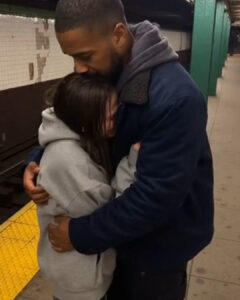
The impact knocked the breath from his lungs as her small body collided with his chest. Elias reacted on instinct—his flashlight clattered to the ground as he wrapped both arms around her, pulling her close, his coat swallowing her shaking frame.
She clung to him like she’d been holding her breath for hours and had finally found air.
“Easy now,” Elias murmured, adjusting his stance, swaying just enough to ground her. “I’ve got you. You’re okay. You’re safe.”
Her words dissolved into hiccuping sobs against his shirt. Hot tears soaked through the fabric as her fingers twisted desperately into his jacket, as if letting go might send her drifting again.
Elias held her without hesitation.
He felt how fast her heart was racing, how her breathing came in shallow bursts. He lowered his chin, resting it lightly on the top of her head, a simple, human gesture that said what words sometimes couldn’t.
The subway roared somewhere far off, a train passing through another station. The wind stirred her hair, but she didn’t pull away.
“I didn’t mean to go so far,” she cried. “I just wanted to calm down, and then everything looked the same, and I didn’t know where I was anymore.”
“That happens,” Elias said quietly. “More than you think.”
She sniffed, her forehead pressed into his chest. “My mom’s going to be so mad.”
Elias smiled softly, even as his throat tightened.
“She’s probably scared,” he said. “Scared and worried. Not mad.”
The girl went still at that, as if considering the idea.
“She’s probably saying the same thing I am right now,” he added gently. “‘You’re safe. I’ve got you.’”
Her grip loosened just a fraction.
Elias slowly shifted his weight, guiding them a step away from the platform edge without breaking the hug. She followed without resistance, trusting him completely now.
“That’s better,” he said softly. “Right here is a good spot.”
She nodded against his jacket.
They stayed like that for a moment—two strangers bound by a sudden, fragile need—until her sobs softened into quiet sniffles and her breathing began to slow.
Elias reached into his pocket with one hand and pulled out his phone.
“We’ll call your mom,” he said. “Or whoever you need. We’ll figure this out together.”
She lifted her head slightly, eyes red but hopeful. “You promise?”
“I promise.”
As he made the call, she stayed tucked against his side, his arm a steady anchor around her shoulders. When the voice on the other end finally answered—panicked, breathless, breaking with relief—Elias handed the phone to the girl.
“Mom?” she whispered.
The word cracked something open in the air.
Elias turned slightly away, giving them privacy, but he didn’t step far. He stayed close enough that she could still lean against him, close enough that she wouldn’t feel alone again.
“Yes,” the girl said through tears. “I’m okay. I’m safe. I’m with a man who helped me.”
Her shoulders relaxed with every sentence.
When she handed the phone back, Elias nodded. “She’s on her way,” he said. “She’ll be here soon.”
The girl let out a shaky breath she’d been holding for a long time.
“Thank you,” she whispered.
Elias crouched slightly so he could meet her eyes. “You did the hard part,” he said. “You asked for help.”
A few minutes later, footsteps echoed down the stairs. A woman appeared, scanning the platform with wild eyes—until she saw them.
She ran.
The reunion was instant and wordless—arms wrapping tight, tears flowing freely. The woman looked up at Elias, her face collapsing with gratitude.
“Thank you,” she said again and again. “Thank you.”
Elias shook his head gently. “She just needed someone to listen.”
As mother and daughter held each other, Elias stepped back, retrieving his flashlight. His rounds weren’t finished after all—but somehow, they felt complete.
As he walked away, the station returned to its usual noise—the hum, the hiss, the distant thunder of trains.
But the whimper was gone.
And in its place was something quieter, steadier.
A reminder that sometimes, safety isn’t a place.
Sometimes, it’s a pair of arms, a calm voice, and someone saying the words that matter most:
I’m here. You’re okay. You’re safe.