The Envelope That Changed Everything – America Focus
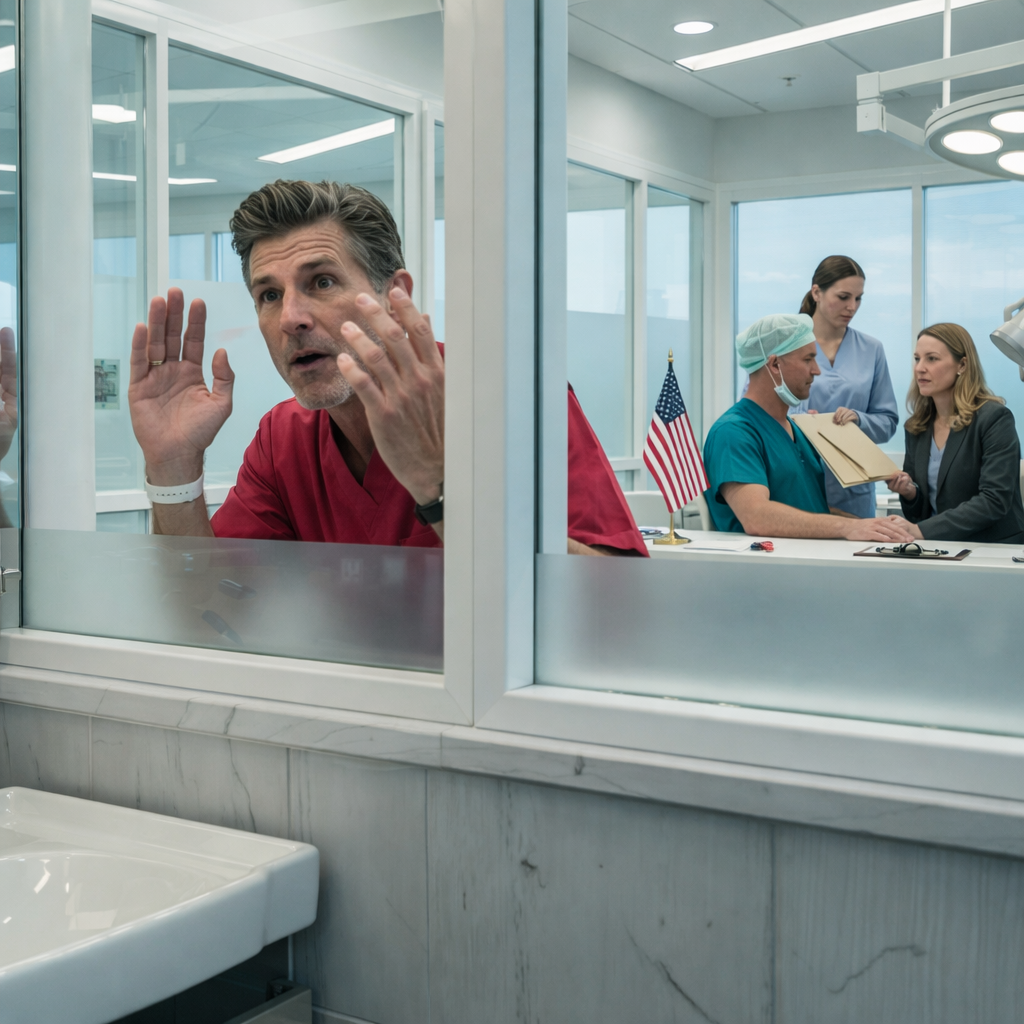
The first thing I noticed was the cold.
Not the kind that creeps into your bones on a winter morning, but a surgical cold. Clean. Artificial. The kind that smells faintly of disinfectant and metal and makes every sound feel louder than it should.
My wife was holding my hand.
Nicole’s fingers were cool but steady, her thumb brushing slow, reassuring circles against my knuckles as we waited under the fluorescent lights. The ceiling tiles above me blurred into pale squares as a nurse adjusted something near my shoulder.
“You’re going to be just fine,” Nicole said softly. “I’ll be right here the whole time.”
I nodded. I wanted to believe her. I did believe her. At least, that’s what I told myself in that moment.
The anesthesiologist leaned into my field of vision, her voice calm and practiced. She explained conscious sedation again, the same way she had in pre-op. Awake but relaxed. No pain. You may hear things.
I remember thinking, Fine. I’ve sat through zoning board meetings that lasted four hours. I can handle a little chatter.
The medication slid into my IV, a spreading heaviness that pinned my arms and legs without fully turning the lights off. My eyelids drooped, vision tunneling, but my mind stayed awake. Alert. Trapped.
That’s when I heard the surgeon’s voice.
Dr. Julian Mercer.
Low. Controlled. Careful.
“Lindsay,” he murmured, somewhere near my right side. “The envelope. Make sure his wife gets it after we’re done.”
A pause.
“He can’t know,” Mercer added. “No one can.”
My heart slammed so hard I thought it would tear free of my ribs. The monitor above me answered with a sudden spike, its rhythmic beeping accelerating.
The nurse’s voice dropped to a whisper. “Mrs. Brennan knows it’s coming.”
“I know,” Mercer said. “Just make sure he doesn’t see it.”
A chill ran through me that had nothing to do with the operating room.
I tried to move. Tried to open my mouth. Tried to say What envelope? or What the hell are you talking about?
Nothing happened.
My body didn’t respond. My tongue felt like it weighed fifty pounds. Panic clawed up my throat, sharp and suffocating, while my mind screamed inside a body that refused to obey.
So I did the only thing I could.
I stayed perfectly still.
I let my breathing even out. I forced my pulse to slow. I pretended to be unconscious while every instinct I had told me something was deeply, catastrophically wrong.
Half an hour later, they wheeled me into recovery.
By nightfall, I would pack a bag and vanish without a word.
But I’m getting ahead of myself.
Before all of this, before the envelope and the whispers and the look on my wife’s face that would haunt me for the rest of my life, I thought I had everything figured out.
Twenty-one years of marriage.
A daughter who made me proud every single day.
A company I’d built with my own hands.
From the outside, my life looked bulletproof.
And that’s exactly why I never saw the knife coming.
I used to believe in the American dream the way people believe in gravity. Not as an idea, but as something solid and unquestionable. You work hard, you build something, you protect your family, and life rewards you with stability.
I had all the proof I needed.
Nicole and I had been married for twenty-one years. Our daughter, Mia, was nineteen and halfway through her sophomore year at the University of Colorado, studying pre-law. Smart, driven, sharper than I’d ever been at her age.
I was fifty-four and the CEO of Redstone Building Corporation, a commercial construction firm I’d grown from a regional outfit into a $32 million operation headquartered in Denver. Cherry Creek house. Reserved table at Elway’s. Broncos season tickets that everyone “joked” about wanting.
The life people post about online with captions like grateful and blessed.
The kind of life that makes you think you’re immune to betrayal.
Except somewhere along the way, my wife became a stranger.
I didn’t see it all at once. It never happens that way. It was a series of small things, each one easy to dismiss on its own.
Nicole started keeping her phone face down on the kitchen counter. Not dramatically. Casually. Like it didn’t matter. But she never used to do that.
She started stepping outside to take calls. Even in February. Even when the temperature dropped to fifteen degrees and her breath came out in white clouds.
Client dinners that ran late. Meetings that didn’t line up with calendars. A new perfume that didn’t belong to any department store I recognized.
Distance that had nothing to do with physical space.
I noticed it, felt it, and told myself I was imagining things. That I was working too much. That marriage after twenty years just settles into something quieter.
I told myself anything that meant I didn’t have to ask questions.
Back in February 2003, when I first met Nicole, none of this existed.
She was twenty years old, working as an event coordinator at a children’s hospital charity gala. I was thirty-three, wearing a rented tux and trying to look like I belonged in rooms full of donors and executives. I’d been working alongside my father for eleven years by then, learning the business, learning how to carry his expectations.
Nicole wore an emerald dress that matched her eyes. When she laughed at a stupid joke I made about load-bearing walls, something in me folded.
We talked for hours that night. About the event. About my work. About nothing important and everything important at the same time.
By November, we were married.
Nine months from meeting to vows.
Everyone told us we were rushing it. My business partner, Brandon Walsh, said I’d lost my mind. Even my mother asked if I was sure.
I didn’t care.
Nicole made me feel alive.
Twenty-one years later, that feeling was gone. Replaced by something hollow and sharp around the edges.
And I still didn’t see the truth.
The hernia happened on a Tuesday in July.
I was at our RiNo project site, a mixed-use redevelopment we were converting from an old warehouse. I’d always been hands-on, even after stepping into the CEO role. I liked being around the crews. Liked knowing what was happening with my projects firsthand.
That day, we were short-staffed. I grabbed one end of a steel I-beam to help move it.
Stupid. Reckless. A fifty-four-year-old desk jockey trying to prove he could still hang.
The pain was immediate. Sharp. Radiating low in my abdomen and down toward my groin.
I knew exactly what it was. I’d watched my father deal with the same thing years ago.
That night at dinner, I mentioned it casually. We were standing at the kitchen island, Mia up in Boulder for summer classes. Nicole was scrolling on her phone.
“I think I pulled something today,” I said. “Pretty sure it’s a hernia.”
Nicole’s head snapped up.
“A hernia?”
Her voice had an edge to it I couldn’t place. Not fear. Not concern. Something tighter.
“And you need to get that checked. Soon.”
“It’s not that bad,” I said. “I’ll see how it feels.”
She set her phone down. Face up.
“Hernias don’t just go away,” she said. “They can get dangerous.”
I blinked. “Nicole, I just told you about it.”
She was already opening her laptop.
“There’s a surgeon,” she said. “Dr. Julian Mercer. Presbyterian St. Luke’s. Five-star reviews. Best in Denver.”
She turned the screen toward me.
His photo stared back. Mid-forties. Clean-cut. The kind of confidence that comes from being very good at what you do.
“You already looked him up,” I said.
“I’m being proactive,” she replied quickly. “You work too hard. Someone has to take care of you.”
It should have felt loving.
Instead, something cold settled in my gut.
I smiled anyway. Nodded. Agreed to call in the morning.
Nicole smiled back. Relief softening her face in a way I didn’t understand at the time.
“Good,” she said. “I just want you to be okay.”
That was the moment everything was set in motion.
I just didn’t know it yet.
September 15th, 2024.
The last day I trusted my wife.
The sun rose over the Rockies, painting the mountains orange through our bedroom window. Nicole made coffee I couldn’t drink, insisting it was “just to smell.” She held my hand during the drive down Colorado Boulevard to UCHealth University Hospital, squeezing it at every stoplight.
“You nervous?” she asked.
“It’s outpatient surgery,” I said. “I’ll be home by lunch.”
She smiled, but it didn’t reach her eyes.
In pre-op, Dr. Julian Mercer introduced himself. Younger than I expected. Expensive watch. Calm, efficient demeanor.
He barely looked at me.
“Straightforward inguinal hernia repair,” he said, glancing instead at Nicole. “Mesh reinforcement. Conscious sedation.”
“How long until I’m back to normal?” I asked.
“Six weeks before heavy lifting,” he said, still looking at her. “Your wife can handle post-op instructions.”
Nicole leaned forward. “I’ll take good care of him, Doctor.”
Something passed between them. A look too quick to call obvious, too long to ignore.
I told myself I was paranoid.
An hour later, I was on the operating table.
And fifteen minutes after that, I heard about the envelope.
In recovery, my head cleared enough to walk.
Nicole was in the consultation room. I shuffled toward the bathroom, hands shaking, every instinct screaming that I needed to see what I wasn’t supposed to.
The small frosted window above the sink gave me just enough view.
I saw Nurse Lindsay hand Nicole a manila envelope.
I saw Nicole open it.
I saw her face change.
Shock first.
Then something else.
Satisfaction.
Relief.
Tears welled in her eyes, but these weren’t tears of fear or grief. These were tears of someone who had just gotten confirmation.
Then Dr. Mercer walked in, closed the door, and sat beside her.
His hand covered hers.
His thumb brushed her knuckles.
I vomited into the sink.
Back in the recovery bed, I texted Brandon Walsh.
I need you. Something’s very wrong.
He replied instantly.
Where are you? UCHealth?
Can you pick me up? Don’t tell Nicole.
I didn’t know what was in that envelope.
But I knew my wife had lied to me.
And whatever she was hiding had just crossed a line I couldn’t walk back from.
The night after I texted Brandon, I barely slept.
Every time I closed my eyes, I heard Mercer’s voice again. He can’t know. I replayed the sound of the monitor spiking, the way my heart had tried to escape my chest while my body stayed frozen. I lay next to Nicole in the dark, listening to her breathing, steady and calm, and wondered how long she’d been able to sleep beside me while keeping secrets big enough to destroy everything.
She woke before I did and kissed my cheek softly.
“How are you feeling?” she asked.
“Fine,” I said. “Sore. Tired.”
She nodded, already distracted, already moving on.
I watched her leave the room and felt something inside me harden into resolve. Whatever was in that envelope, whatever she and Mercer thought I couldn’t know, I was done being the last person in my own life to find out the truth.
Brandon picked me up later that morning in his battered Tacoma, the one he refused to replace because, as he put it, “It’s paid for and it doesn’t ask questions.” He didn’t say much on the drive to his office. He didn’t need to. The look on my face told him this wasn’t about an affair or a midlife crisis.
This was about survival.
His office smelled like burnt coffee and old paper. The same dented filing cabinets lined the walls, the same framed photo of him in his Army CID uniform sat crooked on the shelf. He closed the door, sat across from me, and listened without interrupting as I told him everything.
The hernia. Nicole’s insistence. Mercer. The envelope. The look on her face.
When I finished, Brandon leaned back and exhaled slowly.
“That wasn’t nothing,” he said. “And that wasn’t innocent.”
“What was in the envelope?” I asked.
“I don’t know yet,” he said. “But I’m going to find out.”
He slid a yellow legal pad between us.
“If we do this, we do it clean. You don’t confront her. You don’t tip her off. You act normal. You let me dig.”
I nodded. “Do whatever you need to do.”
“Then you need to be ready,” Brandon said quietly. “Because if your gut is right, this isn’t just cheating.”
I went home that night and played my role.
I laughed when Nicole laughed. I thanked her for dinner. I asked about her day. I held her hand on the couch while she scrolled on her phone, face down, like always.
Inside, I was unraveling.
Two days later, Brandon called.
“Come in,” he said. “Now.”
The tone of his voice told me everything.
I sat across from him as he spread folders across his desk, one after another, like pieces of a puzzle that didn’t want to be solved.
“Julian Mercer,” Brandon said, tapping the first file. “Phoenix General Hospital. Early 2000s. Rising star. Then a quiet resignation after an ethics violation.”
He slid a page toward me.
“Sleeping with a patient’s spouse. Hospital buried it.”
My stomach turned.
“That’s not all,” Brandon continued, pulling out bank records. “He owns a penthouse at the Four Seasons. Nearly a million dollars. Paid in cash-heavy chunks over years.”
“Where did the money come from?” I asked.
Brandon met my eyes. “Your money.”
He laid out another document. “2019. Your life insurance jumps to $4.2 million. Same year Mercer relocates to Denver. Same year structured cash deposits start hitting his accounts.”
My head swam.
“That doesn’t prove Nicole—”
Brandon didn’t let me finish. He placed surveillance photos on the desk.
Nicole entering the Four Seasons.
Nicole using a keycard.
Nicole leaving hours later.
“Three visits since your surgery,” Brandon said. “This isn’t new. This is ongoing.”
I felt the room tilt, my body reacting before my mind could catch up.
“They’re having an affair,” I said.
“Yes,” Brandon said. “But that’s not the worst part.”
He opened another folder.
“Nicole Chamberlain,” he said. “That’s her maiden name. Except it isn’t the only one she’s used.”
He slid a grainy newspaper clipping toward me.
A society photo. A younger Nicole. A younger Julian Mercer.
Engaged.
Phoenix. 2000.
“She was engaged to him before you ever met her,” Brandon said. “Engagement ended right before Mercer’s scandal.”
My mouth went dry.
“And then,” Brandon continued, “she disappears from Phoenix.”
He slid another article across the desk.
A real estate developer. James Worthington. Dead during routine surgery.
Surgeon: Julian Mercer.
The photo of the widow stopped my heart.
Different hair. Same face.
“That’s Nicole,” I whispered.
“Rachel Stone,” Brandon said. “Collected millions. Vanished.”
The pieces slammed together in my head with sickening clarity.
“They killed him,” I said.
“They likely did,” Brandon replied. “And they learned from it.”
I stared at the desk, at the years of my life collapsing into a single horrifying realization.
“This was planned,” I said. “From the beginning.”
Brandon nodded.
“And now they’re planning again.”
The words didn’t scare me the way they should have.
They focused me.
“They’re not touching my daughter,” I said. “Not ever.”
Brandon’s eyes sharpened. “Then we set a trap.”
The next two weeks passed in a blur of preparation. Brandon wired Mercer’s penthouse with cameras and audio. He looped in a detective he trusted, a man who’d been waiting years for Mercer to slip.
I played my part perfectly.
I told Nicole I was feeling better. I went back to work. I mentioned inspections at the RiNo site. I complained about the scaffolding like a man who had no idea his own death was being rehearsed.
The night Brandon said everything was ready, I felt eerily calm.
I called Nicole.
“I’m going to be late,” I said. “Investor meeting.”
She didn’t hesitate. “Okay. Love you.”
“Love you,” I replied.
Minutes later, the cameras showed her entering Mercer’s penthouse.
I watched from the surveillance van as they kissed like people who’d been waiting decades to stop pretending.
I listened as they talked.
About money.
About timing.
About my death.
“Construction sites are dangerous,” Mercer said. “A fall. Equipment failure.”
Nicole laughed.
“And the insurance?” she asked.
“Paid out,” Mercer said. “Then the malpractice suit.”
“And Mia?” Nicole asked.
There was a pause.
“She’s collateral damage,” Mercer said.
“Not our problem,” Nicole agreed.
Something inside me went still.
When the police moved in, it felt almost anticlimactic.
Mercer tried to lie. Nicole tried to scream her way out.
The recordings ended it.
Watching them in handcuffs didn’t bring me satisfaction. It brought clarity.
The life I thought I had was gone.
But my daughter was alive.
That was all that mattered.
The fallout was brutal.
Nicole called Mia before I could. She painted herself as the victim, me as the monster. For weeks, my daughter wouldn’t speak to me. She used her college fund to help defend the woman who had planned to orphan her.
I let her go.
I didn’t push. I didn’t force the truth.
I waited.
The truth has weight. Eventually, it sinks.
When Mia finally listened to the recordings, when she saw the messages, when she heard her mother call her collateral damage, something in her broke and something else took its place.
She came home in December, carrying a duffel bag and years of grief.
“I’m sorry,” she said.
“There’s nothing to forgive,” I told her.
We rebuilt slowly. Carefully. Together.
The trial came and went. Guilty verdicts. Long sentences. An empire of lies reduced to evidence boxes and court transcripts.
Nicole learned too late that the money she’d killed for would never be hers.
One dollar.
That was all.
A year later, I stood on the roof of Redstone’s new headquarters with my daughter beside me, the city stretching out below us. She talked about law school, about justice, about becoming someone who protects instead of exploits.
I listened, proud in a way that hurt and healed at the same time.
Betrayal taught me what love really is.
It isn’t blind trust.
It’s vigilance.
It’s choosing your child over comfort.
It’s listening when something feels wrong, even if the truth costs you everything you thought you had.
I survived because I finally listened.
My daughter survived because I refused to stay silent.
And that envelope they thought I’d never know about?
It saved my life.
-

Daniel Brooks is a writer who enjoys exploring everyday topics, personal stories, and the ideas that connect people. His writing style is thoughtful and easy to follow, with a focus on clarity and authenticity. Daniel is interested in culture, current events, and the small details that often turn simple moments into meaningful stories.
The video arrived on a Thursday night, the kind of night that looks harmless on the outside.
Denver was doing that early winter thing where the sky goes dark before you’ve finished dinner. Streetlights threw pale pools onto wet asphalt, and my apartment windows reflected my own living room back at me, lamp-lit and neat and silent. The only sound was my dishwasher humming through its cycle, steady as a heartbeat.
I’d just kicked off my shoes and loosened my hair when my phone buzzed.
Uncle Jeffrey.
We weren’t close. We weren’t hostile either. He existed somewhere in the gray distance of my family, that place people live when they aren’t central enough to receive demands but still near enough to be used as messengers.
His text was short.
Look at this.
No hello. No explanation. Just the message and a video attachment.
I stared at it for a second longer than I should have, thumb hovering over the play button. The part of me trained by childhood wanted to ignore it. To keep the peace. To keep my evening clean and normal and mine.
The part of me that made a living finding rot under polished numbers tapped play.
The camera was shaky and tilted, like someone had started recording without meaning to. The audio, though, was clear enough to cut through me.
My father’s dining room table came into view. Familiar chairs. Familiar curtains. Familiar yellow light that always made everything in that house look a little older than it was.
A dinner I hadn’t been invited to.
Voices rose and fell over the clink of silverware. Laughter. The hiss of a soda can opening. Someone in the background scraping a chair leg across the floor.
My aunt Stephanie’s laugh was unmistakable, bright and sharp like breaking glass. My brother Brandon’s voice floated in from the left, casual, amused. And then, centered and steady, my father Gregory.
Someone behind the camera, probably Jeffrey, chuckled.
“She’s a good kid,” he said. “Helping you out like this.”
A pause. The camera shifted to my father, Gregory Brennan, holding a beer like it was a prop. He leaned back in his chair, satisfied with himself in that way he always was, like the world owed him comfort.
He snorted.
“She’s not a kid,” he said. “She’s an ATM. And a lonely one.”
The words hit like cold water to the face, but I didn’t move. I didn’t blink. My hand tightened around my phone so hard the edge dug into my palm.
“She’s so desperate for approval,” Gregory went on, “she’d pay for the air we breathe if I asked her to.”
Laughter erupted, the kind that comes easy when you don’t think the person you’re laughing at will ever hear it.
My brother Brandon chimed in, mouth full of something.
“It’s honestly sad,” he said. “She thinks sending Dad money makes her important, but she’s still just, you know, Lakeland.”
My name, said like a joke. Said like a stain.
I watched my father raise his beer as if he were making a toast.
“To the family ATM,” someone said, and they all laughed again.
I didn’t cry.
I didn’t throw the phone.
I didn’t do anything dramatic.
I just sat there on my couch, in my clean apartment, in the quiet life I’d built with my own hands, and let the video run until the end.
Then I replayed it once more.
Not because I wanted to punish myself.
Because I needed the facts.
That’s what auditors do. We don’t flinch away from the numbers just because we don’t like them. We look until the picture becomes unavoidable.
When the screen went black, I set my phone down on the coffee table, face up, as if it were evidence.
Because it was.
Four years earlier, my father’s restaurant supply business had started failing. It wasn’t sudden. It was a slow wobble, a gradual sag, like a structure settling because someone cut corners in the foundation.
He didn’t tell anyone until it was almost too late.
He and my mother Melissa called me one night, both of them crying so hard I could barely understand the words. I remember standing in my kitchen with a fork in my hand, dinner untouched, while my mother’s voice trembled through the speaker.
“Lakeland, please,” she sobbed. “Your dad is days away from losing the house. The foreclosure notice came. We don’t know what to do.”
Then Gregory got on the line, his voice thick with the kind of emotion he only allowed himself when he needed something.
“You’re the only one who can help,” he said. “You’re the responsible one. Please.”
The responsible one.
In our family, that didn’t mean admired. It meant useful.
I’d said yes without letting the word breathe. I’d logged into my bank that same night and scheduled the $2,500 mortgage payment. Automatic. Monthly. The easiest way to keep the screaming away.
Back then, I told myself it was temporary.
A few months. A year, maybe.
Four years later, I had paid $120,000 to keep the house I grew up in from being taken.
And in that video, they laughed about it like I was a machine they’d learned to operate.
I sat in the stillness of my apartment and tried to feel something that looked like the reaction a “normal” person would have. Heartbreak. Rage. Grief.
What I felt first was clarity.
Not the warm kind. The kind that stings your eyes.
In my work, I find fraud by looking for patterns. Repeated transactions. Consistent behaviors. The same mistakes made over and over until they stop looking like accidents and start looking like intent.
That video wasn’t an outlier.
It was a confession.
It explained everything I’d spent my whole life trying to rationalize.
Why Brandon could stumble through life and still be praised as “good-hearted.” Why my successes were treated like suspicious luck. Why my “help” was never thanked, only expected. Why my mother cried when she called me, but never stopped the calls.
In families like mine, cruelty doesn’t announce itself as cruelty. It arrives wrapped in tradition and jokes and roles. It becomes normal. It becomes the air you breathe.
My father didn’t call me his ATM as a slip.
He called me that because that’s what I was to him.
And once you know that, once you hear it in his own voice with laughter behind it, something inside you stops negotiating.
My phone buzzed again.
A text from Uncle Jeffrey.
Sorry. Didn’t mean to send that to you. Thought you should know.
I stared at it for a long time.
Jeffrey’s apology was thin and late, but at least it was real enough to be typed. That made him braver than the rest of them. Or guiltier. Or both.
I didn’t reply.
I didn’t need to.
I got up, went to my desk, and opened my laptop.
The glow of the screen lit my hands, the veins showing faintly under my skin. My fingers hovered over the keys. My breathing stayed steady, almost unnervingly so.
Because the decision had already been made.
Not in that moment.
Years ago, in a hundred small moments when I’d swallowed my anger and paid anyway.
This was just the moment the decision finally became visible.
I logged into my bank.
My accounts loaded with their familiar numbers, neat and comforting in a way that made me almost laugh. Numbers were honest. Numbers didn’t pretend to love you while draining you dry. Numbers either added up or they didn’t.
I clicked into automatic payments.
There it was.
Mortgage payment, $2,500, scheduled for the first of every month.
A line item I could almost see stamped into my life like a brand.
I clicked it.
My cursor hovered over “Cancel.”
For a second, an old image rose up in me, uninvited. My mother’s face when she cried. My father’s voice when he said, “We’ll lose the house.” Brandon’s smug grin when he walked into Christmas with no gift and somehow got praised anyway.
Then I heard my father again.
She’d pay for the air we breathe if I asked her to.
My hand didn’t shake.
I clicked Cancel.
A small confirmation window popped up.
Are you sure you want to cancel this recurring payment?
Yes.
I confirmed it.
Then I moved down the list.
Family cell phone plan. Under my name, because Gregory’s credit had been “in a rough patch” and I’d “helped out” years ago without thinking. Five lines. One of them mine. The others theirs.
I clicked.
Cancelled.
Then the business credit line I’d co-signed for when my father needed “a bridge” to keep inventory moving. A bridge that had turned into a permanent freeway of risk tied to my name.
I clicked into the account.
I withdrew my authorization. Removed myself. Severed the link.
Each action was quiet. Clean. Clinical.
Like closing accounts after an embezzlement investigation, except this time the fraud was personal.
When I finished, I sat back and stared at the screen.
It should have felt like victory.
It felt like air returning to a room I didn’t realize had been suffocating me.
The next day passed in a strange calm.
I went to work. I reviewed reports. I sat in meetings where people argued about minor discrepancies like they were life or death. I nodded, made notes, kept my face neutral.
No one in that office would have guessed that my entire family had been reduced to a line item I’d just deleted.
That night, my father’s text arrived.
It came at 8:17 p.m., right as I was rinsing a mug in my sink. My phone buzzed on the counter, and I glanced down expecting something work-related.
Instead, I saw his name.
Gregory.
The message was short enough to read without opening it.
I disown you. All communication through my lawyer.
No punctuation beyond the period. No explanation. No attempt at emotion, because my father didn’t do emotion unless it served him.
My mouth tasted suddenly metallic.
For a moment, I just stood there, hand still wet, water dripping into the sink. I watched the screen like it might change if I stared hard enough.
Disown you.
The phrase was supposed to be terrifying. A guillotine. A final judgment from the man who’d made himself the sun in our family system, the center everything had to orbit.
But all I could think was: Of course.
Of course the moment I stopped paying, I stopped being useful.
Of course the moment I stopped being useful, I stopped being “family.”
My thumb hovered over the keyboard.
A part of me wanted to write a paragraph. A carefully structured rebuttal. A list of facts. A transcript of his own words. A question that cornered him into admitting what he’d done.
Then I remembered the video.
The laughter.
The toast.
My name used like a joke.
I wrote one word.
Okay.
I hit send.
The message went through with a soft swoosh, and my kitchen returned to silence.
I stood there a moment longer, letting the quiet settle around me. No shaking. No crying. Just the steady beat of my own pulse in my ears.
My coldness wasn’t a phase.
It was a conclusion.
I didn’t know how long it would take for them to notice the payments had stopped, but I knew the moment they did, the performance would begin. The outrage. The guilt. The panic. The sudden insistence that I was cruel, that I was childish, that I was destroying the family.
It was a script they’d used on me my entire life.
Only this time, I wasn’t in the cast.
I turned off the kitchen light, walked into my living room, and sat down on the couch where I’d watched the video. The room was dim except for the city glow leaking through the blinds. I stared at my phone on the coffee table, waiting for it to ring.
It didn’t ring that night.
It didn’t ring the next day either.
And on the third morning, just as I poured coffee into my mug, my screen lit up with a name that made my stomach tighten.
Melissa.
My mother.
The phone rang once.
Twice.
Three times.
I watched it, mug warming my hands, the sound filling my kitchen like an alarm.
And I didn’t move.
The phone rang a fourth time before I finally picked it up.
I didn’t rush. I didn’t fumble. I let the sound fill the kitchen until it stopped feeling like a command and started sounding like what it was: a need. A dependency. A system noticing the plug had been pulled.
I answered on the fifth ring and put it on speaker, setting the phone on the counter like evidence.
“Lakeland?” My mother’s voice came through thin and sharp, already at the edge of hysteria. “What did you do?”
I stared into my coffee as if the surface might show me a version of this conversation where she spoke to me like a daughter instead of a solution.
“What did you do?” she repeated, louder. “The bank just called your father. The mortgage payment was rejected. It’s due today, Lakeland. Today. You need to fix it right now.”
She didn’t ask if I was okay.
She didn’t ask why.
She didn’t say my name with any softness.
Just the crisis. The demand. The expectation that I would move faster than panic.
I waited until I heard her inhale for another round. Then I spoke, calm enough to make my own voice feel unfamiliar.
“I was disowned,” I said. “All communication goes through my lawyer.”
The silence on the line was brief, but I could almost feel her scrambling to find the correct lever to pull.
“What?” she snapped. “What lawyer? Lakeland, don’t be ridiculous. Your father didn’t mean that. He was upset. He said things. He’s stressed. You know how he gets.”
There it was. The minimization. The smoothing over. The reflex to protect the man who had just cut me off like a broken branch.
“Lakeland,” she tried again, softer now, voice shifting into the tone she used when she wanted to sound like a mother. “Honey, please. This isn’t the time for… whatever this is. We can talk about feelings later. Right now we have to handle the mortgage. We can’t lose the house.”
The house.
Not me.
I stared at the coffee until it stopped smelling like comfort and started smelling like habit.
“We,” I repeated, letting the word sit between us. “You mean you.”
Her breath hitched. “Don’t do that. Don’t be cold.”
Cold.
That word had been used on me my whole life, as if refusing to be exploited was an emotional defect.
I could feel an old urge rising in my body, the trained impulse to soothe her, to apologize, to say, Okay, okay, I’ll fix it. It was muscle memory. Survival instinct. Thirty years of conditioning.
Then I heard my father again in my head, laughing.
She’s an ATM. A lonely one.
I picked up my mug with one hand, steady, and said into the phone, “I’m going to hang up now.”
“Lakeland, wait,” my mother’s voice sharpened instantly. “Don’t you dare hang up on me. Don’t you dare. You are being selfish. You’re being cruel. Do you know what you’re doing to this family?”
I looked down at my own kitchen, my own counters, my own life.
“This family disowned me,” I said quietly.
Then I ended the call.
The silence afterward was almost physical, like a pressure change in the room. For a moment, nothing happened. My phone sat there, dark.
Then it began.
The avalanche came in the form of buzzing and banners across my screen, names and numbers lighting up one after another like a slot machine that only paid out grief.
Brandon first.
Brandon: You’re pathetic. Dad is ruined because of you. Fix this. NOW.
My aunt Stephanie next.
Aunt Stephanie: Your mother is hysterical. Whatever childish game you’re playing, you need to stop immediately and apologize.
Childish game.
I stared at the words until they blurred. It was almost impressive how consistent the script was. They didn’t ask what happened. They didn’t ask if I was okay. They didn’t ask why their father had disowned his daughter in the first place.
They went straight to the part where I was the villain for refusing to be the resource.
My phone kept buzzing. Cousins I hadn’t spoken to in months. An uncle who only called on holidays. A family friend who’d once patted my head at Thanksgiving and said, “You’re such a good girl, always helping.”
All of them had something to say now that the payments stopped.
My hands stayed still.
I didn’t respond.
Instead, I opened my laptop.
If they wanted to treat my boundaries like a tantrum, I would respond the only way I knew how: with documentation.
I created a spreadsheet first. Not because I needed it, but because I wanted it. I wanted my own truth in numbers, clean and undeniable.
Forty-eight months of mortgage payments.
$2,500, every month.
A total that looked obscene when it sat in one cell: $120,000.
Then I pulled statements for the family phone plan. Four years of payments. Add them.
Then the credit line I’d co-signed, the fees, the interest. Add them.
I created a ledger the way I would for a client who’d been defrauded, except the client was me.
When the ledger was finished, I stared at it for a long time. My name wasn’t anywhere on that mortgage. My name wasn’t on the house deed. Yet my money had kept it standing.
A thought came to me, sharp and calm.
I paid for the walls they laughed inside.
I opened a new email.
The recipient list was long: extended family, cousins, aunts, uncles. Uncle Jeffrey, who’d sent the video. And several prominent community members who sat on the board of the community medical fund my father managed. People who loved Gregory Brennan’s public persona, the reliable, helpful man who “handled accounts” and “looked out for neighbors.”
My subject line was simple, intentionally boring, like a financial notice.
Re: Financial Support for Gregory Brennan
I typed slowly, not because I was emotional, but because I wanted every word to hold up under scrutiny.
To all,
As I have been formally disowned by Gregory Brennan as of Sunday evening, this email is to notify you that my ongoing financial support has concluded. For full transparency, I have attached a ledger of the support I have provided over the last 48 months, which totals $120,000.
I have also attached a short video from a recent family gathering which provides context for my decision.
Sincerely,
Lakeland
Attachment one: Mortgage Payments Ledger – 120K.pdf
Attachment two: Family Dinner – ATM.mp4
I read the email twice, the way I read anything important.
Facts and context.
Numbers and proof.
I hovered over Send and felt something strange. Not fear.
Relief.
I clicked.
The email left my outbox with a quiet whoosh.
And somewhere in the city, somewhere across Denver, the carefully maintained story of Gregory Brennan began to crack.
The first response came within an hour.
Not from my father. Not from my mother.
From my aunt Stephanie.
She didn’t write an apology. She didn’t ask if I was okay. She didn’t even deny the video.
She wrote:
Stephanie: You have no idea what you’ve done. You are going to destroy your father.
I stared at the message and felt a cold amusement.
No, I thought.
He destroyed himself. I just stopped cleaning up after it.
The next morning, a new email arrived in my inbox from a law firm I didn’t recognize. The tone was stiff, official, and meant to intimidate.
A cease and desist.
It accused me of defamation, harassment, tortious interference with my father’s business. It demanded I retract my email, delete the video, and issue a formal apology. It threatened a lawsuit for $75,000.
I read it once.
Then I laughed out loud, alone in my kitchen, because the audacity was almost art.
They were threatening to sue me for telling the truth.
They thought a letterhead could drag me back into my place.
I forwarded it to a family law attorney in Denver whose name I’d heard whispered with equal parts fear and admiration at work. A woman known for taking apart manipulative people with precision.
She called me an hour later.
Her voice was calm, sharp, awake.
“They’re bluffing,” she said. “Defamation requires statements to be false. You attached proof. The ledger is real. The video is real. They have no case.”
“I know,” I said.
There was a pause. “Then what do you want?”
I looked out my window at the city, the buildings my taxes helped support, the world outside my family’s small orbit.
“I want you to look deeper,” I said. “My father manages a small community medical fund for an elderly neighbor, Mrs. Harrison. I’ve seen some of the paperwork he filed. It’s sloppy in ways that don’t feel accidental.”
The attorney went quiet for a moment, like she was recalibrating.
“What are you alleging?” she asked.
“Embezzlement,” I said, and my voice didn’t shake. “Or something close enough that the difference doesn’t matter.”
“All right,” she said. “Send me everything you have.”
For the next day, I dug into old emails, scanned documents, meeting minutes I’d been copied on, receipts my father had once waved in front of me when he wanted praise for being a “good man.” I sent it all.
Two days later, she called me back.
Her voice had changed. Less sharp. More grim.
“Lakeland,” she said, “it’s exactly what you suspected. And it’s worse.”
I stood in my office at work, the door closed, my heart beating slow and heavy.
“How much worse?” I asked.
“He siphoned sixty thousand dollars,” she said. “Over three years. From a cancer patient’s medical fund.”
The words landed like a weight on my chest.
Stealing from a woman battling cancer.
While taking $2,500 a month from his own daughter.
I gripped the edge of my desk so hard my knuckles whitened.
“This isn’t a family dispute anymore,” my attorney said quietly. “This is criminal.”
I swallowed. “What happens now?”
“We proceed carefully,” she said. “But understand this: once this begins moving through legal channels, you don’t get to control the pace. Truth has its own momentum.”
When I hung up, I sat down slowly, my chair creaking under me, and stared at the wall.
I thought I’d been dealing with emotional abuse. Financial exploitation.
I hadn’t realized my family was built around something darker.
That night, the email I’d sent woke up ghosts.
My phone rang after nine. A number I didn’t recognize.
I almost ignored it, but something in me shifted. Some instinct I’d learned from years of surviving unpredictable people.
I answered.
A woman’s voice, shaking.
“Lakeland?” she whispered. “It’s Natalie.”
Natalie.
My cousin. Aunt Stephanie’s daughter. We’d been close once when we were kids, two girls hiding together at Thanksgiving while the adults drank and criticized.
“Natalie?” I said, sitting up straighter. “Are you okay?”
She took a breath, ragged.
“I saw your email,” she said. “I saw the video. And I… I can’t stay quiet anymore.”
My stomach tightened.
“Natalie, what’s going on?”
Her voice cracked.
“When I was seventeen,” she whispered, “I stayed at your house. You were away at college. I slept in the guest room.”
I felt the air thin around me.
“He came in,” she said. “Your dad. Gregory.”
A coldness spread through my body, slow and nauseating.
“He… he tried,” Natalie choked out. “He told me I was pretty. He sat on the bed. He touched my shoulder.”
I could hear her breathing, fast and shallow like she was right back there.
“What did you do?” I asked, my voice low, careful.
“I screamed,” she said. “I ran into the hallway. I locked myself in the bathroom.”
She swallowed hard.
“The next day I told my mom,” she continued. “I told Aunt Stephanie. And she… she told me I must have misunderstood. She told me if I said anything, I’d ruin the family. She said I was being dramatic.”
The cruelty of that, the way it layered over itself, made my vision blur.
“She’s been protecting him,” Natalie whispered. “They all have. That’s why she laughed in that video. She’s terrified of him. And she’s also… complicit.”
My throat felt tight.
“I’m so sorry,” I said, and the words felt inadequate, thin as paper.
Natalie sobbed. “I didn’t know how to tell you. I didn’t know how to say it without everything falling apart.”
“It’s not your fault,” I said, voice shaking despite my effort. “It’s his. It’s always been his.”
Natalie’s breath hitched. “Are you safe?”
I looked around my apartment, my locked door, the quiet.
“Yes,” I said. “I am. Are you?”
There was a pause.
“I think I might be now,” she whispered. “Because you did something I couldn’t. You made it real.”
After we hung up, I sat in the darkness with my phone in my lap, my mind pulling old memories into new shapes.
My father’s rage when I was a kid. The way everyone hurried to smooth it over.
My mother’s flinch when he raised his voice.
Aunt Stephanie’s brittle smiles.
Brandon’s smugness.
It wasn’t just dysfunction.
It was a system built around protecting a man who hurt people.
An hour later, my phone rang again.
This time, the number was familiar in a distant way, like a name you recognize from an old address book.
Dana.
My late mother’s best friend.
I hadn’t spoken to her in years.
“Lakeland, honey,” Dana said, voice heavy with something like grief. “I saw what happened. Someone forwarded me your email.”
I swallowed. “Dana.”
She exhaled slowly.
“Your mother would be proud of you,” she said softly. “You finally did what she never could.”
My chest tightened.
“What do you mean?” I asked.
Dana’s voice trembled, but it held steady.
“Gregory wasn’t just a bad father,” she said. “He was an abusive husband. Emotionally, financially. He bled her dry. He controlled every penny, every decision. He made her feel stupid, small, helpless.”
A memory surfaced: my mother checking with my father before buying groceries, like spending money required permission.
“I watched him do it to her,” Dana continued. “And now I’ve watched him do it to you.”
I stared at the dark window, the city lights blurred by my suddenly wet eyes.
“You’re not the scapegoat because you’re flawed,” Dana said gently. “You were the next victim in his pattern. You were the one who could carry the weight, so he made you carry it.”
I couldn’t speak for a moment.
When I finally did, my voice was small.
“Why didn’t anyone stop him?” I asked.
Dana sighed. “Because stopping him had a cost. And most people decided it was easier to pay the cost in silence.”
After the call ended, I sat very still and felt something inside me settle into place like a lock clicking shut.
My family wasn’t broken in a chaotic way.
It was functioning exactly as designed: protect Gregory, feed Gregory, orbit Gregory, sacrifice whoever needed sacrificing.
And I had stepped out of orbit.
News of a $60,000 embezzlement from a cancer patient’s fund didn’t stay quiet. It spread through their community the way smoke spreads through a house, finding every crack and corner.
Within a week, the story was everywhere among the people who loved to gossip while pretending they didn’t.
My father’s name started appearing in messages, in whispered conversations, in phone calls that ended abruptly when someone walked into the room.
And then my brother Brandon did the stupidest thing he could have done.
He tried to get ahead of it.
He posted on Facebook.
A long, rambling status about how I was jealous, unstable, vindictive. How I had “access to the books.” How I was framing our father to steal his house. How I was the one who stole the money.
He even wrote the amount.
$60,000.
He thought he was controlling the narrative.
Instead, he handed the truth a megaphone.
That afternoon, my attorney called me, and for the first time I heard something close to satisfaction in her voice.
“You’re not going to believe this,” she said. “The Harrison family is filing a criminal complaint. And they’re naming both Gregory and Brandon.”
My stomach flipped.
“Brandon too?”
“His Facebook post is essentially a public admission that he knows the amount and the details,” she said. “It reads like panic. Prosecutors love panic. It makes people sloppy.”
For the first time since the video, I felt something like vindication.
Not joy.
Just the sensation of gravity finally working.
The confrontation I’d imagined my whole life didn’t come with shouting across a dinner table or a dramatic phone call.
It came with a knock.
A desperate, uneven knock on my apartment door two weeks after the initial email.
I looked through the peephole and saw my father standing in the hallway.
Gregory Brennan looked smaller than I remembered. Not physically, but spiritually, like someone had deflated him. His eyes were red-rimmed. His jaw was covered in stubble. His shoulders sagged.
He didn’t look like the man who raised his beer and toasted me as an ATM.
He looked like a man who’d run out of options.
I opened the door halfway and kept the chain on.
He swallowed hard when he saw me.
“Lakeland,” he said, voice cracking. “Please.”
I didn’t answer.
“They’re going to arrest me,” he whispered. “The police. They’re talking about fraud. About… about theft.”
He looked down at his hands, wringing them like he didn’t know what to do with them.
“You have to help me,” he said. “You’re my daughter.”
My stomach twisted at the word.
“You’re the auditor,” he added quickly, as if that explained everything. “You can fix this. You can tell them it was a misunderstanding. A mistake. I just need money for a better lawyer. Please.”
There it was.
Not regret. Not apology.
A request for one last withdrawal.
I stared at him through the crack in the door and felt nothing warm.
I thought about the video. About the toast. About Natalie at seventeen. About Mrs. Harrison with cancer.
About my mother crying, trapped in a life she couldn’t leave.
Gregory leaned closer, eyes desperate. “You don’t understand what this will do to the family.”
I almost laughed.
“I understand exactly,” I said calmly.
I reached into my bag by the door and pulled out a folded document.
I’d printed it earlier that day after my attorney sent it to me.
The criminal complaint.
I slid it through the gap in the door.
Gregory’s hands shook as he unfolded it.
His eyes scanned down the page, moving faster and faster, until they stopped.
I watched the exact moment his face changed.
Confusion first.
Then horror.
Then a kind of betrayal so pure it almost looked childish.
He looked up at me, eyes wide.
“Brandon?” he whispered.
On the document, my brother’s name was listed as a co-conspirator.
I held Gregory’s gaze.
“You should probably give that to his lawyer too,” I said.
His mouth opened as if he was going to argue, deny, demand.
Instead, his voice came out thin.
“This… this isn’t right,” he said. “He’s my son.”
I tilted my head slightly.
“And I’m your daughter,” I said. “Remember? The one you disowned.”
His face twisted.
“Lakeland, I didn’t mean it like that,” he started, scrambling. “I was upset. You pushed me. You humiliated me.”
I could feel the old script trying to resurface: You made me do this.
I didn’t let it.
“I was disowned,” I said again, and my voice was almost gentle. “Talk to my lawyer.”
Then I closed the door.
I didn’t slam it. I didn’t need to.
The click of the lock felt louder than any shout.
I leaned my forehead against the door for a moment after, breathing in the quiet of my own apartment, my own life.
My hands weren’t shaking.
My heart wasn’t racing.
What I felt was something like peace, edged with grief.
Because even when you stop loving someone, or stop needing them, there is still a mourning for what should have been.
The collapse that followed wasn’t one dramatic explosion.
It was a series of controlled demolitions.
First, the legal threats evaporated. My father’s scary cease and desist disappeared the moment my attorney responded with documentation of embezzlement and the Harrison family’s complaint.
Then the criminal case moved forward with a speed that shocked the people who were used to manipulating outcomes through charm and intimidation.
Brandon cracked first.
My brother, the golden child, the one who had always been protected, took a plea deal when he realized the system wouldn’t protect him from prosecutors.
He testified against Gregory.
He painted himself as the victim, the obedient son, the one who “didn’t understand” what his father was doing.
He avoided jail time.
But the community saw him clearly for the first time.
Not golden.
Just cowardly.
Gregory went to trial.
With my notes, the financial records, the paper trail, and now Natalie’s testimony feeding into a broader investigation, the case wasn’t difficult to prove. The judge didn’t look impressed. The prosecutor didn’t flinch.
My father was convicted of felony fraud.
Three years in state prison.
The house I grew up in went next.
With Gregory incarcerated and Brandon drowning in legal fees, the mortgage they’d been screaming about finally did what it had always been threatening to do.
The bank seized the property.
It sold at auction for a price that felt like an insult to the memories I’d once attached to it.
I didn’t attend the auction.
I stayed in my apartment, made myself dinner, and didn’t pretend that house had ever truly been mine.
Because it hadn’t.
It was a stage where I played the scapegoat.
And I had left the production.
A week after my father’s sentencing, my boss called me into her office.
I braced myself for some corporate version of “We’re concerned about the publicity.” I braced for consequences.
Instead, she slid a folder across her desk and smiled.
“We want to promote you,” she said. “Senior Director of Audits.”
I stared at her, stunned.
She leaned forward slightly. “I don’t know all the details of what you’ve been dealing with personally,” she said, “but I do know that you’ve handled intense pressure with professionalism and integrity. We need that kind of leadership.”
I walked out of her office and into the glass elevator, city skyline unfolding as I descended. For a moment, I watched Denver spread out beneath me and felt something solid settle in my chest.
For the first time in my life, my worth wasn’t being negotiated at a dinner table.
It wasn’t tied to what I could pay.
It was recognized without extraction.
That night, sitting alone in my quiet apartment, I looked at my bank account and saw something startling.
The $2,500 that used to disappear each month was still there.
It felt like finding breath you didn’t know you were missing.
I started investing it in myself.
Therapy, at first, even though I hated the idea of paying someone to listen to pain that had been caused for free.
A better apartment with more light.
A vacation where I didn’t have to answer calls.
A savings account that belonged only to me.
Then, one evening, I opened a blank document and started writing.
Not audit reports.
My story.
The unglamorous mechanics of being the “responsible one.” The way families like mine build invisible chains and call them love. The way the scapegoat learns to equate usefulness with belonging.
I built a small blog and called it The Scapegoat’s Ledger.
I wrote about financial abuse. Emotional blackmail. The guilt. The fear. The peace tax we pay just to avoid the screaming.
I showed people how to keep receipts.
The response was immediate.
Messages poured in from strangers who sounded like they’d grown up in my kitchen, under my father’s voice, carrying the same invisible weight.
I realized there were thousands of us.
So many people paying to remain tolerated.
So many people being told they were cold when they finally asked for warmth.
On a quiet Sunday evening, I sat at my desk and reread the first post I’d written. The words looked almost too plain on the screen, as if they couldn’t possibly hold what they held.
I thought about the moment I’d clicked Cancel on the mortgage payment.
About my father’s text.
About my reply.
Okay.
One word that ended an entire system.
My phone buzzed with a new message.
It was from Natalie.
I told my therapist. I told my husband. For the first time, I’m not carrying it alone. Thank you.
I stared at it until my eyes blurred.
Then I typed back.
I’m proud of you. You deserved better.
I set my phone down and let the quiet fill the room.
It was a different kind of quiet than the one I grew up with. Their silence had always been weaponized. Heavy with punishment and demands.
This silence was simply peace.
I never heard from my father again.
I never heard from Brandon, except through rumors that filtered through distant relatives I no longer spoke to. A warehouse job. A smaller apartment. A life reduced to consequences.
My mother tried once, months later. A voicemail left at 2:00 a.m., her voice trembling, half pleading, half angry.
“You didn’t have to do this,” she said. “You didn’t have to destroy us.”
I deleted it without listening twice.
Because the truth was, I hadn’t destroyed them.
I had stopped rebuilding them every month with my money and my patience.
They collapsed under their own weight.
And I finally understood something that should have been obvious all along.
Love that only exists when you’re useful isn’t love.
It’s a contract.
And I had terminated it.
-

Emily Dawson is a writer who enjoys exploring personal stories, everyday experiences, and the human side of current topics. Her writing style is warm, clear, and easy to read, with a focus on authenticity and relatable storytelling. Emily is interested in culture, people, and the small moments that often carry the biggest meaning.