“YOU DON’T PLAN A SONG LIKE THIS — IT FINDS YOU WHEN THE WORLD CHANGES.” Toby Keith remembered the call clearly. His father was gone — a proud veteran, a man who taught him the difference between standing tall and standing for something. Toby carried that weight quietly… until the fall of 2001. In the weeks after the attacks, he played shows for troops, shook hands with soldiers barely old enough to shave, and heard stories that could break a man twice his size. One night, after talking with a young Marine who’d just lost a friend, Toby sat alone in his bus and let the words come. It wasn’t meant to be polished. It wasn’t written for radio. It was anger, pride, grief, and patriotism — all tangled into one truth he couldn’t shake. That truth became “Courtesy of the Red, White and Blue.” When he first performed it for the troops, the room didn’t cheer — it stood. Not because it was loud, or bold, or defiant… but because it said what they all felt and didn’t have the breath to say. Some songs are entertainment. This one was a vow — to his father, to his country, and to every soldier who ever carried the flag into danger. And long after the guitars fade, the promise in that song never does. 🇺🇸 – Country Music
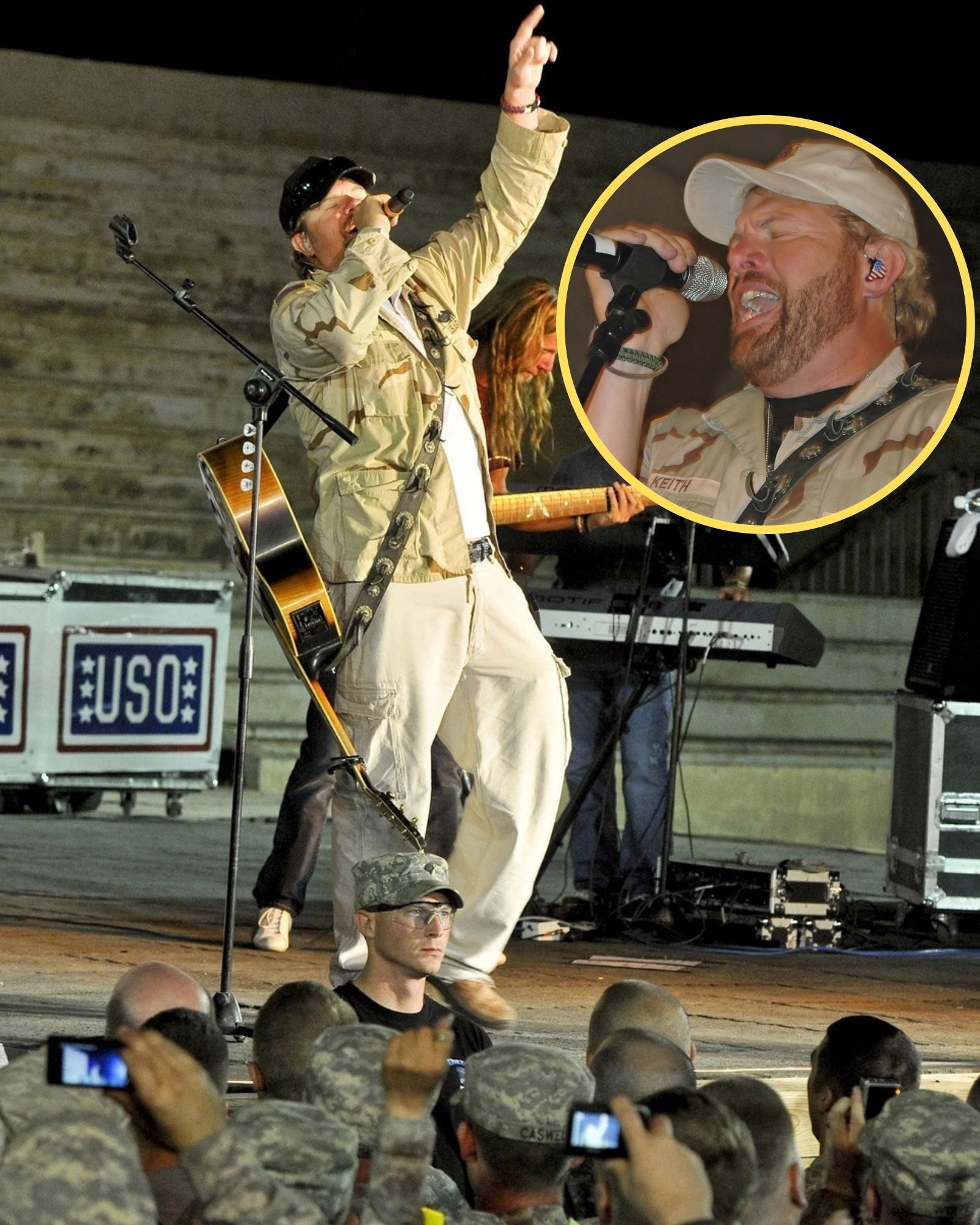
Some songs are created to entertain, while others are written because the artist simply cannot hold the words inside. Toby Keith’s “Courtesy of the Red, White and Blue (The Angry American)” belongs firmly in that second category. Released in 2002, the song was born from a deeply personal place — Toby’s grief over the passing of his father, a proud Army veteran, and the wave of emotion that swept the nation after the September 11th attacks.
This wasn’t a carefully crafted Nashville ballad. It was raw, direct, and overflowing with feeling. Toby once shared that he wrote the song in about 20 minutes, almost as if it spilled out of him. You can hear that urgency in every lyric. While the song is bold, patriotic, and unmistakably intense, at its core, it is personal — Toby expressing his truth in the only way he knew how.
Musically, the track leans into powerful country-rock energy: driving drums, roaring guitars, and Toby’s unmistakable baritone leading the way. There’s no subtlety — it’s strength, grit, and conviction, capturing the mood of a country in shock but refusing to break.
When Toby performed the song for U.S. troops overseas, it became more than a single — it became a rallying cry. Soldiers sang along, embraced it, and carried it with them as a symbol of unity. For some listeners, the song was also controversial because of its blunt tone and fierce imagery. But that honesty was intentional. Toby wasn’t trying to soften anything — he was expressing raw emotion exactly as he felt it.
Twenty years later, “Courtesy of the Red, White and Blue” remains one of Toby Keith’s most defining works. It may not be tender like “You Shouldn’t Kiss Me Like This” or introspective like “Don’t Let the Old Man In,” but it reveals another side of him: the straightforward son of a soldier, unafraid to speak from the heart in the middle of a difficult moment.
At the heart of the song is a simple idea: America’s strength comes from its people — their pride, resilience, and perseverance. Whether loved or criticized, the song ensured that Toby Keith’s voice could not be ignored, and it gave many listeners something solid to hold onto when they needed it most.
Video
Post navigation

They found it by accident — a small, wrinkled page hidden in the back of an old notebook on Merle Haggard’s tour bus. The ink was fading, the edges curled, the handwriting unsteady. There was no title, no chords, nothing to hint that this was meant to become a song. Just a few fragile lines about forgiveness, growing older, and trying to make peace with a world that doesn’t stop for anyone.
A close friend said that during Merle’s final week, he spent long stretches of time sitting by the bus window, watching the California light sink slowly behind the hills. He wasn’t talking much then. Instead, he hummed softly to himself — barely a melody, more like a man remembering the sound of his own heart. No one knew he was writing again. And no one guessed he had one last song left in him.
When the band finally gathered around the page years later, they didn’t hear tragedy in those shaky lines. They heard release. Something gentle. Something a man writes when he’s finally ready to stop carrying things he held onto for too long. It reminded them of the quiet honesty in “If I Could Only Fly,” one of Merle’s most tender recordings — a song that already felt like a whispered goodbye. The unfinished lyrics carried the same softness, the same sense of a man talking to himself more than to the world.
Reading that page, you can almost picture him: a blanket around his shoulders, the bus humming beneath him, the last bit of sunlight fading, and Merle writing not to perform, not to impress, but simply to let something inside him settle. It’s rare to catch an artist in that private space — the moment where the music is just for them.
And maybe that’s why this discovery lingers with fans today. It isn’t about what the song could’ve been on a record. It’s about imagining the voice behind those words. The breath before the first note. The truth he never got to sing out loud.
Now one question keeps echoing in every circle of Merle Haggard listeners:
What would that song have sounded like…
if he had just one more day?
And maybe, if you play “If I Could Only Fly” late at night, you can almost hear the answer hiding between the lines.