The Questions Her Mother Asked — and the Help Izabella Never Received. – Daily News
Izabella Loving was five years old.

At an age when children are supposed to measure their days in cartoons, bedtime stories, and scraped knees, Izabella’s world was already shrinking. Her body was failing her. Her strength was fading. And the people meant to protect her were not doing so.
According to prosecutors, as Izabella’s condition worsened, her mother did not call a doctor. She did not rush to an emergency room. She did not ask a neighbor for help.
Instead, she opened a search engine.
The questions were typed quietly, behind a screen, away from anyone who could intervene:
“Signs my child is dying.”
“How long can you go without food.”
“My five year old is peeing blood.”
“Kidneys failing.”
These were not the searches of a mother seeking help.
They were the searches of someone watching a child fade — and doing nothing to stop it.
Izabella lived in a home where, authorities allege, cruelty had become routine. While her siblings slept in a proper bed, she was forced to sleep alone inside a locked, makeshift box. While other children were fed meals, prosecutors say Izabella was often given little more than a piece of bread to survive on.
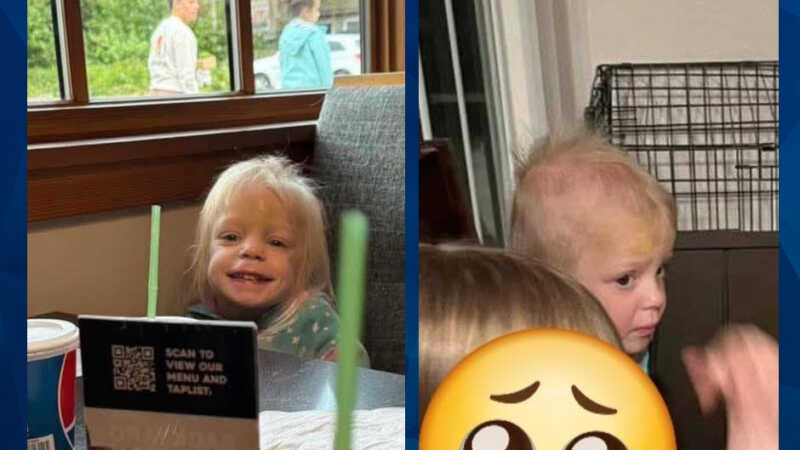
She was small.
She was vulnerable.
And she had no power to escape the adults controlling her life.
Investigators later described signs of repeated trauma on Izabella’s body. Injuries that told a story of prolonged suffering — not a single moment of violence, but a pattern. A life lived in fear, hunger, and isolation.
Still, no one intervened.
On her final night alive, authorities allege Izabella’s father took her temperature, gave her a bath, and placed her back inside the locked box. Her temperature was low — a warning sign no caregiver should ignore. Hours passed.
Izabella became unresponsive.
By the time emergency services were called, it was too late.

She died in the very place that should have been her safest.
When investigators began unraveling what happened inside that home, the truth came out slowly — and then all at once. The burglary. The lies. The shifting stories. And eventually, the digital trail left behind by a mother who allegedly searched for answers online while her child lay dying nearby.
Andrea Loving was initially charged with child abuse causing substantial bodily harm. As more evidence emerged, prosecutors upgraded the charge to murder.
Her husband, Nicholas Loving, has also been charged with murder.

Both parents now stand accused of failing Izabella in the most fundamental way possible: by denying her care, safety, and dignity.
During a police interview, Andrea allegedly said something chilling in its honesty: that she should go to jail for not helping her daughter — and that her husband should go to jail for killing her.
For Izabella, those words came too late.
She never had the chance to explain what she was feeling. Never had the vocabulary to describe hunger the way adults do. Never had the power to demand medical care. She relied entirely on the adults around her to notice, to act, to protect.
They did not.
Instead, prosecutors say, one parent searched the internet.
The other allegedly inflicted the violence.
And a five-year-old girl was left to endure the consequences.
News of Izabella’s death weighed heavily on the community. Vigils were held. People left stuffed animals, flowers, handwritten notes. Strangers who had never met her stood silently, grieving a child whose story felt too cruel to belong in real life.
But this wasn’t a story.
It was a life.
Izabella was not a headline. She was not evidence. She was a little girl with a name, a face, and a future that should have unfolded slowly, not ended abruptly behind closed doors.
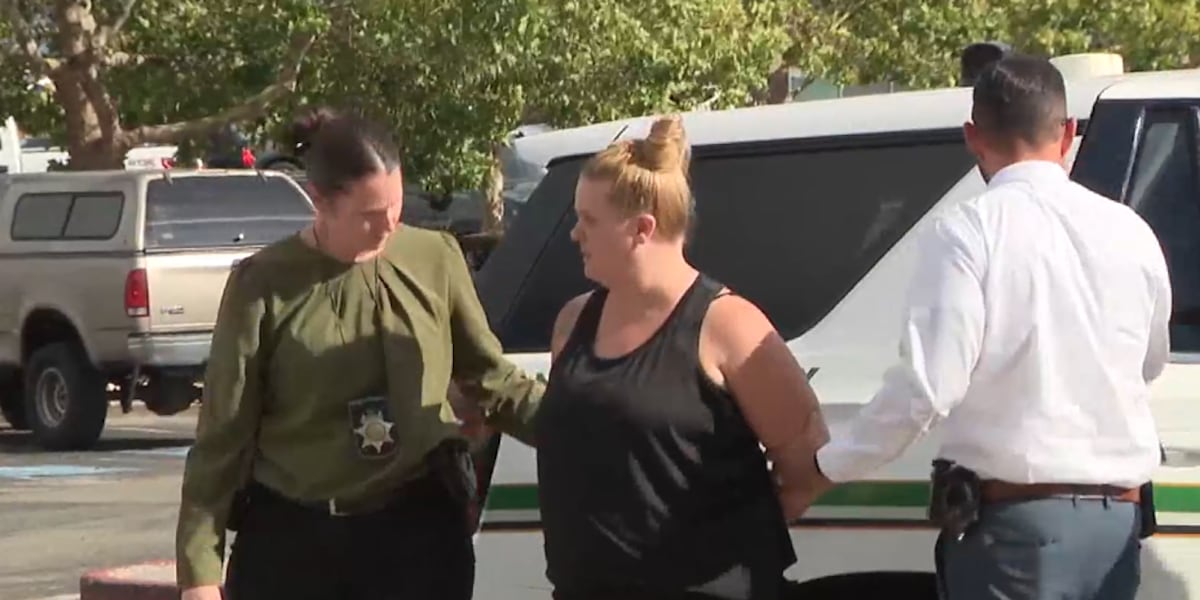
Cases like hers force uncomfortable questions into the open.
How many warning signs are missed because abuse happens quietly?
How many children suffer because adults fear consequences more than they value life?
How often does neglect hide behind routine, behind silence, behind the assumption that someone else will notice?
Izabella’s story is not just about what was done to her — it is about what wasn’t done for her.
No one stepped in.
No one interrupted the pattern.
No one made the call that could have saved her.
And when help finally arrived, it came only to document what was already lost.
As the legal process moves forward, courts will determine guilt. Evidence will be argued. Sentences may be handed down. Justice, in its formal sense, will take shape.
But justice does not mean restoration.
Nothing will bring Izabella back.
Nothing will erase her final days.
Nothing will give her the childhood she was denied.
What remains is responsibility — to remember her, to tell her story carefully and truthfully, and to recognize that child abuse does not always look like chaos. Sometimes it looks like quiet neglect. Sometimes it looks like unanswered cries. Sometimes it looks like a search history instead of a phone call for help.
Izabella Loving deserved care.
She deserved protection.
She deserved to grow up.
Instead, she became a reminder — of how fragile children are when the adults in their lives fail them, and how devastating the consequences can be when warning signs are ignored.
Her name should not fade into statistics.
Her life should not be reduced to court documents.
Because Izabella was five years old.
And she should still be here.
The first sound was not a trumpet or a roar.

It was a low, broken rumble — the kind that doesn’t carry across the savanna, but vibrates deep in the chest. The kind only another elephant would fully understand.
At a wildlife conservancy in southwestern Kenya, rangers moved quickly through the brush after receiving an urgent call. A young elephant calf had been found struggling, his movements frantic, his steps uneven. Something was wrong. Very wrong.
When they reached him, the reason became painfully clear.
A poacher’s snare — thin, cruel, nearly invisible — had wrapped itself tightly around the calf’s leg. With every step he took, it bit deeper into his flesh. He was only two years old. Still learning how to follow the herd. Still close enough to his mother that her shadow was his safety.
Now, he was trapped.
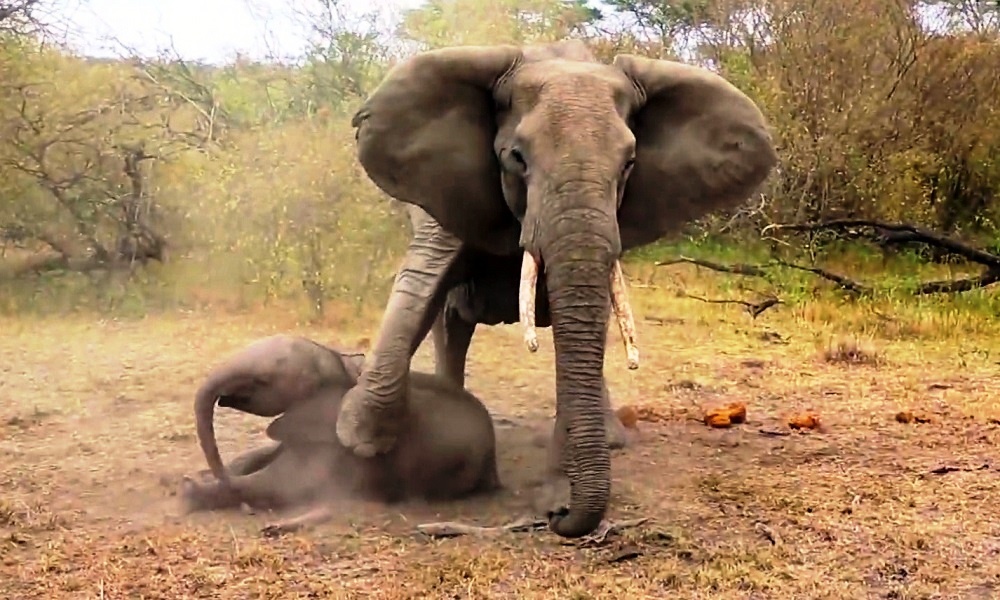
The snare was not meant for mercy. It was designed to hold, to wound, to weaken — so that tusks could be taken later. For the calf, it meant pain, panic, and exhaustion.
For his mother, it meant terror.
She stood close, circling him, her massive body tense, her trunk brushing his side again and again as if checking that he was still there. Still breathing. Still alive. She could sense the danger even before the humans arrived. Elephants always can.
When the veterinary team approached, they moved carefully. Slowly. Every step was calculated. An injured elephant calf is unpredictable — not because he is aggressive, but because fear has taken over. And a frightened mother is even more dangerous, driven by a single instinct: protect at all costs.
The decision was made to sedate the calf.
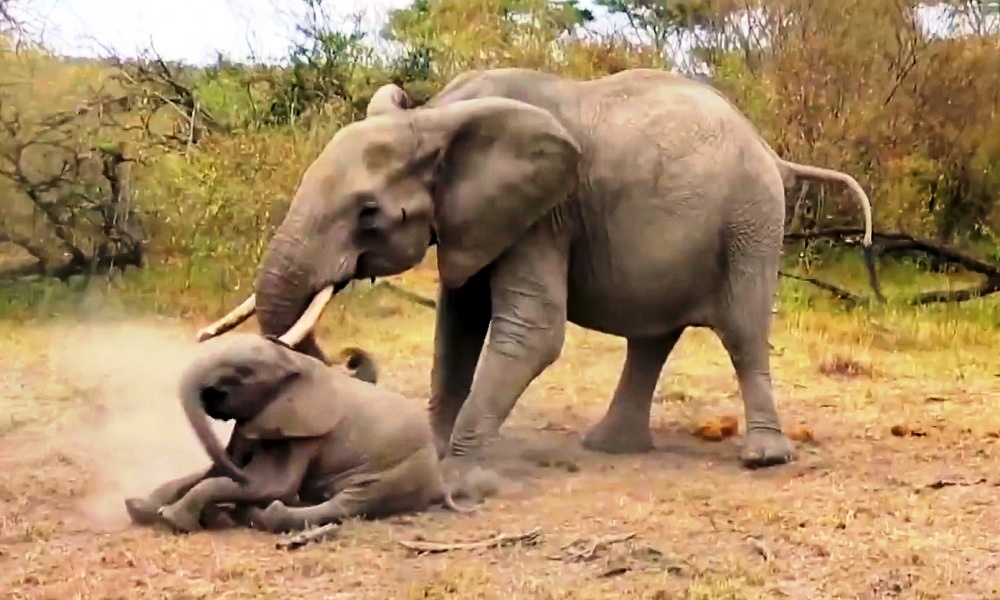
It was the only way to safely remove the snare without causing further injury. The dart flew true. The medication entered his system. Within moments, his legs began to buckle.
And that was when everything changed.
The calf collapsed.
To the veterinarians, it was expected. Necessary. Controlled.
To his mother, it looked like death.
She froze for a split second — the world narrowing to the small body crumpling at her feet. Then she rushed forward.
The video that followed would later move thousands to tears.

She nudged him with her trunk. Gently at first. Then harder. She hooked her trunk under his body, trying to lift him, her movements clumsy with panic. She pushed with her legs, bracing her massive weight behind the effort, as if sheer strength could wake him.
“Get up,” her body language screamed.
“Breathe.”
“Stay with me.”
The calf did not respond.
Her fear escalated into something raw and heartbreaking. She stamped her feet, kicking dust into the air. She trumpeted sharply, the sound tearing through the silence — a call not just of alarm, but of grief. Of refusal.
She would not accept this.
She paced around him, touching him again and again, her trunk tracing his face, his side, his limp leg. Each time she pulled back, as if waiting for a sign — a twitch, a breath, anything.
Nothing came.
For the veterinarians, the situation became increasingly dangerous. A distressed elephant mother is powerful beyond measure, and her focus was unwavering. She saw the humans not as helpers, but as part of the threat that had caused her baby to fall.
She positioned herself between them and the calf, her body a living wall.
At that moment, the team faced an impossible choice.
They could not reach the calf safely while she remained awake. And without removing the snare, his chances of survival were slim. Time was slipping away — not just because of the wound, but because stress alone can kill an elephant calf.
With heavy hearts, they made the call to sedate her too.
The dart struck. Her movements slowed. The fight drained from her body, though her eyes never left her baby. Even as she sank to the ground, her trunk stretched toward him, reaching until the last moment.
Only then could the team work.
They moved fast. Hands cut away the snare, revealing deep wounds but — miraculously — no fatal damage. Blood was cleaned. Medication applied. The leg was treated carefully, every action taken with urgency and respect.
All the while, the calf lay still.
The mother slept nearby.
It was quiet then. Too quiet.
And then — a breath.
The calf stirred. A faint movement. His trunk twitched. Slowly, life returned to his small body as the sedative wore off. When he finally struggled to his feet, shaky but standing, there were tears among the humans watching.
Not from relief alone.
But from what they knew would come next.
As the mother awakened, disoriented and weak, she lifted her head. Her eyes searched immediately — scanning, scanning — until they found him.
Her baby.
Alive.
The transformation was instant.
She rose unsteadily, closing the distance between them in seconds, her trunk wrapping around his body, pulling him close, pressing her forehead against his side. She touched his leg where the snare had been, checking, memorizing, reassuring herself he was real.
Her rumble returned — low, steady, calming now.
He leaned into her.
The crisis had passed.
Later, veterinarians confirmed the wound would heal. The snare had been cruel, but not lethal — this time. The calf would recover. He would walk with the herd again. He would grow.
But the emotional scars linger — not just for elephants, but for the people who witnessed the scene.
Because what that mother showed was not instinct alone.
It was love.
Elephants grieve. They remember. They form bonds that last lifetimes. They feel fear as sharply as we do, and relief just as deeply. In that moment, stripped of distance and difference, her reaction mirrored something universal: a mother refusing to let go.
This incident did not end in tragedy.
But it could have.
And that is what makes it so painful — and so important.
Somewhere nearby, a poacher had set a trap and walked away. No witness to the suffering it would cause. No intention to stay. No responsibility for the terror inflicted on a mother and child.
The snare did not kill this time.
But it has before.
And it will again, unless something changes.
For now, though, there is this image — a mother elephant standing over her calf, refusing to believe he is gone, fighting with every ounce of her being to bring him back.
It reminds us that love is not uniquely human.
It reminds us that cruelty echoes far beyond its target.
And it leaves us with a simple truth, impossible to ignore:
If we can recognize a mother’s grief in the wild — if we can feel it, understand it, be moved by it — then we cannot pretend ignorance when our actions, or our silence, allow such suffering to continue.
She would not leave him.
And neither should we.