Unexpected Bear Nap: A Family’s Unusual Morning Discovery. – Daily News
The morning began the way most quiet mornings do — with routine, half-awake movements, and the expectation that nothing out of the ordinary was waiting on the other side of the bedroom door.
That assumption would not last long
 .
.
When the family stepped into their hallway, they noticed something was wrong. The house felt… different. Too quiet. Not the peaceful quiet of early morning, but a strange stillness, as if the home itself were holding its breath.
Then they opened the closet.
Inside, curled up on a shelf as if it belonged there, was a full-grown black bear — fast asleep.
For a moment, no one moved. No one spoke. The brain struggles in moments like that, trying to reconcile the impossible with what the eyes are clearly seeing. A bear does not belong in a closet. Bears live in forests, not homes. And yet, here it was — breathing slowly, completely at ease.

Sometime during the night, the bear had wandered into the house through the mudroom. Attracted by smells or curiosity, it had pushed its way inside and accidentally locked itself in by deadbolting the door from the inside. Trapped, confused, and clearly hungry, the bear had done what any large, resourceful animal might do.
It explored.
The mudroom was left in chaos — items knocked over, containers opened, signs of a frantic search for food. But once the bear realized escape wasn’t immediately possible, it made another decision.
It climbed.
It curled up.
And it went to sleep.
By the time deputies from the sheriff’s office arrived, the bear was no longer a trespasser in a panic. It was a tenant enjoying a very comfortable nap.
Carefully, officers approached the window near the closet and tried to wake the bear gently. They knocked. They made noise. They hoped the animal would stir, realize it had overstayed its welcome, and wander back outside.
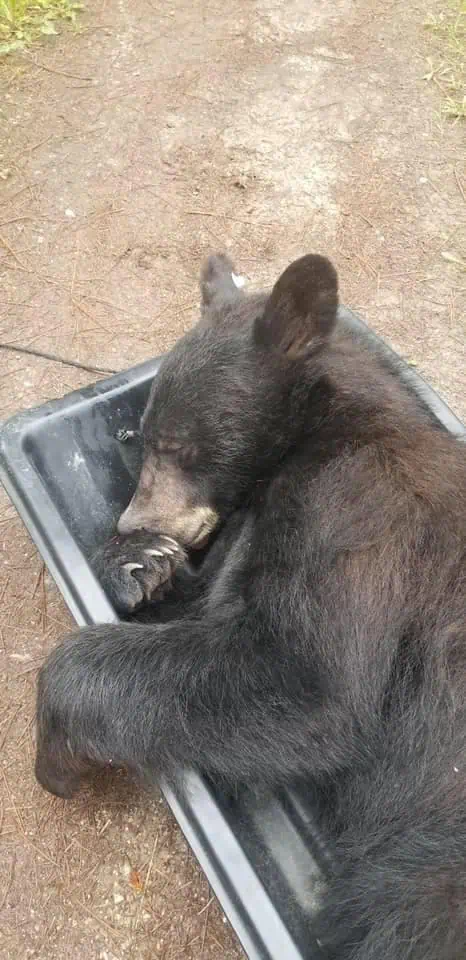
The bear stretched.
It yawned.
And then it settled back down, entirely uninterested in leaving.
Even when deputies unlocked the mudroom door — offering the bear a clear path to freedom — it didn’t move. The message was unmistakable.
Not now.
At this point, humor and disbelief mixed with concern. A bear inside a home is no joke, no matter how sleepy or calm it appears. Safety — for the family, the officers, and the animal — was now the priority.
Wildlife officials were called in to assist.

When Montana Fish, Wildlife, and Parks arrived, they assessed the situation carefully. The bear was tranquil, not aggressive, but unpredictable by nature. Attempting to force it out could lead to panic — and panic with a bear can turn dangerous in seconds.
So they made the safest choice.
The bear was tranquilized.
Slowly, gently, its long nap deepened. Once sedated, the bear was carefully removed from the house and transported to a safe location where it could wake up far from human homes — back where it belonged.
The homeowners watched from a distance, hearts racing but grateful. No one had been hurt. The bear was unharmed. What could have been a frightening encounter ended with nothing more than a demolished mudroom and an unforgettable story.
Later, the family managed to laugh about it.
They joked that the bear had simply been searching for the “bear necessities” — perhaps a snack, perhaps a place to rest — and had found the closet to be just right. The sheriff’s office even leaned into the humor, comparing the incident to Goldilocks testing beds, reminding residents to lock doors and secure their homes.
But beneath the lighthearted tone, the incident carried a deeper reminder.
As human neighborhoods expand closer to wild spaces, encounters like this become more likely. Bears are not villains. They are survivors — guided by instinct, hunger, and opportunity. A forgotten lock, an unsecured door, or an inviting scent can turn a house into an accidental shelter.
This bear didn’t come looking for trouble.
It came looking for food.
And when it couldn’t leave, it did the most bear-like thing possible.
It slept.
By the end of the day, the home was empty again — no bear, no officers, no wildlife vehicles. Just a family standing in their house, staring at a closet they would never look at the same way again.
Some stories involve danger.
Some involve drama.
And some involve waking up to a bear asleep on a shelf.
This one ended safely — with respect for the wild, gratitude for quick responders, and a reminder that nature sometimes shows up in the most unexpected places.
The sun rose quietly on New Year’s Day, indifferent to the grief that had already begun to take shape. Morning light spilled across streets and sidewalks, carrying with it the promise of a fresh start, a clean page on the calendar. For most families, it was a day meant for rest, laughter, and hope.

For one family, it would become a day they could never escape.
By the afternoon, the laughter that once floated near a neighborhood playground had vanished. The swings stood still. The ground where children had run freely would soon be marked not by footprints, but by mourning.
QueenEr’Re Reed was only eleven years old.
She was still a child in every sense of the word—an age filled with half-formed dreams, favorite songs, inside jokes, and plans that had not yet learned how fragile they were. She should have been worrying about school assignments, friends, and what came next in a life that felt endless.
Instead, her life ended before the day was over.

On that New Year’s Day, QueenEr’Re was doing exactly what children are meant to do. She was outside, surrounded by family, cousins, and the comfort of familiar faces. It was ordinary. It was safe. It was the kind of moment no one thinks twice about because nothing bad is supposed to happen there.
No one could have known those ordinary moments would be her last.
The gunshots came without warning.
One second there was noise, movement, life. The next, chaos ripped through the air, shattering everything it touched. Innocence disappeared in an instant. A playground—meant for scraped knees and laughter—became a place of terror.

Emergency responders arrived quickly, their sirens slicing through the stunned silence. QueenEr’Re was rushed to the hospital, hope clinging desperately to every breath she took. For a moment, people dared to believe. They prayed. They waited. They refused to imagine the unthinkable.
But hope was not enough.
QueenEr’Re did not survive.
An eleven-year-old girl was gone. A family lost their child. A future vanished.
The next day, grief settled over the Reed family like a weight too heavy to move. Their home, once filled with the sounds of a growing child, became painfully quiet. Every room held reminders of her presence—things she touched, things she loved, things she would never return to.
Her family spoke first of her smile.
They said it lit up rooms without effort, that her laughter carried warmth even on the coldest days. QueenEr’Re was joy—unfiltered and generous. She was a daughter who loved deeply, a cousin who played fiercely, a child whose presence made others feel safe.
Photographs shared by loved ones told the story words struggled to capture. A bright-eyed girl. A future wide open. Curiosity and confidence shining through every image.
Those photos became both comfort and torment.

The loss rippled outward almost immediately. The community felt it before anyone had time to explain it. Neighbors gathered near the playground, standing together in silence. Candles appeared where children once ran. Some people cried openly. Others stood frozen, unsure how to process the cruelty of it all.
Parents held their children closer than usual.
One question echoed again and again: How did this happen?
Local leaders addressed the tragedy as the investigation began. Words like “senseless” and “heartbreaking” were spoken with visible exhaustion—phrases used too often, yet never any less true. “No child should ever lose their life to gun violence,” one official said, his voice heavy with grief.
For QueenEr’Re’s family, words offered no relief.
No statement could fill the hollow space she left behind. Grief does not listen to reason. It does not respond to explanations. It simply exists—raw, relentless, and unforgiving.
Her mother’s pain was etched into every breath she took. She spoke through tears, trying to understand how a place meant for play had become a place of death. A mother’s worst nightmare had unfolded in the open, without mercy.

Family members described the moment they received the news as unreal. Time slowed, then fractured completely. The world stopped making sense. Thoughts turned to birthdays that would never be celebrated, milestones that would never be reached, a life frozen forever at eleven.
In the days that followed, the playground stood eerily quiet. Police tape fluttered in the winter air, a cruel reminder of what had happened. Children passed by with confused expressions, sensing something was wrong even if they couldn’t explain it.
Vigils formed almost immediately.
People who had never met QueenEr’Re came carrying candles and flowers. Prayers were whispered into the cold night—prayers for justice, for healing, for peace. Grief did not ask for permission. It crossed boundaries and united strangers.

Teachers at QueenEr’Re’s school faced an impossible task. They had to explain death to children too young to understand it. An empty desk became a symbol too heavy for words. Friends asked when she was coming back. Some waited, convinced there had been a mistake.
Reality arrived slowly—and painfully.
QueenEr’Re’s life, though heartbreakingly short, left a deep and lasting mark. Her name became a reminder of what is lost when violence enters places meant to be safe. Her story joined countless others calling for a world where children are allowed to grow up.
As investigators worked, the community waited. Justice felt necessary, but never enough. Nothing could undo what had already been done.
The Reed family focused on honoring their daughter—not as a headline, not as a statistic, but as a person. They spoke of her kindness, her humor, her dreams. They wanted the world to know who she was, not just how she died.
Memorials continued to grow. Stuffed animals. Handwritten notes. Balloons swaying gently in the winter air. Each candle represented shared heartbreak. Each flower carried a promise not to forget.

New Year’s Day will never feel the same again.
What once symbolized hope now carries unbearable sorrow. The calendar itself became a reminder of loss. And yet, even in grief, moments of unity emerged. Neighbors leaned on one another. Community became both shield and lifeline.
QueenEr’Re Reed was more than a victim.

She was a child who mattered.
A life that should have continued.
And as the candles burned low and the playground slowly reopened, one truth remained unchanged: an eleven-year-old girl was gone—and the world is poorer because of it.