Chains to Tears: Raju the Elephant and the Freedom He Waited Half a Century to Feel. – Daily News
For fifty years, the world Raju knew was made of heat, noise, and iron.

He was taken from his family when he was still small enough to stumble on unsteady legs, before he could learn the unspoken language of the herd—how mothers guide calves with a gentle touch, how elders teach patience, how safety lives in togetherness. That life ended abruptly. In its place came ropes, commands shouted in unfamiliar voices, and the sharp sting of metal that taught him fear before it taught him obedience.
Day after day, year after year, Raju walked the same unforgiving paths. The sun burned down on his back. The asphalt scorched his feet. A man sat atop him, steering him through crowds, turning his massive, gentle body into a tool for begging. Coins clinked into outstretched hands. Scraps of food were tossed his way. And always, there was the chain.

The spiked shackle around his leg dug into his flesh with every step. It was heavy, constant, inescapable. Over time, it became part of him—an extension of pain he no longer reacted to because reacting changed nothing. The bullhook followed. Each scar it left was a lesson: do not resist, do not slow down, do not hope.
Elephants are known for their memory. They remember paths to water long after rivers dry. They remember faces, voices, losses. Raju remembered suffering with the same clarity. He remembered hunger that never truly left, exhaustion that sleep could not fix, and loneliness that no crowd could ease. Surrounded by people every day, he was utterly alone.

Years passed. Decades slipped by unnoticed. Calves were born, grew, and aged somewhere far away, while Raju remained frozen in the same cycle. His body weakened. Infections festered beneath the chain. Abscesses formed in his feet. Malnutrition hollowed him out. His spirit bent low, nearly breaking.
Then, in July 2014, something different happened.
It did not arrive loudly. There were no drums, no celebrations. Just a small group of people who looked at Raju and saw not a spectacle, not a source of income, but a life that mattered. They fought quietly, persistently, through paperwork and court orders, until permission was granted to take him away from the streets that had defined him for half a century.

When the moment came, when hands finally reached for the chains that had never once been removed, Raju stood still.
As the metal loosened and fell away, witnesses noticed something extraordinary. Tears streamed down his face. Not metaphorical tears, not imagined ones—real tears, rolling from tired eyes that had seen nothing but cruelty for fifty years. In that moment, the world seemed to pause, as if even Raju himself could not believe it was real.

For the first time since he was a calf, nothing was holding him down.
At the rescue center, the truth of his suffering became painfully clear. His leg was badly wounded from the shackle. His feet were damaged from years of walking on hard surfaces. His body showed signs of prolonged neglect, his health a quiet record of everything he had endured. Veterinarians worked carefully, knowing that every touch carried the weight of trauma.

But alongside the pain came something new: gentleness.
No one shouted at Raju. No one struck him. Food arrived regularly. Water was clean and plentiful. He was allowed to rest. At first, he did not know what to do with the freedom. His movements were cautious, his eyes watchful, as if waiting for punishment that never came.
Healing was slow. Fifty years of harm cannot be undone quickly. Yet, with each passing day, Raju changed. He began to explore. He discovered grass beneath his feet—soft, forgiving, alive. He learned that night no longer meant danger. He slept without chains for the first time in his memory.
Four years later, the elephant who once dragged himself through streets was almost unrecognizable.
To mark the anniversary of his rescue, caregivers prepared a surprise. His space was decorated. Boxes filled with treats were placed nearby. Raju approached them with curiosity, using his trunk to explore, to unwrap, to play. Popcorn spilled out, and he gathered it eagerly, delight evident in every movement.
Then there was the pool.

At first, Raju hesitated. Water had never been a place of joy for him. But slowly, he stepped in. The coolness wrapped around his tired legs, easing joints that had carried pain for decades. He stood there, still and calm, as if the water itself was holding him up. Over time, the pool became his favorite place—a symbol of comfort he had never known was possible.
Watermelon followed. Sweet, refreshing, abundant. No competition. No rush. Just pleasure.
Caregivers watched in quiet awe. Not because Raju’s recovery erased the past, but because it proved something profound: even after unimaginable suffering, joy can return.
Raju became more than a rescued elephant. He became a reminder. A reminder of what cruelty steals, and of what compassion can restore. His life stood as testimony to all the animals still waiting, still chained, still invisible.
“I am truly amazed by his resilience,” one of his veterinarians said. And it was true. Raju did not simply survive. He learned, again, how to live.
His remaining years will never make up for the fifty that were taken. But they will be his.
Years filled with rest instead of marching. With care instead of pain. With water, sweetness, and the quiet dignity every living being deserves.
Raju carries his past with him. Elephants always do.
But now, he also carries freedom.
At first glance, Vutomi moves like any other elephant—slow, deliberate, unhurried by the world around her. She wades into the water with calm confidence, submerging her massive body until only the curve of her back and the gentle sway of her head remain visible. The water clings to her skin in dark, glistening patterns, evidence of a moment of peace, of relief from the heat and dust of the land.
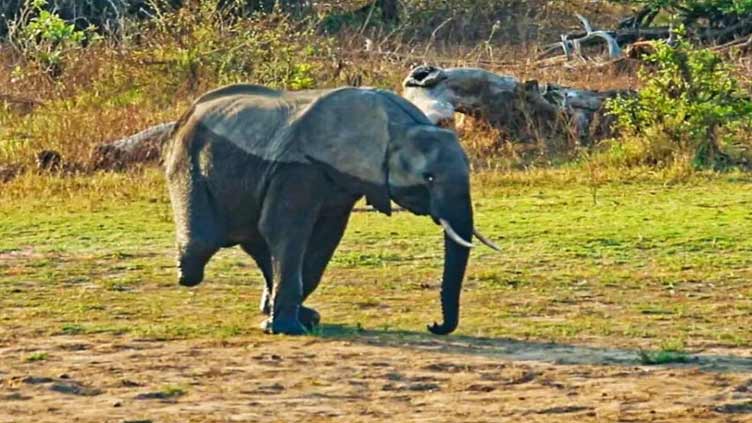
But when she rises and begins to walk again, the truth becomes impossible to ignore.
Vutomi has only three legs.
Where there should have been four powerful pillars supporting her enormous weight, one is gone. In its place is absence—a loss that, for most creatures of the wild, would have meant a swift and merciless end. In a world where weakness is often punished, survival rarely grants second chances.
And yet, Vutomi is still here.
She limps, yes. Her movement carries a slight unevenness, a rhythm shaped by adaptation rather than perfection. But she keeps pace. She does not fall behind. And most remarkably, she is not alone.
Her herd surrounds her.
They do not rush her. They do not abandon her. They adjust—subtly, instinctively—slowing when she slows, pausing when she pauses, forming a living shield around one of their own. In their quiet presence, there is no pity. Only belonging.
No one knows exactly how Vutomi lost her leg.
Perhaps it was a snare—one of the cruel wire traps meant for other animals, hidden and indiscriminate, tightening until flesh gives way. Perhaps it was a predator encounter when she was younger, a moment when survival demanded a terrible sacrifice. Whatever the cause, it happened long ago, and it happened without witnesses.
What matters is what came after.
For an elephant, the loss of a limb is catastrophic. Their bodies are built for balance, for bearing immense weight across four legs. Even minor injuries can become fatal. Infection, exhaustion, inability to keep up with the herd—any one of these could have ended Vutomi’s story before it truly began.
But elephants are not solitary beings.
They are families. They are memory. They are care, passed from one generation to the next.
Somehow, in the days and weeks after her injury, Vutomi was not left behind. The herd stayed. They waited. They adapted alongside her, as she learned—step by step—how to move in a body that had been permanently changed.
Pain would have been constant in those early days. Confusion, too. The instinct to run when danger approached, clashing with the reality that running was no longer possible. Each movement would have required recalculation. Each step, a negotiation between strength and limitation.
And yet, she learned.
She learned how to distribute her weight. How to use momentum differently. How to rest when her body demanded it. How to rise again.
Watching her now, immersed in water and surrounded by her companions, it is easy to forget how extraordinary her existence is. She drinks. She bathes. She socializes. She lives an ordinary elephant’s life—made extraordinary only by the quiet resilience beneath it.
Those who encounter Vutomi often feel an unexpected ache in their chest.
Not because her story is tragic, but because it is profound.
In the wild, survival is often portrayed as ruthless, governed by strength alone. But Vutomi’s life tells a deeper truth. Strength is not only in muscles or limbs. It is in adaptation. In community. In the willingness of others to slow down and make space for someone who cannot move as they once did.
Her herd embodies this truth every day.
They walk with her into the bush, disappearing together into the trees. No one pushes her aside. No one treats her as expendable. She is not defined by what she has lost, but by who she remains.
There is a lesson here, one that extends far beyond the savanna.
Vutomi does not know she is inspiring. She does not know she is being watched, filmed, spoken about. She simply wakes each day and continues—because life, despite everything, is still worth living.
Her story is not loud. There is no dramatic rescue, no human intervention, no miraculous cure. There is only perseverance, and the quiet compassion of a community that refuses to leave one of its own behind.
In a world where injury often leads to isolation, where weakness is hidden or discarded, Vutomi stands—on three legs—as living proof that survival does not have to be solitary.
She is still walking.
Still drinking.
Still following the herd into the heart of the wild.
And as long as they walk with her, she will continue to move forward—not perfectly, not easily, but bravely, step by step, carried not just by her own strength, but by the unwavering presence of those who chose to stay.