He Stayed Until She Breathed Again. – Daily News
The fire had been burning for days before the land finally began to give in.
Eucalyptus groves that once whispered in the wind now crackled and collapsed. Creek beds smoldered. The air was thick with ash and the bitter sting of smoke that refused to lift, even after the flames moved on. It was the kind of devastation that didn’t just scorch the earth — it hollowed it out.
Firefighter Marcus hadn’t slept properly in nearly two days.
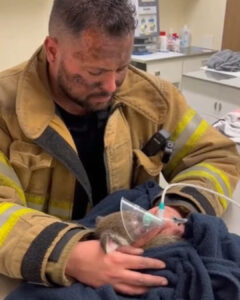
Soot streaked his face in uneven lines, carving evidence of exhaustion into his skin. His turnout jacket hung heavy on his shoulders, stiff with sweat and smoke, the yellow fabric darkened and torn in places. Every muscle in his body ached with the deep, bone-level fatigue that only comes when adrenaline has carried you far beyond what you thought you could endure.
The worst part, though, wasn’t the exhaustion.
It was the silence that followed the fire.
Marcus moved slowly through what had once been a shallow creek bed, boots sinking into blackened mud still warm beneath the surface. Charred branches lay scattered like fallen bones. The smell of burned fur and vegetation lingered — a smell that firefighters learn to dread because it means life was here, and now it wasn’t.
That was when he saw her.
A kangaroo lay near the edge of the creek, her body still, fur singed and blackened. She had tried to flee — you could tell by the position of her legs — but the fire had been faster.
Marcus stopped.
He had seen this too many times over the past days. Too many animals lost, too many bodies left behind when the flames passed through faster than anything could run. He bowed his head for a moment, a quiet, instinctive gesture of respect.
Then something made him look again.
A twitch.
So small it could have been his imagination. Just the faintest movement near the kangaroo’s abdomen.
Marcus’s breath caught.
“No…” he whispered, stepping closer.
He knelt carefully beside her, heart pounding now, the exhaustion pushed suddenly to the side. With hands that had carried hoses, axes, and stretchers all week, he reached toward the pouch with a gentleness that felt almost foreign in a disaster zone.
Inside, hidden from the fire by the body that had failed to save her, was a baby kangaroo.
A joey.
She was impossibly small — no bigger than Marcus’s palm. Her eyes were squeezed shut, her skin pink beneath sparse fur, her tiny chest fluttering in shallow, panicked gasps that sounded more like whispers than breaths. Smoke had filled the air for hours. Every breath she took was a struggle.
“Oh, hey… hey, little one,” Marcus murmured, his voice cracking.
He didn’t think about the rules. He didn’t call for instructions. He didn’t hesitate.
He unshouldered his pack and pulled out his spare blanket — the one he’d meant to use if he got caught overnight again. He wrapped the joey gently, shielding her from the ash-filled air, and pressed her instinctively against his chest.
Her tiny paws curled weakly into the fabric of his jacket.
She was alive.
Barely.
Marcus stood and ran.
Back toward the fire truck, boots slipping on ash and mud, lungs burning as he pushed his exhausted body harder than it wanted to go. Other firefighters shouted after him, confused, but one look at his face told them not to slow him down.
“Clinic,” he said breathlessly once he reached the radio. “I’ve got a live joey. Smoke inhalation. She’s bad.”
The ride to the veterinary clinic felt endless.
Marcus sat hunched in the back of the truck, helmet forgotten on the floor, arms wrapped tightly around the small, fragile bundle rising and falling unevenly against his chest. He counted her breaths out loud without realizing it. One. Two. Three. Don’t stop.
“Easy,” he whispered, lowering his forehead until it nearly touched the blanket. “You stay with me. Just breathe.”
The joey made a faint sound — a tiny whimper that barely registered over the engine — but it was enough to make his throat close.
At the clinic, vets and technicians swarmed the moment he burst through the door. Oxygen masks appeared. Monitors beeped to life. Hands reached for the joey, but Marcus hesitated for half a second longer than necessary.
“She’s all I’ve got left,” he said quietly, voice thick with ash and emotion.
“We’ve got her,” a vet replied gently.
Marcus let go.
He stayed anyway.
He stood by the table as the oxygen mask was fitted over the joey’s tiny snout, his heavy gear still on, ash smearing the clean clinic floor. No one told him to leave. No one asked him to change. They could see it in his eyes — he wasn’t going anywhere.
“Come on, little one,” Marcus whispered, resting a soot-stained finger lightly against her back. “I’ve got you. I’m right here.”
The joey’s breathing was erratic at first. Too fast. Too shallow. Her tiny chest struggled beneath the mask, each breath a fight against smoke-filled lungs that had never been meant to inhale fire.
Minutes stretched.
Then — slowly — something changed.
Her breathing deepened. Just a little. The frantic flutter eased into a more regular rhythm. Her tiny paws relaxed their grip on the blanket, unclenching for the first time since Marcus had found her.
“There,” he murmured, barely daring to breathe himself. “That’s it. You’re doing it.”
The fire crew had long since gone back out. The clinic lights dimmed as night settled in. But Marcus stayed planted beside the table, helmet at his feet, jacket still on his shoulders, eyes fixed on the rise and fall of a chest no bigger than his thumb.
Hours passed.
The vet finally spoke softly. “She’s stable. Weak, but stable.”
Marcus nodded, a silent acknowledgement, tears cutting clean paths through the soot on his face.
He sank into a chair but never took his hand away from the joey’s back.
“You’re safe now,” he whispered again, the same words he’d spoken to terrified families and stranded animals all week. “You’re not alone.”
In the quiet of the clinic, far from the roar of flames and collapsing trees, a firefighter who had spent days battling destruction did something just as important as any line he’d held.
He stayed.
He watched every breath.
He listened to every faint sound.
He refused to leave.
Because sometimes, saving a life doesn’t look like charging into fire.
Sometimes it looks like kneeling in ash.
Noticing a twitch where there shouldn’t be one.
And holding on — long after everyone else has gone home — until someone small and fragile remembers how to breathe again.
The courtroom had finally gone quiet.
The gavel rested where it fell, the sentence delivered, the man responsible for years of cruelty led away in handcuffs. Papers were gathered. Chairs scraped back. Justice, in its formal sense, had been served.
But Judge Harlan wasn’t finished.
Instead of heading back to chambers, he drove straight to the county animal shelter. He didn’t change out of his robe. He didn’t call ahead. He just walked through the concrete halls, the echoes of barking and metal doors closing around him, until he reached the last kennel.
That was where Finn was.
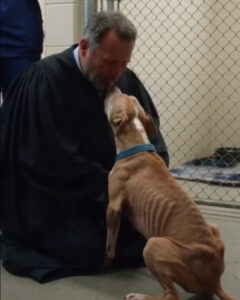
The pit bull barely looked like a dog anymore. His ribs pressed sharply against thin skin, hips jutting out, legs trembling under the effort of standing. His eyes were empty—not afraid, not angry—just resigned. The look of an animal who had learned that nothing good ever came from hoping.
The staff whispered behind Judge Harlan as he stopped in front of the kennel.
“That’s him,” one said quietly. “The one from court.”
Judge Harlan knelt down on the concrete floor, his robe pooling around him. Dust clung to the fabric, but he didn’t notice. His eyes never left Finn.
“Hey, buddy,” he said softly. “It’s me.”
Finn didn’t bark. Didn’t growl. Didn’t lift his head.
Judge Harlan reached forward and unhooked the kennel door.
“I’m the one who heard you,” he continued, voice steady but low. “I couldn’t stop what happened before. But I can be here now.”
For a long moment, nothing happened.
Then Finn moved.
Slowly. Unsteadily. Each step looked like it might be his last. His legs shook, his body sagging under its own weight, but he kept coming—drawn by something he didn’t fully understand, only felt.
When he reached the judge, Finn collapsed into his lap.
Not jumped. Not leaned.
Collapsed.
His head pressed against Judge Harlan’s chest, his thin body curling inward as if trying to disappear inside the safety of another being. A rough, dry tongue reached up and licked the judge’s cheek—once, then again—tentative, almost apologetic.
Judge Harlan inhaled sharply.
“Oh,” he whispered, arms closing around Finn without thinking. “Oh, look at you.”
Finn let out a deep, shuddering sigh—the kind that carries years of pain with it. His tail tapped weakly against the robe, once… twice… like he was afraid to hope too much.
A shelter technician gasped softly.
“He won’t leave you.”
Judge Harlan buried his face into Finn’s neck, tears soaking into the coarse fur.
“I don’t want him to,” he said, voice breaking. “I can’t get enough of this face.”
Finn stayed exactly where he was.
For the first time in his life, no one pushed him away. No one shouted. No one raised a hand.
“You’re safe now,” the judge whispered. “It’s over. You don’t have to be strong anymore.”
Finn’s breathing slowed. His body relaxed fully into the embrace, as if he had been waiting his whole life for someone to say those words and mean them.
Later, the paperwork would be signed. Adoption forms. Medical plans. A new address. A quiet house with soft beds and slow mornings.
But none of that mattered in that moment.
What mattered was this: the same man who had spoken for Finn in court had shown up when the cameras were gone. The same hands that held a gavel now held a broken dog who had never known mercy.
Justice had been served that day.
But compassion—that came after.
