Kurt Vonnegut’s Last Lesson: How to Make Your Soul Grow. – Daily News
In 2006, at Xavier High School in New York City, an English teacher named Ms. Lockwood gave her students an unusual assignment: write to a famous author and ask for advice. The students dutifully mailed out their letters, never expecting much in return. After all, authors—especially the great ones—rarely have the time to respond to fan mail, let alone to an entire class of teenagers.

But one did.
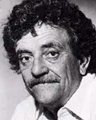
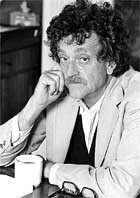
Kurt Vonnegut, then 84 years old and one of America’s most beloved novelists, took the time to write back. He had already lived his long and extraordinary life: World War II soldier, prisoner of war during the bombing of Dresden, author of Slaughterhouse-Five, Cat’s Cradle, and Breakfast of Champions. By 2006, he had stopped making public appearances. Age had left him frail, and he often described himself with his signature mix of humor and sadness as “resembling nothing so much as an iguana.”
Still, he opened his heart to a classroom of strangers. His response wasn’t long, but it contained a message so powerful that it still resonates today.
“Dear Xavier High School, and Ms. Lockwood, and Messrs Perin, McFeely, Batten, Maurer and Congiusta,” he began. “I thank you for your friendly letters. You sure know how to cheer up a really old geezer (84) in his sunset years.”
Vonnegut could have ended the letter there, a polite thank-you. Instead, he offered the students what may be the most important piece of advice he ever gave:
“Practice any art, music, singing, dancing, acting, drawing, painting, sculpting, poetry, fiction, essays, reportage—no matter how well or badly—not to get money and fame, but to experience becoming, to find out what’s inside you, to make your soul grow.”
This was the heart of his message. Success didn’t matter. Recognition didn’t matter. What mattered was the act of creation itself—the simple, joyful discipline of making something, anything, that allowed a person to grow from the inside out.
“Seriously! I mean starting right now,” Vonnegut urged. “Do art and do it for the rest of your lives. Draw a funny or nice picture of Ms. Lockwood, and give it to her. Dance home after school, and sing in the shower… Make a face in your mashed potatoes. Pretend you’re Count Dracula.”
It was whimsical, yes, but also profoundly serious. Vonnegut was trying to tell those students that art wasn’t about talent or ambition—it was about becoming more alive.
Then he gave them an assignment.
“Write a six line poem, about anything, but rhymed. No fair tennis without a net. Make it as good as you possibly can. But don’t tell anybody what you’re doing. Don’t show it or recite it to anybody, not even your girlfriend or parents or whatever, or Ms. Lockwood. OK?”
And then—tear it up. Destroy it. Scatter the pieces into trash cans far apart from one another.
Because the reward wasn’t in the applause, or the grade, or the praise. The reward was already earned in the act of creation itself.
“You will find,” Vonnegut concluded, “that you have already been gloriously rewarded for your poem. You have experienced becoming, learned a lot more about what’s inside you, and you have made your soul grow.”
Kurt Vonnegut died the following year, in 2007. That classroom assignment would be among the last pieces of public advice he ever gave. And yet it may also be one of his greatest legacies.
In a world that measures value by likes, shares, grades, and paychecks, Vonnegut reminded a handful of students—and now, millions of people who have read his letter since—that the truest reward comes not from recognition, but from the quiet act of making something for its own sake.
It is a lesson not just for writers, but for all of us: Dance, sing, draw, play, write—not because the world demands it, but because your soul does.
On a chilly afternoon in late autumn, Vesna Vukojevic was walking down the streets of Trstenik, Serbia, when she caught sight of something that made her stop in her tracks. It was the kind of moment that slices through the noise of everyday life, searing itself into memory with its quiet tragedy.

There, outside a small bakery, sat a stray dog. His ribs were visible under his rough coat, his eyes wide with the weight of loneliness. What made Vesna’s heart ache, however, wasn’t just his condition — it was what he was doing.
The dog had nestled himself against a mechanical statue. Its arm moved back and forth in an endless, predictable rhythm. And this starving, forgotten animal pressed himself against it so that, with every mechanical swing, it brushed across his fur.
For anyone watching, it looked almost as though the dog was being petted.
In reality, it was something far more heartbreaking: a desperate attempt to mimic affection he hadn’t felt in far too long.
Vesna pulled out her phone, recorded the scene, and shared it online. She may not have realized it in that moment, but her short video would circle the globe within hours.
The clip spread like wildfire, striking a deep chord with anyone who saw it.
“That just killed part of me,” one person wrote in response.
“Poor dog just wants to be loved,” another added.
The comments poured in by the thousands, each reflecting the same truth: this wasn’t just a video of a stray. It was a stark reminder of how deeply all living beings crave love — and how unbearable its absence can be.
But among the viewers was someone who couldn’t stop at sadness.
Nina Savić, an animal lover and rescuer based in Belgrade, was more than 200 miles away when she first saw the video. Yet something about that dog pressed against a machine touched her in a way she couldn’t shake. She couldn’t let him remain a symbol of heartbreak on the internet.
With the help of friends, Nina set out to track him down. It wasn’t simple — stray dogs in Serbia are many, and they move constantly in search of scraps. But the town of Trstenik had seen him before, wandering the streets, curling up on corners, waiting by bakery doors for a kind handout.
When Nina and her team finally found him, he was wary. Strays learn caution as a survival skill, and for a dog who had been ignored for so long, trust was something foreign. But patience won out. Bit by bit, they coaxed him into safety.
And just like that, the lonely dog leaning against a statue was no longer alone.
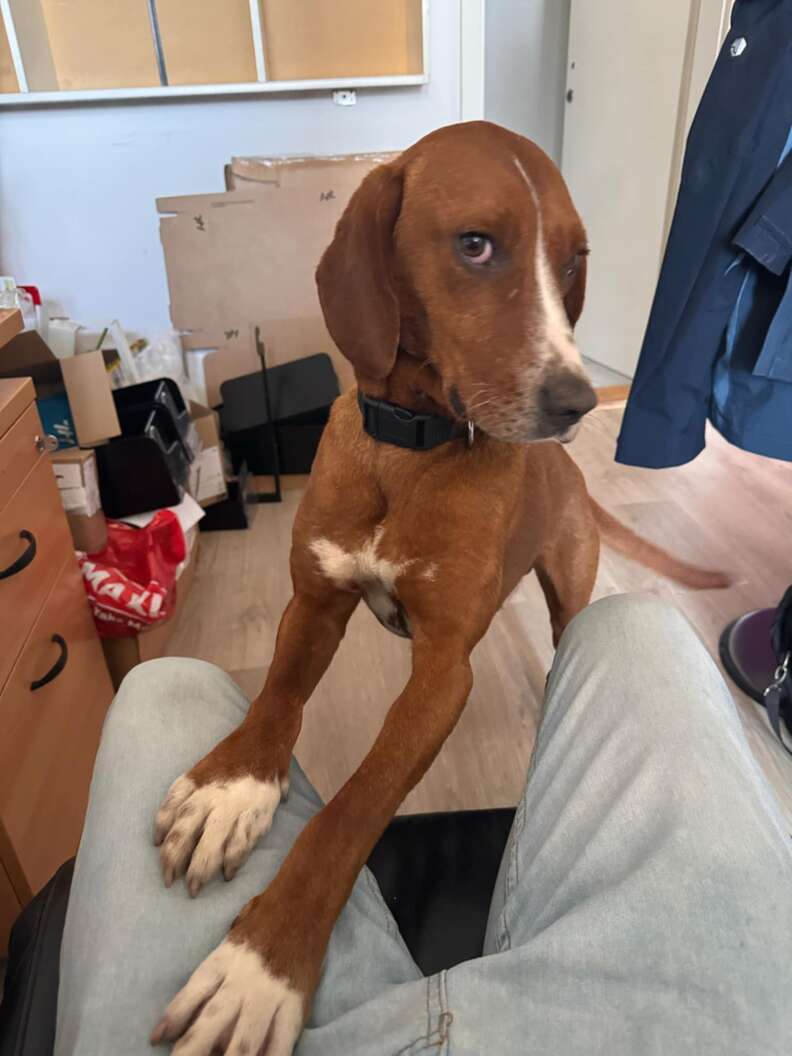
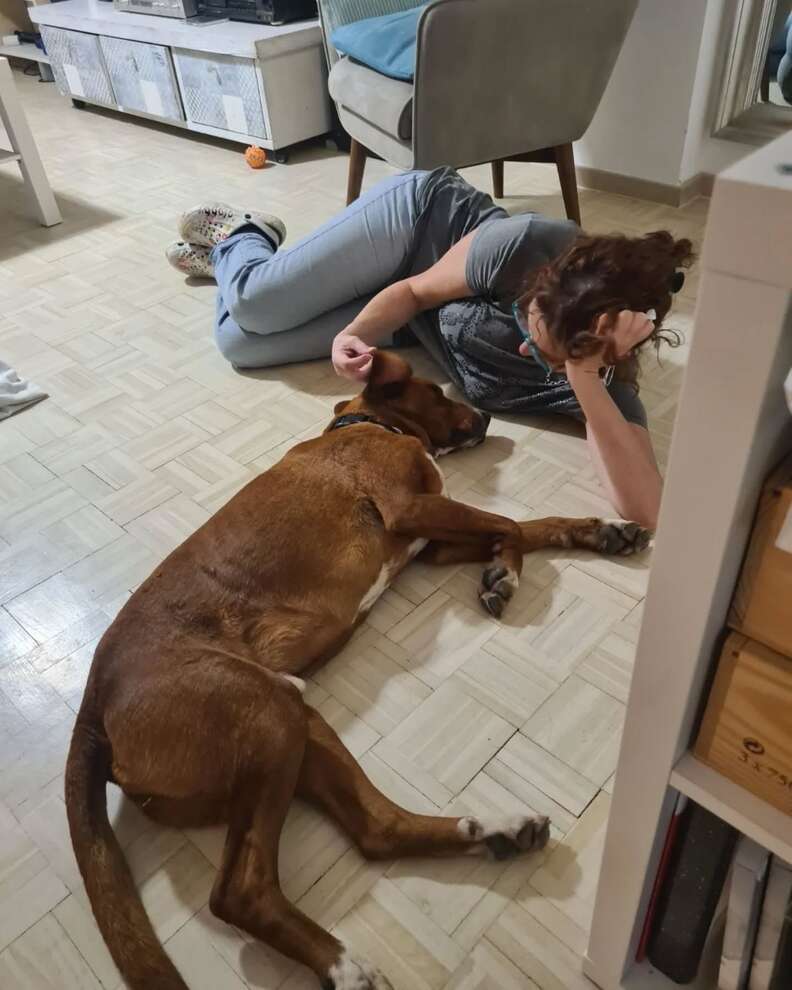
Nina named him Hogar the Horrible, a playful, ironic title that made rescuers laugh — because anyone who met him quickly discovered that his heart was nothing but tender.
Still, Hogar needed time. At first, when human hands reached out to stroke him, he flinched, uncertain. He seemed to wonder: was this real, or just another illusion like the machine’s mechanical arm?
But slowly, as days turned into weeks, he began to change. Blankets replaced cold sidewalks. Gentle voices replaced passing footsteps. A bowl of food waited for him every evening, and loving arms welcomed him every morning.
“Hogar is wonderful,” fellow rescuer Maja Pinter later said. “He loves to be cuddled. He just puts his head in the hands of everyone he meets.”
The dog who once pretended a statue could love him now sought affection eagerly, his eyes softening with the confidence that he finally belonged.

What struck Nina and Maja most was how quickly Hogar adapted to kindness. It was as if the months of loneliness had not hardened him but instead deepened his capacity to love. Everyone who visited Nina’s home found themselves falling for him.
“Everyone is in love with him,” Pinter admitted. “He knows how to win everyone’s heart.”
And Hogar, for his part, seemed determined never to waste a single chance to show affection. He leaned into every hand offered, wagged his tail at every smile, and curled himself into laps with a sense of relief so profound it was almost visible.
For now, Hogar lives with Nina in Belgrade. She has already given him more than he ever dared dream of: safety, warmth, and love. She admits that while she hopes to find him a forever family, she would happily keep him forever herself. After all, she has already been changed by him.
Hogar’s story is no longer just about a lonely stray. It is about the way compassion can rewrite even the most tragic beginnings.
Once, he pressed his frail body against a machine, begging it to act as a substitute for a human hand. Now, he wakes each day surrounded by people who adore him, his once-empty world filled with love.
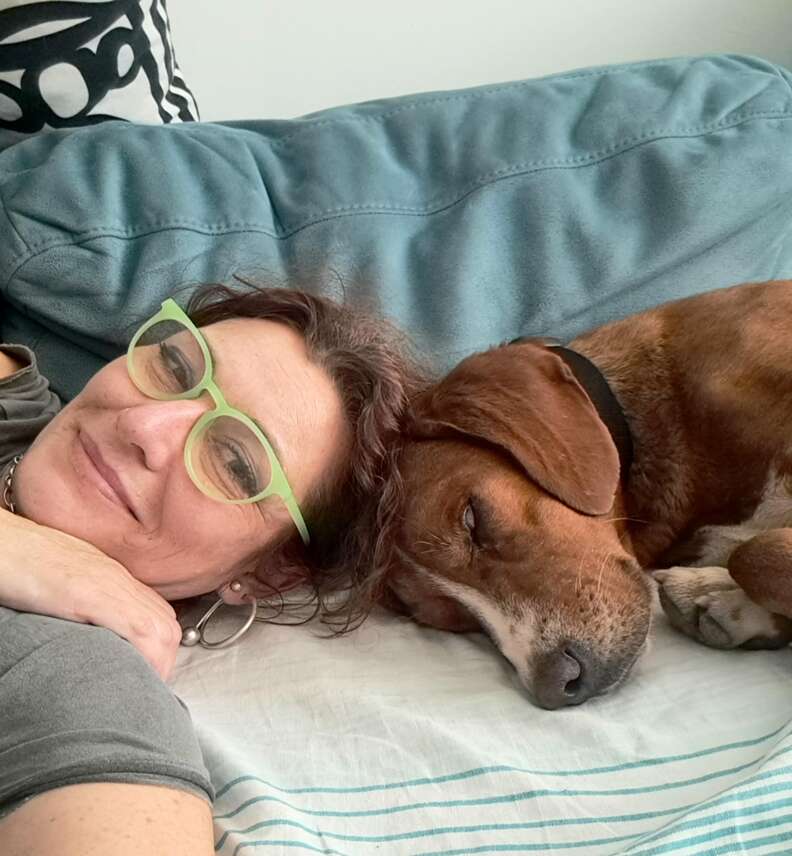
From the sidewalks of Trstenik to a warm home in Belgrade, Hogar’s journey is a reminder of the resilience of animals — and of the transformative power of simple human kindness.
He will never again have to imagine affection. He will never again be forced to lean on cold metal for comfort. He has found what he was searching for all along: not scraps, not survival, but touch, warmth, and love.
And now, he is no longer just Hogar the Horrible. He is Hogar the Beloved.