A Wire Around Her Trunk, A World Ready to Save Her. – Daily News
The savanna stretched wide and golden under the Kenyan sun, a place where life moves in rhythm with the earth. Among the shifting herds of Tsavo East National Park, a young calf wandered close at her mother’s side. Barely a year old, she was still learning the world through her trunk — tugging at grass, splashing water, reaching for her mother’s tail. From a distance, she looked like any other baby elephant: playful, curious, safe within her mother’s towering shadow.

But someone watching more closely saw the truth.
Halfway along the calf’s trunk was a cruel constriction — a wire snare, thin but merciless, cutting into flesh every time she moved.
Poachers set such snares with brutal efficiency. They tighten as the animal struggles, designed to trap, maim, and eventually kill. For this calf, it meant slow suffering, and as she grew, the wire would have sliced deeper until infection or blood loss claimed her. Not even her fiercely protective mother could have freed her without making the injury worse.

The tourist who noticed the wound made the call that would save her life.
Within hours, Sheldrick Wildlife Trust (SWT) and their partners at Kenya Wildlife Service (KWS) dispatched a mobile veterinary unit. They knew time was critical. Each day the snare stayed on, the risk of permanent damage or death increased.
Finding the pair in Tsavo’s vast wilderness was a mission in itself. Relief flooded the team when they finally spotted the little calf moving cautiously beside her mother. But another problem loomed: how to help a baby elephant without enraging a protective mother who would defend her calf against any perceived threat.
The answer was sedation. Both mother and daughter were safely darted, drifting into temporary sleep as rangers stood watch. For a moment, the wild fell silent. Then the team rushed forward.

They worked quickly, cutting away the wire that had begun to bite into tender skin. What they found was sobering — the wound was deeper than expected, but not yet catastrophic. With antiseptics, careful cleaning, and treatment, the danger of infection was reduced. In time, the calf’s flesh would heal, and with it, her chance at a normal life.
When the antidote was administered, the little elephant stirred, blinking against the bright sun. Disoriented, she wobbled for a moment, her world strange and unfamiliar. But then she heard her mother’s low rumble. Instinct pulled her forward. She pressed against her mother’s side, calm once more.
Together, they walked back into the bush, the calf trailing close, her small steps echoing the great rhythm of her family’s journey.

Later, SWT shared the moment with the world in simple, powerful words:
“A little life saved. An elephant family kept whole.”
And somewhere in Tsavo, a calf once bound by cruelty now moves freely again, her trunk a symbol not of pain, but of survival.

The call came in late May, urgent and alarming: a dog tied to a fence in the blazing Arizona sun. It was 99 degrees Fahrenheit that day, the kind of heat that burns through shoes and silences the air. She had no shade. No water. Just a short leash and the concrete radiating heat like an open flame.

An investigator from the Arizona Humane Society (AHS) rushed to the scene. What they found was worse than anyone had imagined.
The dog, a small female with painted leopard-print spots across her body, panted heavily, her sides heaving with exhaustion. Her paws shifted back and forth, searching for relief on a thin strip of dirt to avoid the scorched pavement. The thermometer read 133 degrees at ground level—deadly heat for any animal. And yet, even in this desperate state, she wagged her tail, friendly, trusting. Vulnerable.
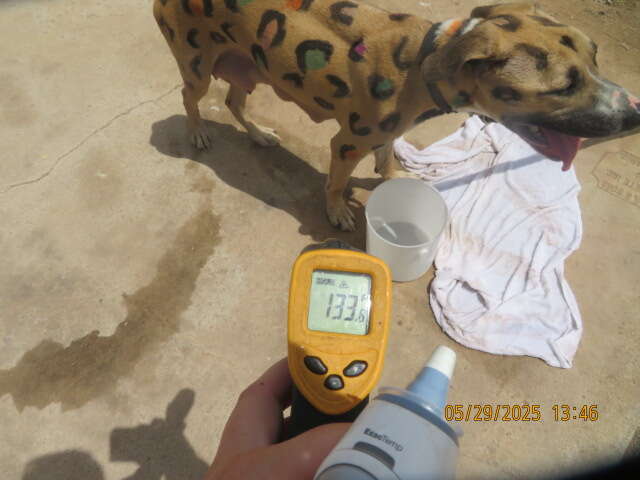
The investigator quickly placed a towel on the ground and poured fresh water. The dog, trembling, collapsed onto the towel and gulped water like it was the sweetest gift she had ever received.
But then came the deeper concern: the dog was clearly nursing. Somewhere nearby, there had to be puppies.
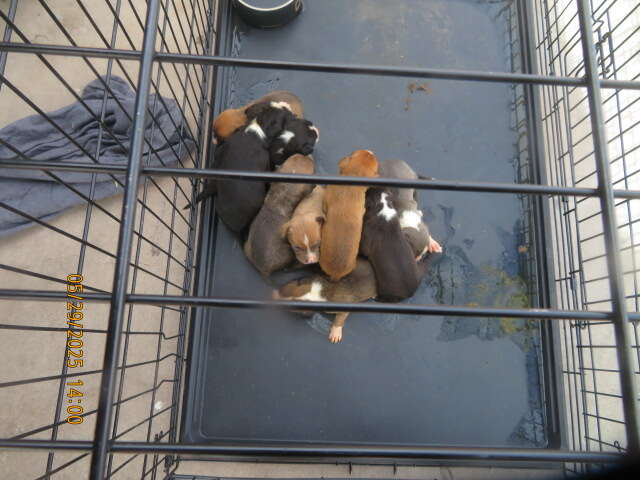
When the police tracked down the dog’s owner, they admitted she had come into their possession about a month earlier as a stray. They led the investigator inside their home—and there, huddled together, were nine tiny puppies, just three weeks old.
They should have been nursing under their mother’s watchful care. Instead, they were surviving apart, deprived of her comfort during the hottest hours of the day. Faced with the undeniable truth that they couldn’t provide proper care, the owners surrendered the mother and her pups on the spot.
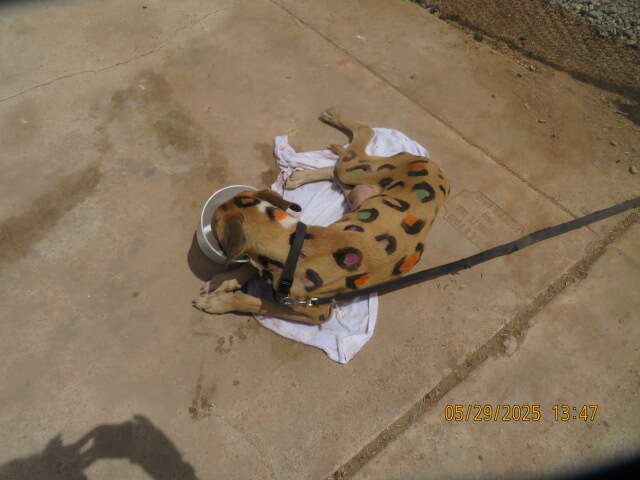
The mother, now named Rainbow Brite, and her puppies, affectionately called the Sprites, were rushed to AHS’s Lazin Animal Foundation Trauma Hospital. Veterinarians cooled her with chilled towels, checked her vitals, and worked to stabilize her body after the heat stress. Despite her ordeal, she showed no aggression, only gratitude.
“She’s about 5 years old, and she still has so much love to give,” said Ruthie Jesus, AHS field manager. “Even tethered and vulnerable, she greeted us with nothing but gentleness.”
Rainbow Brite was underweight, but with proper food and care, she’ll regain her strength. Most importantly, she’ll have the chance to nurse her puppies safely until they’re old enough to be adopted into loving homes.
Today, Rainbow Brite and her nine Sprites are thriving in a foster home, resting in comfort for the first time in weeks. The painted leopard spots still linger on her fur, a cruel reminder of vanity at her expense. But in time, they will fade—just as the memories of her suffering will fade, replaced by a new life of love and dignity.

A single call saved not one life, but ten.
Rainbow Brite’s story is a reminder that cruelty can be hidden in plain sight, disguised behind paint and excuses. But it also proves something greater: that compassion, spoken in a single phone call or act of courage, can change everything.