THEY HELD HIS FUNERAL ON THE GRAND OLE OPRY STAGE. THE SAME BOARDS HE HAD STOOD ON FOR 66 YEARS. Country Music Hall of Fame. Sixty-six years on the Opry. The oldest living member on the night he last walked off that stage — December 20, 2014, the day after his 94th birthday — to celebrate with the only family he’d ever really claimed. On January 8, Brad Paisley served as emcee. His friend’s casket sat center stage while Vince Gill played guitar that had once belonged to Dickens’ late guitarist Jabbo Arrington. Carrie Underwood — visibly pregnant, standing in black — told the room how her mother had warned her before her very first Opry appearance: “Watch out for Little Jimmy Dickens, because he likes the pretty girls.” She broke into tears. Then she and Gill sang Go Rest High on That Mountain together. Gill had sung that same song on that same stage less than two years earlier, at George Jones’ funeral. At the close, Brad Paisley stopped mid-sentence to choke back tears: “At 94, your journey has ended — but we’ll take it from here, little buddy.” Then the whole house sang Will the Circle Be Unbroken — a tradition, they said, that Dickens himself had started. When it was over, the curtain came down. Little Jimmy Dickens left the Opry stage for the last time. – Country Music
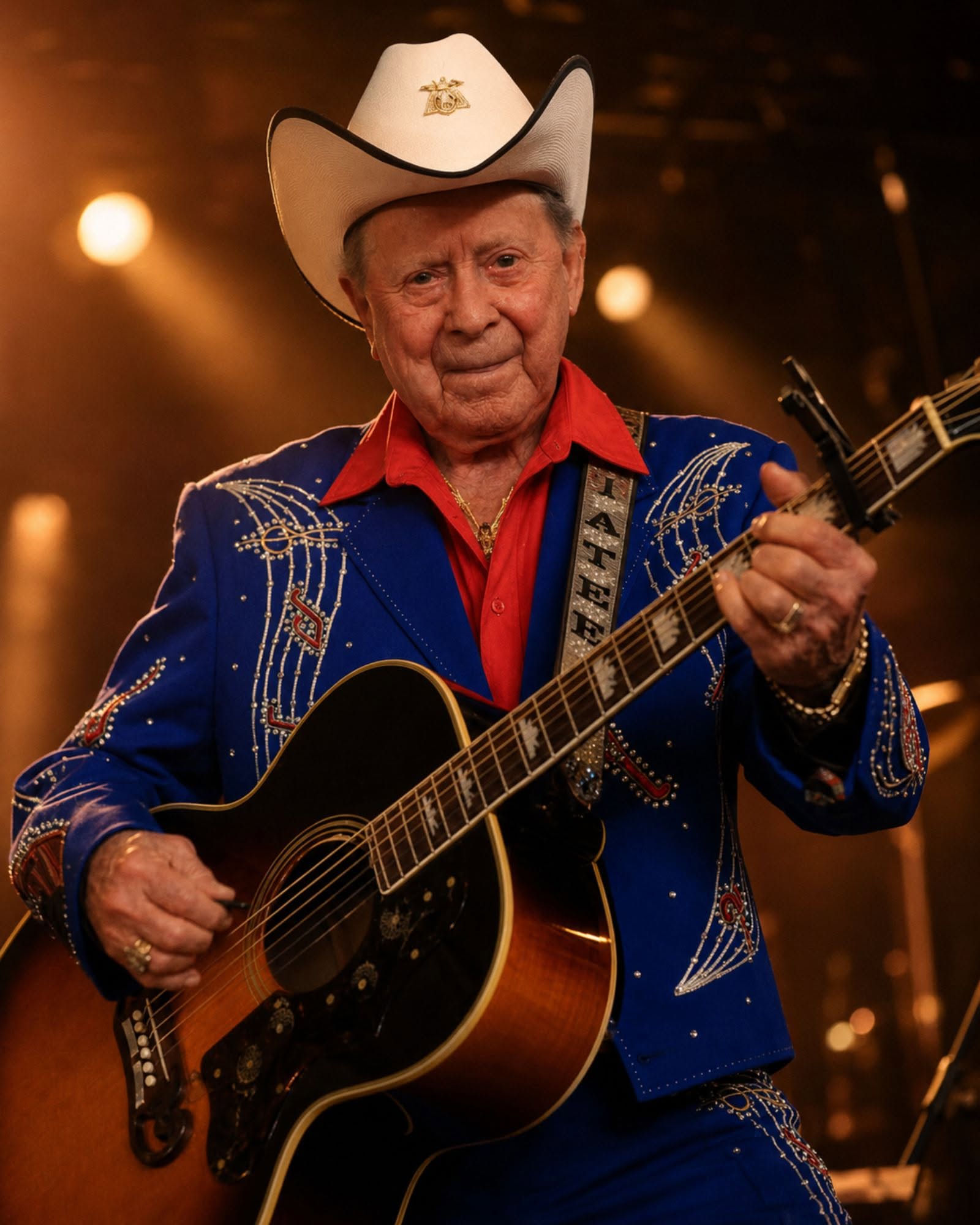
Little Jimmy Dickens and the Final Opry Farewell
There are some goodbyes that do not feel ordinary. They feel larger than life, shaped by music, memory, and a room full of people who understand exactly what has been lost. That was the feeling inside the Grand Ole Opry when Little Jimmy Dickens was honored one last time on the very stage he had helped define for 66 years.
For decades, Little Jimmy Dickens was part of the heartbeat of country music. He was funny, warm, sharp, and unmistakable, a man whose presence on the Opry stage became as familiar as the building itself. When he stepped away from that stage for the final time on December 20, 2014, just one day after his 94th birthday, it marked the end of an era that had stretched across generations of fans, performers, and Saturday night traditions.
A Stage He Helped Make Legendary
The Grand Ole Opry is more than a venue. To country music fans, it is a living archive, a place where songs carry history and where every board seems to hold the footsteps of artists who changed the genre. Little Jimmy Dickens stood on those boards for 66 years, longer than many careers even lasted. His voice, his humor, and his larger-than-life personality made him a true Opry fixture.
When the time came to hold his funeral there, the choice felt deeply personal and deeply right. This was not just a tribute in a fancy room. It was a homecoming to the place where Little Jimmy Dickens had lived so much of his professional life.
Brad Paisley Leads the Tribute
On January 8, Brad Paisley served as emcee, helping guide the service with the kind of respect and emotion that only comes when the tribute is for someone truly beloved. The casket sat center stage, surrounded by a crowd that included friends, fellow musicians, and people whose lives had been touched by Little Jimmy Dickens over the years.
The emotion in the room was not rushed or hidden. It moved quietly from one moment to the next, as if everyone understood that grief and gratitude were sharing the same space. The Opry stage, usually alive with applause and laughter, held a different kind of silence that day.
At 94, your journey has ended — but we’ll take it from here, little buddy.
Those words from Brad Paisley carried the weight of affection, admiration, and final respect. They were simple, but they landed like a goodbye from one generation of country artists to another.
Carrie Underwood’s Emotional Memory
One of the most touching moments came when Carrie Underwood stood in black, visibly pregnant, and remembered her first Opry appearance. She told the room that her mother had warned her, “Watch out for Little Jimmy Dickens, because he likes the pretty girls.” The story brought warmth to the service, a reminder that Little Jimmy Dickens was not only a legend, but also a personality people remembered in bright, human detail.
As she spoke, emotion overtook her, and tears followed. Then she and Vince Gill sang Go Rest High on That Mountain together, turning the room tender and still. It was the kind of performance that does not need decoration. The song, the voices, and the setting were enough.
Vince Gill and a Shared Country Music Memory
Vince Gill was no stranger to this kind of moment. Less than two years earlier, he had sung the same song on the same stage at George Jones’ funeral. That memory lingered in the room too, connecting one farewell to another, one great country voice to the next.
At the service for Little Jimmy Dickens, Vince Gill also played a guitar that had once belonged to Jabbo Arrington, Little Jimmy Dickens’ late guitarist. That detail gave the performance an even deeper sense of continuity, as if the music itself were carrying memories from one life into the next.
Near the end, the room joined together for Will the Circle Be Unbroken, a song that felt especially meaningful there. It was said that Little Jimmy Dickens himself had started that tradition, making the moment feel like history coming full circle. Everyone in the room seemed to understand that this was not simply a song choice. It was a statement of belonging, of remembrance, and of faith in the legacy left behind.
When the singing ended, the curtain came down. The final movement was quiet, but powerful. Little Jimmy Dickens left the Opry stage for the last time, surrounded by music, love, and the place that had carried his name for so many years.
It was a farewell that felt fitting for a man who had given so much to country music. The boards had held his steps for 66 years, and in the end, they held his memory too.
Post navigation
Kris Kristofferson’s Final Message Was Not About Fame, but Freedom
Nearly two years after Kris Kristofferson passed away, people still talk about the same line. Not a hit lyric. Not a movie quote. Not an acceptance speech. The words people remember most were the ones he wanted on his tombstone: “I have tried in my way to be free.”
That choice says almost everything about Kris Kristofferson. He lived a life that looked, from the outside, like a collection of major wins. Rhodes scholar. Army captain. Helicopter pilot. Actor. Country music legend. Songwriter. He moved through American culture like someone who could have chosen one path and stayed comfortably inside it. Instead, he kept reaching for something more personal, more difficult, and more honest.
What makes that final line so powerful is that it was not even his own. It came from Leonard Cohen. Kris Kristofferson, a man with a whole shelf of original songs and a voice that carried enough truth to fill arenas, chose borrowed words because they said exactly what he meant. He did not seem interested in building a monument to himself. He wanted a simple statement of intent: I tried.
A life that could have become a legend
Kris Kristofferson’s story often reads like fiction. He excelled in school, earned a Rhodes scholarship, served in the military, and trained as a helicopter pilot. At one point, he had the kind of future that seemed set up for stability and prestige. But that was never the whole story. The pull of music kept growing stronger, and Kris Kristofferson made the kind of decision many people only imagine making: he walked away from a safe path to chase a life that felt true.
That choice did not come with immediate rewards. In fact, it took a long time before the world understood what he had. He worked hard, took risks, and lived with uncertainty. Yet even when success finally arrived, he never seemed fully interested in polishing his image. He was not trying to become untouchable. He was trying to remain human.
“I have tried in my way to be free.”
Those words feel especially moving because they are both modest and brave. They do not claim perfection. They do not pretend that freedom is easy. They admit struggle. They admit compromise. They admit that a life can be meaningful even when it is unfinished.
Why that line still stays with people
In an era when so much public life is built around branding, Kris Kristofferson’s final wish feels almost startling. He did not ask to be remembered as the best. He did not ask for a summary of awards or a list of accomplishments. He asked for recognition of effort, of honesty, of a personal fight to live on his own terms.
That is why the line has endured. It speaks to anyone who has ever felt the pressure to perform a version of themselves for the world. Kris Kristofferson’s message cuts through all of that. It suggests that a life does not have to be flawless to be meaningful. It only has to be lived with some measure of courage and truth.
There is also something deeply moving about the fact that the phrase came from Leonard Cohen. It links two artists who understood the weight of language and the beauty of restraint. Kris Kristofferson could have chosen a line from one of his own songs, but instead he reached for words that echoed his own quiet philosophy. In that decision, he revealed something tender: he knew how to honor another artist when the words fit better than his own.
Not a statue, but a confession
Some public figures leave behind polished legacy statements. Kris Kristofferson left behind something more intimate. His desired epitaph was not a victory lap. It was a confession, almost a whisper. It acknowledged that freedom is rarely complete, that integrity is often imperfect, and that trying can matter as much as succeeding.
That may be why his memory feels so alive. Kris Kristofferson never seemed interested in being untouchable. He was interesting because he seemed aware of the cost of every choice, and he kept making them anyway. He wrote songs that felt like they had been lived, not manufactured. He played roles that added to his mystique, but never replaced his sincerity.
In the end, the line people remember most is the one that brings everything into focus. Kris Kristofferson did not ask the world to celebrate his status. He asked it to understand his effort. That is a rare and honest request.
And maybe that is why it still lands so deeply nearly two years after his passing. In just a few words, Kris Kristofferson offered the final portrait of a man who valued truth over image. Not perfect. Not finished. Just a person who tried, in his own way, to be free.