When Echo Finally Fell Into Kindness. – Daily News
The pasture looked almost unreal in the late afternoon light.
Golden sun spilled across the grass, warming the earth, turning every blade green and alive. It was the kind of place animals were meant to know instinctively—open, quiet, honest. A place of wind and movement and space.
But Echo had forgotten places like this existed.
The trailer door creaked open slowly, metal groaning as Dr. Lena knelt to lower the ramp. She moved with care, as if even the sound of the hinges might frighten what waited inside. Behind her, the rescue team stood ready—IV bags hanging, hands steady, eyes fixed forward. Everyone knew this moment mattered.
Inside the trailer stood Echo.
She was a gray mare, once strong and proud, built for running beneath wide skies. But months of confinement had stolen that from her. Locked in darkness, starved, barely handled except when survival demanded it, her body had thinned into sharp angles and trembling muscle. Her coat was dull. Her ribs showed. Her eyes—large, dark, searching—held a fear that came from being alone too long.
Lena swallowed hard.
“Take your time,” she whispered, though Echo could not understand the words. She could only feel the tone—low, steady, patient.
Echo shifted her weight forward, testing the ramp with one hoof. It shook beneath her, unfamiliar and uncertain. Her nostrils flared as she breathed in the air beyond the trailer.
Grass.
Sun.
Wind.
Her head lowered. She sniffed again, slower this time, as if something in her memory stirred. She took another step, then another, until her hooves touched grass for the first time in months.
For a single heartbeat, Echo stood there—suspended between past and present.
Then her legs folded.
The collapse was sudden and terrifying. One moment she was upright, the next her knees gave way beneath the weight of everything her body had endured. Starvation, dehydration, exhaustion—all crashing down at once.
“Echo!” Lena cried.
She didn’t think. She didn’t call for help. She ran.
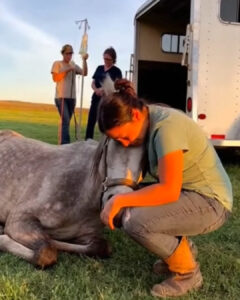
Lena dropped to her knees in the dirt, sliding forward just in time to wedge herself beneath the mare’s heavy head before it struck the ground. The impact knocked the breath from her chest, but she held firm, arms wrapping around Echo’s neck, pressing her face into the mare’s warm hide.
“I’ve got you,” Lena sobbed. “I’ve got you. Easy… easy, girl.”
Echo’s breath came in ragged gasps, chest heaving, eyes wide with panic. This was not the first time she had fallen. In the dark place where she had been kept, falling meant pain. It meant no one came. It meant struggling alone to stand again—or not standing at all.
Her body tensed, muscles quivering, preparing to fight gravity once more.
“No,” Lena whispered firmly, tears soaking into gray hair. “You don’t have to fight. Not here. Not anymore.”
The rescue team moved closer, careful, quiet. IV lines were prepared, hands hovering, ready but waiting. One of the technicians glanced at the monitor, voice tight.
“She’s crashing.”
Lena didn’t move.
She stayed right there in the grass, dirt on her knees, arms locked around Echo’s neck as if letting go might undo everything. She stroked the mare’s cheek, her jaw, her forehead—slow, confident movements meant to anchor her.
“You’re safe now,” Lena murmured over and over. “No more darkness. No more starving. I’m right here.”
Echo’s breathing hitched.
Then something changed.
She let out a long, trembling sigh—the kind that carries pain out with it. Her body softened, weight settling fully into Lena’s arms instead of fighting against them. The tension drained from her muscles inch by inch.
Echo leaned into her.
The team exchanged quiet looks of relief as they moved in, placing IVs, adjusting fluids, monitoring vitals. But Lena remained where she was, her body curved protectively around the mare’s head, her hand never leaving Echo’s neck.
Minutes stretched into an hour.
The sun dipped lower, painting the pasture in amber light. Grass rustled softly in the breeze. Somewhere in the distance, birds called as if nothing extraordinary was happening at all.
But for Echo, everything had changed.
Lena’s breathing slowed deliberately, deep and steady, and Echo’s followed. Their breaths synced—human and horse sharing the same rhythm, the same calm. Every so often, Echo’s eye would flick toward Lena’s face, as if checking that she was still there.
Each time, Lena met her gaze.
“I’m not leaving,” she promised quietly. “I’m right here.”
Her legs went numb from kneeling.
Her arms ached.
Her throat burned from holding back sobs.
She stayed anyway.
Because this was not just a medical crisis. It was a moment of trust. And trust, once broken, only returns when someone proves they will stay.
Gradually, signs of strength returned.
Echo’s breathing deepened.
Her heart rate steadied.
A low, almost inaudible nicker vibrated against Lena’s chest—a sound so soft it felt more like a secret than a voice.
“She’s stabilizing,” one of the team members whispered.
Lena closed her eyes, tears spilling freely now, and rested her forehead against Echo’s neck.
“You’re doing it,” she breathed. “You’re so brave.”
When Echo finally lifted her head on her own, Lena eased back slowly, carefully, as if afraid to break the fragile peace. But Echo didn’t pull away. She stayed lying in the grass, eyes half-closed, body relaxed for the first time since arriving.
This was not a stall.
Not a barn.
Not a cage.
This was open land beneath an open sky.
In the days that followed, Echo’s recovery was slow and uneven. There were setbacks. Weak moments. Times when standing felt impossible. Healing a body starved for months is never simple.
But something essential had already returned.
She had learned that falling did not mean abandonment.
Each day, Lena visited Echo in the pasture. Sometimes she sat beside her. Sometimes she brushed her gently. Sometimes she simply rested a hand on Echo’s neck and breathed with her.
Echo began to walk again—tentative steps at first, then longer ones. She grazed slowly, discovering food that didn’t come with fear. She slept stretched out instead of curled tight.
And always, she watched Lena.
Because the first kindness you receive after cruelty leaves a mark deeper than any scar.
On that first day, when Echo’s legs failed her and she collapsed beneath the weight of everything she had survived, she did not hit the ground alone.
She was caught.
And in that simple, powerful act—knees in the dirt, arms wrapped tight, refusing to let go—her life turned toward healing.
Sometimes rescue doesn’t look like standing strong.
Sometimes it looks like allowing yourself to fall.
And discovering, in that fall, that someone is finally there to hold you.
The fire had been burning for days before the land finally began to give in.
Eucalyptus groves that once whispered in the wind now crackled and collapsed. Creek beds smoldered. The air was thick with ash and the bitter sting of smoke that refused to lift, even after the flames moved on. It was the kind of devastation that didn’t just scorch the earth — it hollowed it out.
Firefighter Marcus hadn’t slept properly in nearly two days.
Soot streaked his face in uneven lines, carving evidence of exhaustion into his skin. His turnout jacket hung heavy on his shoulders, stiff with sweat and smoke, the yellow fabric darkened and torn in places. Every muscle in his body ached with the deep, bone-level fatigue that only comes when adrenaline has carried you far beyond what you thought you could endure.
The worst part, though, wasn’t the exhaustion.
It was the silence that followed the fire.
Marcus moved slowly through what had once been a shallow creek bed, boots sinking into blackened mud still warm beneath the surface. Charred branches lay scattered like fallen bones. The smell of burned fur and vegetation lingered — a smell that firefighters learn to dread because it means life was here, and now it wasn’t.
That was when he saw her.
A kangaroo lay near the edge of the creek, her body still, fur singed and blackened. She had tried to flee — you could tell by the position of her legs — but the fire had been faster.
Marcus stopped.
He had seen this too many times over the past days. Too many animals lost, too many bodies left behind when the flames passed through faster than anything could run. He bowed his head for a moment, a quiet, instinctive gesture of respect.
Then something made him look again.
A twitch.
So small it could have been his imagination. Just the faintest movement near the kangaroo’s abdomen.
Marcus’s breath caught.
“No…” he whispered, stepping closer.
He knelt carefully beside her, heart pounding now, the exhaustion pushed suddenly to the side. With hands that had carried hoses, axes, and stretchers all week, he reached toward the pouch with a gentleness that felt almost foreign in a disaster zone.
Inside, hidden from the fire by the body that had failed to save her, was a baby kangaroo.
A joey.
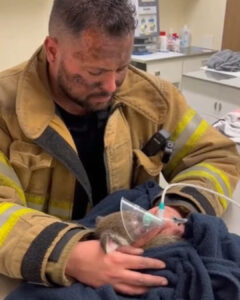
She was impossibly small — no bigger than Marcus’s palm. Her eyes were squeezed shut, her skin pink beneath sparse fur, her tiny chest fluttering in shallow, panicked gasps that sounded more like whispers than breaths. Smoke had filled the air for hours. Every breath she took was a struggle.
“Oh, hey… hey, little one,” Marcus murmured, his voice cracking.
He didn’t think about the rules. He didn’t call for instructions. He didn’t hesitate.
He unshouldered his pack and pulled out his spare blanket — the one he’d meant to use if he got caught overnight again. He wrapped the joey gently, shielding her from the ash-filled air, and pressed her instinctively against his chest.
Her tiny paws curled weakly into the fabric of his jacket.
She was alive.
Barely.
Marcus stood and ran.
Back toward the fire truck, boots slipping on ash and mud, lungs burning as he pushed his exhausted body harder than it wanted to go. Other firefighters shouted after him, confused, but one look at his face told them not to slow him down.
“Clinic,” he said breathlessly once he reached the radio. “I’ve got a live joey. Smoke inhalation. She’s bad.”
The ride to the veterinary clinic felt endless.
Marcus sat hunched in the back of the truck, helmet forgotten on the floor, arms wrapped tightly around the small, fragile bundle rising and falling unevenly against his chest. He counted her breaths out loud without realizing it. One. Two. Three. Don’t stop.
“Easy,” he whispered, lowering his forehead until it nearly touched the blanket. “You stay with me. Just breathe.”
The joey made a faint sound — a tiny whimper that barely registered over the engine — but it was enough to make his throat close.
At the clinic, vets and technicians swarmed the moment he burst through the door. Oxygen masks appeared. Monitors beeped to life. Hands reached for the joey, but Marcus hesitated for half a second longer than necessary.
“She’s all I’ve got left,” he said quietly, voice thick with ash and emotion.
“We’ve got her,” a vet replied gently.
Marcus let go.
He stayed anyway.
He stood by the table as the oxygen mask was fitted over the joey’s tiny snout, his heavy gear still on, ash smearing the clean clinic floor. No one told him to leave. No one asked him to change. They could see it in his eyes — he wasn’t going anywhere.
“Come on, little one,” Marcus whispered, resting a soot-stained finger lightly against her back. “I’ve got you. I’m right here.”
The joey’s breathing was erratic at first. Too fast. Too shallow. Her tiny chest struggled beneath the mask, each breath a fight against smoke-filled lungs that had never been meant to inhale fire.
Minutes stretched.
Then — slowly — something changed.
Her breathing deepened. Just a little. The frantic flutter eased into a more regular rhythm. Her tiny paws relaxed their grip on the blanket, unclenching for the first time since Marcus had found her.
“There,” he murmured, barely daring to breathe himself. “That’s it. You’re doing it.”
The fire crew had long since gone back out. The clinic lights dimmed as night settled in. But Marcus stayed planted beside the table, helmet at his feet, jacket still on his shoulders, eyes fixed on the rise and fall of a chest no bigger than his thumb.
Hours passed.
The vet finally spoke softly. “She’s stable. Weak, but stable.”
Marcus nodded, a silent acknowledgement, tears cutting clean paths through the soot on his face.
He sank into a chair but never took his hand away from the joey’s back.
“You’re safe now,” he whispered again, the same words he’d spoken to terrified families and stranded animals all week. “You’re not alone.”
In the quiet of the clinic, far from the roar of flames and collapsing trees, a firefighter who had spent days battling destruction did something just as important as any line he’d held.
He stayed.
He watched every breath.
He listened to every faint sound.
He refused to leave.
Because sometimes, saving a life doesn’t look like charging into fire.
Sometimes it looks like kneeling in ash.
Noticing a twitch where there shouldn’t be one.
And holding on — long after everyone else has gone home — until someone small and fragile remembers how to breathe again.