A Light That Walked Gently Among Elephants. – Daily News
On the night of January 3rd, 2026, the moon rose full and luminous over Kenya, casting a pale silver glow across the earth. It was the kind of moon that makes the world feel hushed, as if everything living knows to slow down and listen. In that quiet light, with her family gathered close, Kirsty van Zeller — née Smith — slipped gently from this world after a courageous battle with cancer.

She was far too young.
And she was everything.
To say that Kirsty was part of the Sheldrick Wildlife Trust is not enough. To know the Trust was to know Kirsty. For ten years, she stood at its heart — often unseen, often unnamed, but always essential. She did not seek the spotlight. She preferred to work quietly, deliberately, ensuring that everything and everyone around her was cared for, understood, and valued.
She was Angela’s right hand, a steady presence in moments of pressure and growth, helping shape the organisation into what it is today. Systems, relationships, stories — Kirsty touched them all. She built bridges between people and elephants, between distant hearts and the fragile lives they sought to protect.
If you ever visited the Nursery, you likely met her.

Perhaps she greeted you with that unmistakable warmth — a smile that felt like an invitation, a voice that made you feel immediately at ease. If you reached out to the Trust with a question or a concern, there is a good chance Kirsty was the one who answered. If you followed the Nursery livestreams from thousands of miles away, you almost certainly heard her voice — calm, welcoming, full of quiet joy.
Even through a screen, she had a way of making people feel seen.
But it was with animals that Kirsty’s essence shone most clearly.
She saw brilliance in all of earth’s creatures — not just the charismatic, not just the vulnerable, but every life, large or small. To her, each being was worthy of respect and attention. That belief wasn’t philosophical. It was lived.
At the Nursery, orphaned elephants were drawn to her as if by instinct. They would gather beside her, legs folded awkwardly beneath massive bodies, eyes closed in deep trust as they suckled gently on her finger. In her presence, animals relaxed. They softened. They felt safe.
It wasn’t magic.
It was kindness without agenda.

Kirsty moved through the world with a rare completeness — as if she understood something fundamental about life that many of us spend decades trying to learn. She listened more than she spoke. She noticed what others missed. She gave her energy freely, without calculation, without keeping score.
Wherever she stood, there was a quiet halo of life around her.
And yet, Kirsty was not only a conservationist, not only a protector of elephants. She was, above all else, a mother.
A loving wife.
A cherished sister.
A daughter and granddaughter.
A steadfast friend.

She fought valiantly for time — not for herself, but for her daughter, who is only three years old. There is no way to make sense of a loss like that. No language that can reconcile a child growing up with stories where there should have been memories still being made.
And yet, even here, Kirsty left something enduring.
She leaves her daughter a legacy of love so vast it will echo for a lifetime. A legacy written not just in words or photographs, but in the way the world responded to her mother — in the elephants who lived because of her work, in the people who learned compassion through her voice, in the countless lives she touched without ever knowing their names.
Kirsty often reflected on the words of naturalist Henry Beston, who wrote that animals are not lesser beings, but “other nations, caught with ourselves in the net of life and time, fellow prisoners of the splendour and travail of the earth.”
She lived those words.
She moved through the world as if she understood that life is not something to dominate or rush past, but something to witness and protect. She lived by voices we may never hear, by instincts we have forgotten how to trust. And in doing so, she reminded others what it means to be fully human.
Her illness did not define her final years. Courage did. Grace did. Even as her body weakened, her spirit remained intact — generous, attentive, luminous. She continued to give, to connect, to care.
Those who loved her speak not only of grief, but of gratitude.

Gratitude for knowing her.
For learning from her.
For standing beside her.
The loss feels impossible because she was irreplaceable. But the imprint she left is everywhere — in the Trust she helped build, in the elephants who leaned into her calm, in the people across the world who felt less alone because of a woman they may never have met.
On that moonlit night, as she left this world, the earth did not lose her entirely.
She remains in the quiet moments at the Nursery.
In the way elephants still seek gentleness.
In the voices of those who speak about conservation with compassion rather than urgency alone.
In a child who will grow up knowing her mother mattered deeply — not just to her family, but to the world.
We will miss her terribly.
But we are so very blessed to have known her.
Rest softly, Kirsty.
You were pure gold.
The lake looked peaceful that morning.
A wide, frozen sheet stretched across the land, pale and still beneath a winter sky. From a distance, it seemed solid—quiet, harmless, almost inviting. But winter has a way of disguising danger, and beneath the smooth surface, the ice was thin, fragile, waiting for a single wrong step.
Gunther and Wilhelm never meant to test it.
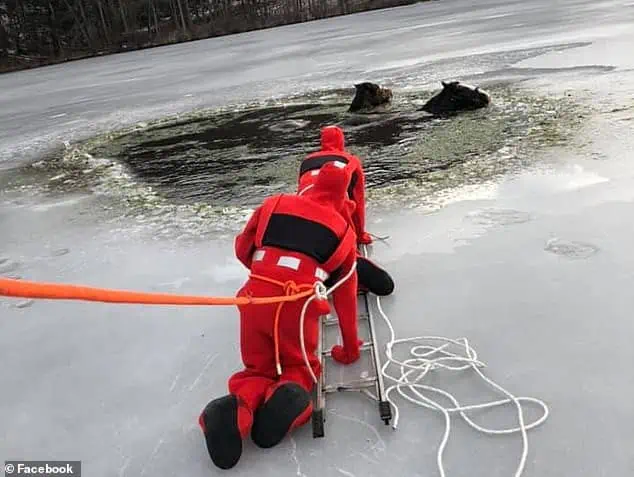
The two Clydesdales—both 15 years old, both massive and gentle—had wandered from the familiar safety of their pasture. Known at their farm for curiosity and a mischievous streak, they slipped past fencing and followed instinct rather than caution. Somewhere along the way, the open expanse of the frozen lake caught their attention.
Horses do not understand ice.
They don’t recognize the difference between solid ground and a surface that only pretends to be. To them, it looks like land.
The moment the ice gave way, there was no time to react.
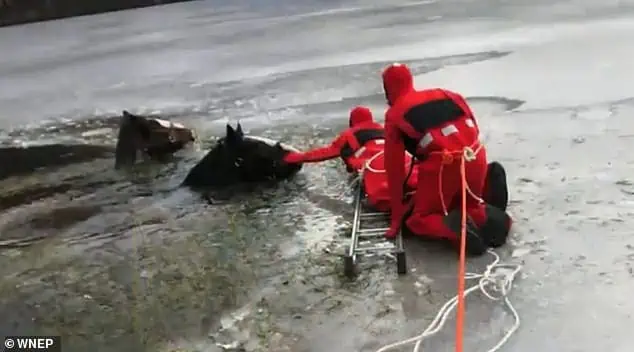
With a cracking sound that echoed across the lake, the surface collapsed beneath their weight. One second they were standing. The next, they were plunging into freezing water, legs flailing as the shock stole their breath.
The cold was instant and brutal.

Water rushed around their massive bodies, soaking their thick coats, dragging heat away faster than they could fight it. Their size—usually a symbol of strength—worked against them now. Each movement fractured more ice, widening the hole, making escape impossible.
They struggled to keep their heads above water.
Their breath came in panicked bursts, steam rising from their nostrils as the icy lake tightened its grip. Time was no longer measured in minutes, but in heartbeats.
Someone saw them.
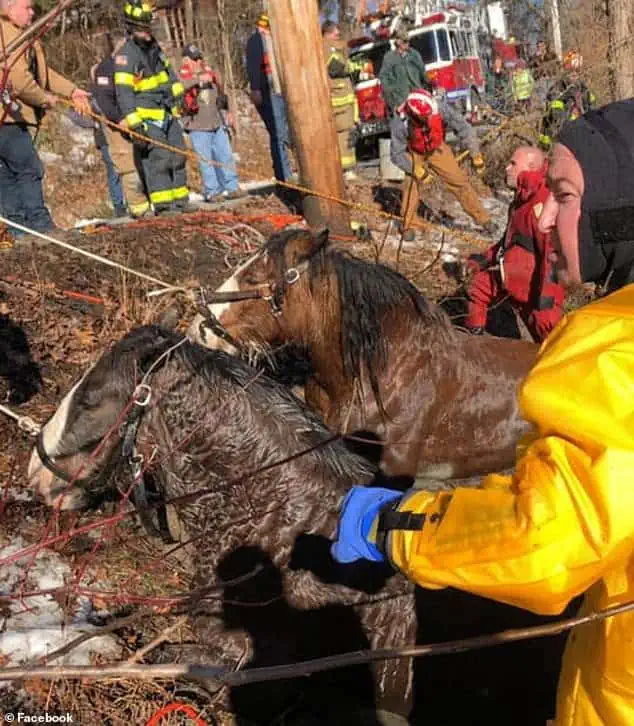
The call went out quickly, and within moments, sirens cut through the winter air. Firefighters from the Blue Ridge Hook and Ladder Fire Company arrived to a sight few of them would ever forget: two enormous horses trapped in a jagged hole in the ice, eyes wide, bodies trembling, fighting not to sink.
There was no simple solution.
Gunther and Wilhelm were too heavy to lift. Too weak from cold to swim free. Too frightened to be easily guided. Any wrong move could push them under—or break more ice beneath the rescuers themselves.
The lake had become a trap.
Firefighters moved carefully, spreading their weight, testing each step. They brought boats, ropes, chainsaws—tools meant for emergencies, but not for something like this. Not for saving two thousand-pound animals from a frozen lake.
Fire Chief Leon Clapper looked at the scene and made a hard call.
“We can’t pull them out,” he said. “And we can’t lift them.”
There would be no dramatic hoisting. No quick extraction.
Instead, they would have to give the horses a way out.
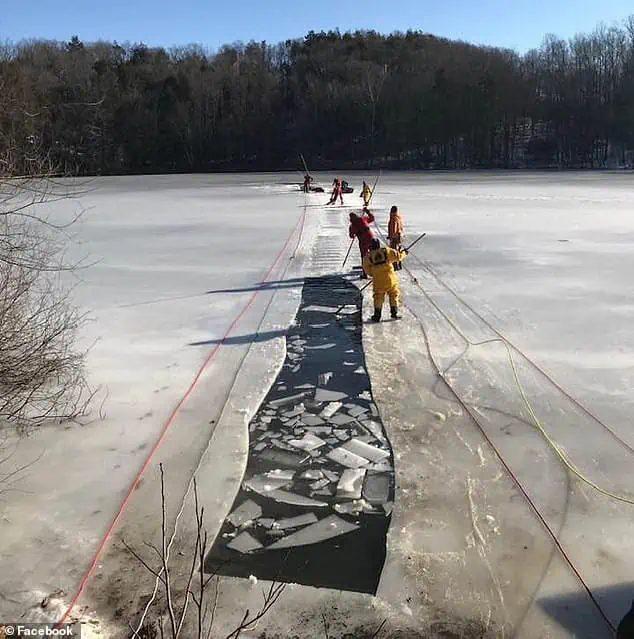
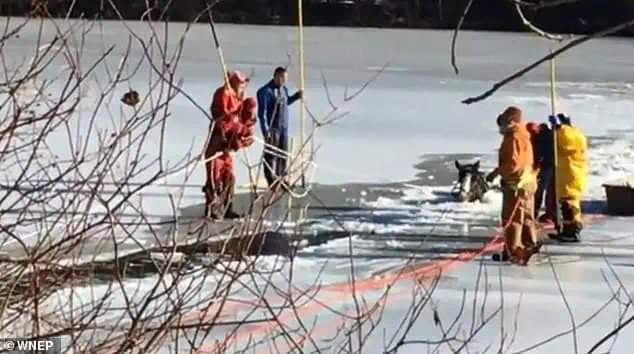
The plan was risky and exhausting: cut a trench through the ice, a narrow channel leading from the hole back to shore. A path the horses could follow—slowly, carefully—guided step by step out of the water.
Chainsaws roared to life.
Firefighters worked shoulder to shoulder, carving through thick ice as freezing spray soaked their gear. Every cut had to be precise. Too wide, and the ice would collapse. Too narrow, and the horses wouldn’t fit. All the while, Gunther and Wilhelm waited, their strength draining, their bodies shuddering uncontrollably.
People gathered along the shore, watching in silence.
Some had lived there their entire lives and had never seen anything like this. A lake that had always been quiet now held the weight of fear, hope, and an impossible rescue unfolding in real time.
When the trench was finally cut, the hardest part remained.
The horses had to move.
Firefighters reached the edge of the water, speaking softly, voices low and steady. Horses respond to tone, to calm more than command. Gunther shifted first, hooves scraping against ice, muscles trembling as he tried to find footing.
Wilhelm followed, slower, weaker, his head dipping dangerously low.

“Easy… easy…”
The trench worked.
Inch by inch, the horses were guided forward. Every step forward was a victory. Every pause sent hearts racing. The water dragged at their legs, refusing to let go, but the solid edge of shore drew closer.
And then—finally—Gunther’s front hooves found land.
He collapsed forward, legs buckling, chest heaving as firefighters rushed in to steady him. Wilhelm followed moments later, stumbling onto the shore, soaked, shaking, alive.
The crowd exhaled.
Blankets appeared. Heat lamps. Veterinarians and farm staff moved quickly, wrapping the horses, rubbing circulation back into their limbs, checking for injuries that cold water often hides until it’s too late.
Miraculously, there were none.
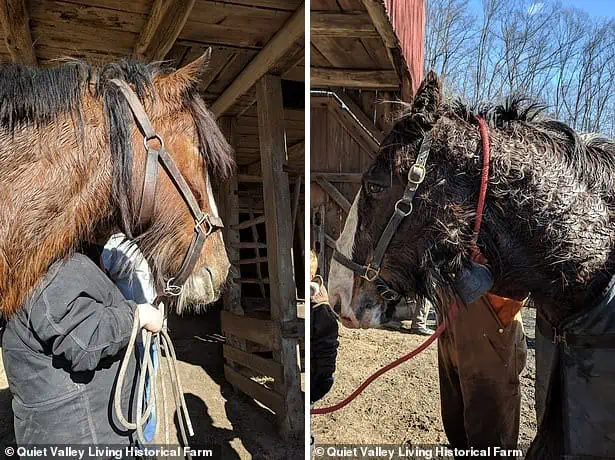
No broken bones. No lasting damage. Just exhaustion, shock, and the deep, bone-rattling cold of an ordeal they had no words to describe.
As Gunther and Wilhelm stood there—massive, dripping, shivering—they looked nothing like the powerful workhorses people admired. They looked small. Vulnerable. Like survivors.
Community members stayed, helping however they could. Someone brought extra blankets. Someone else fetched heaters. Knowledge was shared, hands were offered, and no one left until the horses were stable.
“It was a true team effort,” Chief Clapper later said. And it was.
Firefighters. Veterinarians. Neighbors. Strangers.
All moving with one purpose.
Back at the farm, updates were shared quickly. Gunther and Wilhelm were recovering. Eating. Standing. Slowly warming back into themselves. Their caretakers joked that the two “little Houdinis” had once again proven their talent for mischief—but behind the humor was relief that words couldn’t fully carry.
Plans were made to reinforce fencing. To prevent another escape. To make sure curiosity wouldn’t lead them back into danger.
But for one long winter day, the world paused.
It paused for two horses who fell through ice.
For firefighters who refused to give up.
For a community that came together when something living needed help.
Gunther and Wilhelm didn’t understand why the ice broke.
They didn’t know what chainsaws or trenches were.
They didn’t know how close they came to never leaving that lake.
They only knew the cold.
The fear.
And then—hands guiding them home.
Sometimes heroism isn’t loud.
Sometimes it’s chainsaws cutting a path through ice.
Sometimes it’s calm voices in freezing air.
Sometimes it’s refusing to accept that something too big, too heavy, too difficult cannot be saved.
And sometimes, it’s two brave Clydesdales stepping back onto land, reminding everyone watching that even in winter’s grip, compassion can carve a way out.