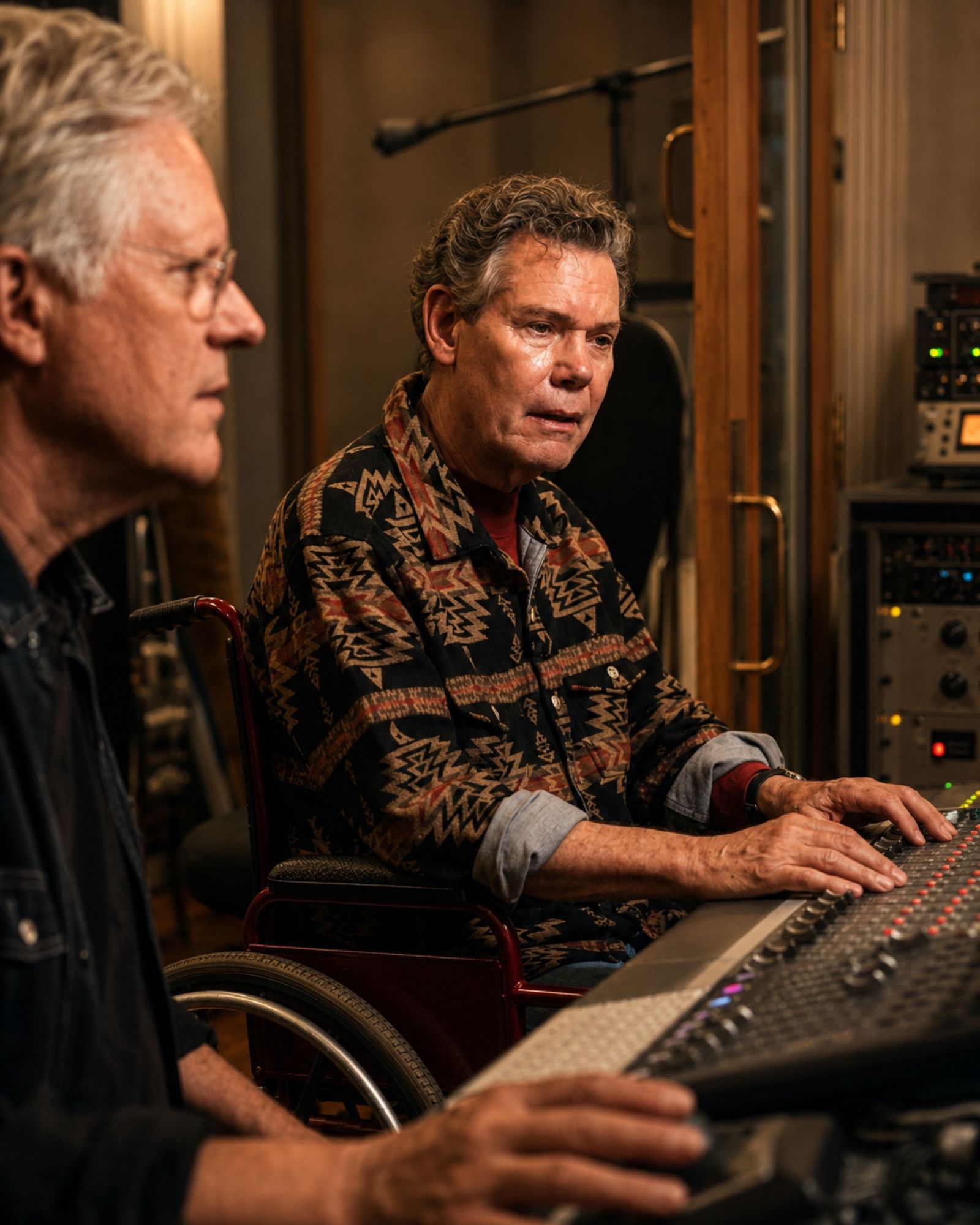
THE VOICE AI BROUGHT BACK WAS RANDY TRAVIS’S — BUT THE MAN LISTENING TO IT WASN’T THE SAME MAN ANYMORE. In 2012, Randy Travis was everywhere for the wrong reason. A crash on a Texas highway. A mugshot. A night so public and painful it looked like the bottom of a life that had once carried one of country music’s purest voices. Then 2013 nearly took the rest. A massive stroke left him fighting to survive. It damaged his speech, stole much of his ability to sing, and turned the voice behind “Forever and Ever, Amen” into something he could mostly hear only in memory. For years, Randy could sit beside his songs. He could feel the words. He could mouth along. But the sound that once filled arenas was trapped somewhere his body could no longer reach. Then in 2024, with his wife Mary’s blessing and his longtime team guiding it, AI helped build a new Randy Travis recording from the voice he had left behind. When “Where That Came From” played, it wasn’t just technology. It was a man meeting the ghost of his own gift — and realizing some parts of us can be lost, and still find their way back through a song. – Country Music
In country music, some voices feel less like performances and more like home. Randy Travis has always been one of those voices. Smooth, deep, calm, and honest, it carried heartbreak and hope with the same steady grace. For decades, fans knew him as the man behind songs like Forever and Ever, Amen, a singer whose sound seemed built to last forever.
But life changed suddenly. In 2012, Randy Travis was in the public eye for all the wrong reasons after a crash on a Texas highway and a night that became a painful headline. Then, in 2013, a massive stroke nearly took everything else. It left him fighting to survive, and it damaged the very thing that had defined so much of his life: his voice.
For a singer, losing the ability to sing is not just a career setback. It is a personal silence. Randy Travis could still hear the songs in his mind, and he could still feel their meaning, but the instrument that once gave those songs life was no longer fully his to command. The voice that had filled arenas and touched millions became something he could mostly only remember.
A Silence That Lasted for Years
After the stroke, Randy Travis faced a long road of recovery. The world knew him as a star, but the private reality was much harder. Simple communication became a challenge. Singing, once effortless and natural, became something far more complicated and fragile. Even so, Randy Travis did not disappear. He remained present, resilient, and deeply connected to the music that made him legendary.
That connection mattered. It kept his story alive in a different way. Fans never stopped listening, and the songs never stopped meaning something. Yet there was always the quiet ache of what had been lost. Randy Travis had become a living reminder that talent is powerful, but the body can change the terms without warning.
Then Came the Song That Changed Everything
In 2024, something remarkable happened. With Mary Travis’s blessing and the support of longtime collaborators, AI was used to help create a new Randy Travis recording from the voice he had left behind. The result was Where That Came From, a song that did not feel like a trick or a gimmick. It felt intimate, careful, and deeply emotional.
The goal was not to erase what had happened. It was not to pretend time had stood still. Instead, the project reached back through archives, memories, and sound, and gently rebuilt a voice that fans knew by heart. When the song played, people did not only hear technology. They heard the presence of Randy Travis returning in a form that felt both familiar and impossible.
Where That Came From was more than a recording. It was a moment that made listeners stop, listen, and remember how much one voice can matter.
The Man Listening Was Different, Too
What made the moment so powerful was not only the sound. It was the man hearing it.
Randy Travis was not the same person who once stood at the center of country radio without effort. He had lived through public mistakes, a frightening medical crisis, and years of rebuilding life in a new way. The man who listened to the finished song had been shaped by loss, patience, and survival. He was older, quieter, and more aware of what can vanish in an instant.
That is what made the song so moving. It was not simply Randy Travis hearing Randy Travis again. It was a man meeting the echo of his own gift after years of silence, and understanding how much of himself had changed along the way.
Why It Hit So Hard
People responded because the story felt bigger than one artist. It touched on memory, identity, and the strange power of technology to restore something that once seemed gone forever. For longtime fans, the song was emotional because it brought back a beloved sound. For others, it raised a deeper question: what happens when a voice outlives the body that gave it life?
In Randy Travis’s case, the answer was not cold or mechanical. It was human. The song carried history, trust, and care. It honored the life behind the voice instead of trying to replace it.
And maybe that is why Where That Came From meant so much. It reminded people that some losses do not end the story. Sometimes they change the shape of it. Sometimes they return as memory, as courage, or as a song that sounds like the past but lands in the present with new force.
A Lasting Kind of Miracle
Randy Travis’s voice was brought back by AI, but what listeners really heard was something deeper than a technical achievement. They heard legacy. They heard resilience. They heard a life that had been interrupted, then reframed, then offered back in a new and astonishing way.
And the man listening was not the same man anymore. He had been tested by pain, humbled by time, and carried forward by love and faith. That is what made the moment unforgettable. It was not about going backward. It was about finding a way to stand inside the loss and still sing, even if the song arrived from somewhere new.
For Randy Travis, the voice may have returned through technology. But for everyone who listened, the feeling was unmistakably real.
Post navigation
Don Williams never sounded like he was trying to win a room. He sounded like he was trying to keep it calm. In an era when many stars leaned hard into big gestures and louder performances, Don Williams moved in the opposite direction. He sang with ease, restraint, and a kind of quiet certainty that made people lean in instead of back away.
That was the magic of Don Williams. He did not need to prove that he belonged on stage. He already carried himself like someone who understood what mattered. Before the fame, before the awards, before the songs became part of everyday life for millions of listeners, Don Williams had something rare: a steady presence. It was not flashy. It was not built for headlines. But it was deeply memorable.
The Gentle Giant Arrives
When people call Don Williams the Gentle Giant of country music, the nickname fits because it captures both sides of his appeal. He was physically imposing, but his music was warm and unhurried. He did not push emotion at listeners. He let emotion settle naturally, like dust after a long drive home. That calm delivery became his signature, and it made his songs feel honest in a way that could not be manufactured.
Don Williams sang as if he trusted the listener. He never rushed a line. He never crowded a melody. He allowed space to do its work, and that space gave his songs room to breathe. In a culture that often rewards louder and faster, Don Williams reminded people that gentleness can be powerful too.
Songs That Felt Like Real Life
Part of Don Williams’ lasting appeal comes from the way his songs felt lived-in. “Tulsa Time” had an easy confidence that made it feel like a friend telling a story over coffee. “I Believe in You” carried a message that was simple but deeply reassuring. “Good Ole Boys Like Me” looked back on youth with honesty, humor, and just enough regret to feel true. “Lord, I Hope This Day Is Good” reached for peace in a way almost anyone could understand.
These were not just songs to sing along with. They were songs to return to. They felt like familiar places. A listener could hear Don Williams and think of a porch light glowing after dark, a truck parked outside a country store, or a kitchen table after dinner when the noise of the day finally fades. His music had that effect because it never pretended to be bigger than life. It simply reflected life back with kindness.
Don Williams made country music feel safe without making it small.
Why His Voice Mattered So Much
Don Williams did not sing like a man chasing the spotlight. He sang like a man who had already figured out that attention is not the same thing as meaning. His voice was deep, smooth, and calm, but it was never cold. It had patience in it. It had trust in it. It sounded like someone who had seen enough of life to know that not every feeling needs to be shouted.
That is why his music connected across generations. Older listeners heard truth in it. Younger listeners found comfort in it. Even people who did not know every lyric could recognize the mood instantly. Don Williams created a space where worry eased up for a moment. His songs did not erase pain, but they made room for hope.
A Style That Never Went Out of Date
There was something timeless about the way Don Williams carried himself and the way he recorded a song. He did not chase trends. He did not need to reinvent himself constantly to stay relevant. Instead, he stayed true to a sound that valued melody, clarity, and sincerity. That choice gave him longevity because honesty does not age quickly.
People came to Don Williams not because he was loud, but because he was dependable. His music offered a kind of emotional shelter. In times of joy, it felt like company. In times of sadness, it felt like understanding. In times of uncertainty, it felt like a hand on the shoulder saying everything will be all right.
The Quiet Legacy
Don Williams left behind more than hit records. He left behind a standard for what it means to sing with dignity. He showed that a country song does not need to shout to be unforgettable. It can whisper and still reach the farthest parts of a person’s heart.
That is why Don Williams is still remembered with such affection. He gave people something sturdy in a world that often feels rushed and noisy. He was a reminder that calm can be beautiful, that kindness can be strong, and that a voice does not have to fight for attention to be impossible to forget.
Don Williams sounded like a porch light left on. Warm. Steady. Waiting. And for millions of listeners, that was exactly what they needed.