HE TOLD HIS DRUMMER TO PLAY WITHOUT STICKS — ON LIVE NATIONAL TELEVISION. 1994 ACM Awards. Millions watching. Alan Jackson was told his band had to play to a pre-recorded track. In other words — fake it. Most artists would’ve smiled and gone along. Jackson didn’t. He walked out in a Hank Williams t-shirt instead of a tuxedo. Then told his drummer Bruce Rutherford: go up there, swing your arms — but don’t bring your sticks. On national television. A drummer going through the motions with empty hands while a perfect studio track played underneath. When host Dick Clark asked about the t-shirt, Jackson just smiled: “I love Hank. Hank’s country.” He never mentioned the drummer. Never explained. Just let the truth sit in plain sight and waited for people to notice. The ACM never addressed it. The producers hoped nobody saw. But 30 years later, people are still talking about the night Alan Jackson exposed the machine — without saying a single word. One YouTube comment put it best: “One of the most gangster moments ever.” Was it disrespect — or the most honest thing anyone’s ever done at an awards show? – Country Music
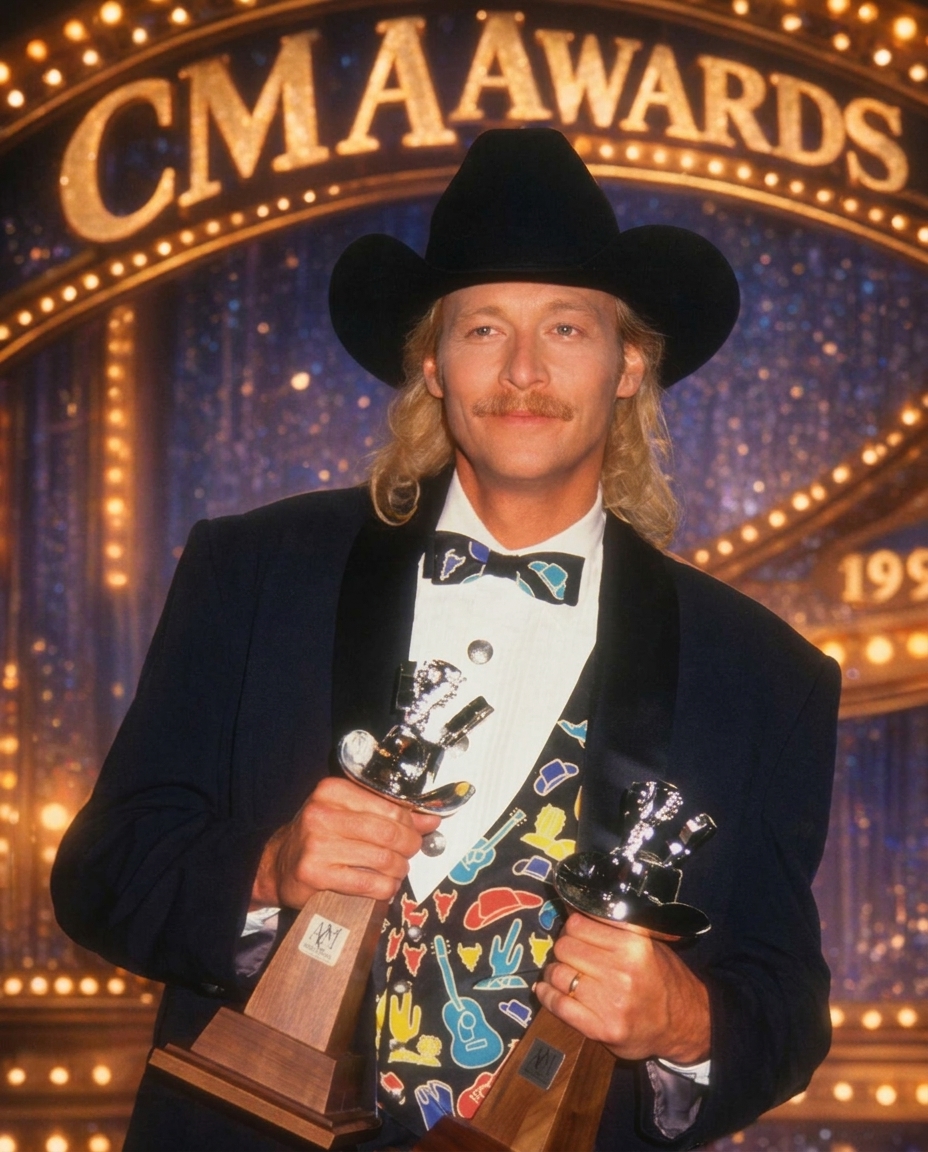
THE NIGHT ALAN JACKSON MADE A SILENT STATEMENT ON LIVE TELEVISION
It was supposed to be just another polished moment in country music history. The 1994 ACM Awards promised everything audiences expected—bright lights, big names, and perfectly choreographed performances designed for millions watching at home.
But that night didn’t go exactly as planned.
Behind the scenes, something had changed. Alan Jackson and his band were told they wouldn’t be performing live in the traditional sense. Instead, they would play along to a pre-recorded track. The music would sound flawless. Every note would be controlled. Every second predictable.
For many artists, that was simply part of the job.
For Alan Jackson, it was something else entirely.
A Quiet Decision Before the Spotlight
Alan Jackson had built a career on authenticity. His music wasn’t about spectacle—it was about truth, simplicity, and staying connected to the roots of country music. So when the request came to “play along” instead of truly perform, it didn’t sit right.
There was no public protest. No backstage argument that made headlines. Just a quiet decision.
Instead of resisting loudly, Alan Jackson chose a different path—one that would say everything without saying a word.
A Performance That Looked Normal… Until It Didn’t
When Alan Jackson stepped onto the stage, nothing seemed out of place at first glance. The cameras rolled. The audience watched. The music began.
But then, something subtle—and strange—started to unfold.
Behind Alan Jackson, drummer Bruce Rutherford lifted his arms and moved in rhythm with the music… without holding any drumsticks.
No sticks. No sound coming from his hands. Just the motion.
To casual viewers, it may have passed unnoticed. But for those paying close attention, it was impossible to ignore.
It was a quiet contradiction playing out in real time: a “live” performance where one of the band members wasn’t actually playing at all.
As if that subtle message wasn’t enough, Alan Jackson made another choice that raised eyebrows.
Instead of wearing a formal tuxedo, Alan Jackson walked on stage in a simple Hank Williams t-shirt.
At an event known for its polished image, the decision stood out immediately.
Later, when host Dick Clark asked about the outfit, Alan Jackson’s answer was simple and direct:
“I love Hank. Hank’s country.”
No explanation. No deeper commentary. Just a statement that seemed small—but carried weight.
What Was Really Being Said?
Alan Jackson never publicly criticized the show. He never called out the producers. He never explained the drummer’s missing sticks.
He didn’t need to.
The message was already there, hidden in plain sight.
By allowing the illusion to continue—but making it just imperfect enough to notice—Alan Jackson turned the moment into something far more powerful than a protest.
It became a question.
What does it mean to perform? What does it mean to be real on a stage built for perfection?
A Moment That Refused to Fade
The broadcast ended. The awards moved on. And officially, nothing unusual had happened.
There were no statements. No apologies. No follow-up explanations.
But the moment didn’t disappear.
Over the years, viewers began to revisit the performance. Clips resurfaced. Conversations grew. What once seemed like a small detail became something people couldn’t stop talking about.
Decades later, that quiet act still resonates.
Not because it was loud—but because it wasn’t.
Disrespect… or Honesty?
Some saw it as defiance. Others saw it as integrity.
Was Alan Jackson challenging the system—or simply reminding people what music is supposed to be?
There’s no single answer. And maybe that’s the point.
In an industry built on performance, Alan Jackson found a way to reveal the truth without breaking the rules outright. He didn’t stop the show. He didn’t refuse to appear.
He just let people see what was already there.
And sometimes, that kind of honesty speaks louder than anything else.
Thirty years later, the question still lingers—quiet, unresolved, and impossible to ignore.
Was it disrespect… or was it one of the most honest moments ever shown on an awards stage?
Post navigation
Branson, Missouri, in the mid-1990s was a town built on live music, loyal crowds, and the kind of tradition that asked performers to earn every applause. Night after night, fans filled Charley Pride’s theater because they knew exactly what they were coming for: a steady voice, timeless songs, and the calm confidence of an artist who had already become part of country music history.
Then, just before three sold-out December shows, everything changed.
Charley Pride had surgery and could not perform. For most artists, that kind of setback would have meant cancellations, refunds, and disappointed fans driving home early. But Charley Pride made a different choice. Instead of bringing in a famous guest or searching for a safe substitute from Nashville, Charley Pride picked someone much closer to home.
Charley Pride called his son, Dion Pride.
A Famous Last Name Can Open a Door — But It Cannot Hold a Crowd
It sounded simple on paper. Dion Pride would step in for three nights while Charley Pride recovered. But nothing about it was simple once the theater lights came up.
These were not small club dates. These were sold-out performances in a venue carrying Charley Pride’s name, filled with people who had come expecting the man himself. The audience was not there to witness an experiment. They were there for the star they had trusted for years.
Even Charley Pride seemed to understand the weight of that moment. With the dry humor that made him so relatable, Charley Pride reportedly joked that Dion Pride “may have bitten off more than he could chew.” It was the kind of line that made people smile, but underneath it was something real. Everyone knew the challenge was enormous.
Dion Pride walked into that challenge carrying two things: a guitar and a last name heavy enough to make some performers freeze before the first note.
Dion Pride Did Not Try to Copy Charley Pride
That may have been the most important part of the story.
Dion Pride did not walk onstage trying to imitate Charley Pride. He did not chase his father’s phrasing, his timing, or the exact shape of his presence. That would have been the fastest way to lose the room. Instead, Dion Pride did something harder and more honest. Dion Pride played as himself.
There is something brave about that, especially in country music, where legacy can be both a blessing and a burden. Audiences can be generous, but they can also hear the difference between confidence and costume. Dion Pride seemed to understand that the only way through those three nights was not to borrow Charley Pride’s identity, but to stand firmly in his own.
And little by little, that choice began to work.
The crowd listened. Then the crowd leaned in. Then the crowd responded.
What might have begun as curiosity quickly became respect.
Branson Started Talking
Word travels fast in a music town, especially when expectations are high and the outcome is uncertain. In Branson, people noticed. Local media noticed too. What could have been remembered as a temporary emergency started to feel like something more meaningful: a young artist proving he belonged in the room, even if the room first knew him because of his father.
That kind of moment cannot be manufactured. It has to happen live, with real nerves, real pressure, and real songs.
By the second and third night, the story had already started spreading beyond the theater walls. Dion Pride was no longer just “Charley Pride’s son filling in.” Dion Pride was becoming the reason some people were suddenly paying closer attention.
The hardest stage to earn is not always the biggest one. Sometimes it is the one already owned by your family name.
What Did Charley Pride Feel Watching From Home?
That question lingers because it feels bigger than show business.
What does a father feel when he cannot take the stage himself, but sees his son step into the silence and hold it together? Maybe there was relief. Maybe there was pride in the deepest sense of the word. Maybe Charley Pride sat at home smiling at the thought that Dion Pride had not tried to become a copy, but had found the courage to become himself in front of an audience that had every reason to be demanding.
Charley Pride had spent a lifetime earning respect. He knew better than anyone that applause can be given politely for a moment, but only honesty can keep it coming back. That December in Branson, Dion Pride seems to have discovered exactly that.
Three nights. A sold-out theater. A father recovering from surgery. A son asked to stand where a legend usually stood.
It could have been a nervous footnote in the story of Charley Pride. Instead, it became something warmer and more lasting — a reminder that legacy is not only about inheriting a name. It is about meeting the moment when that name is no longer enough.
And somewhere behind the curtain, even from home, Charley Pride likely knew what those crowds were finally learning for themselves: Dion Pride had earned his place the hard way.