When the Ice Gave Way, They Went In After Him. – Daily News
The morning began like so many others in northern New York—quiet, pale, and cold enough to sting the lungs with every breath.
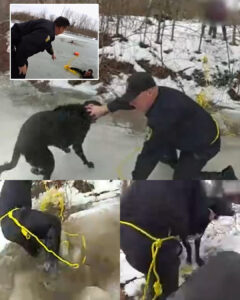
A woman took her Labrador mix for a walk, bundled against the January chill, the world around them frozen into stillness. The canal beside the path looked solid, sealed over by a smooth sheet of ice that reflected the dull winter sky. It looked safe. It looked finished.
It wasn’t.
The dog stepped closer, curious, tail lifting slightly as his paws tested the edge. The ice cracked without warning—sharp, sudden, violent. In an instant, the surface gave way and the dog disappeared beneath it, plunging into dark, freezing water.
The sound that followed was not a splash.
It was panic.
The woman screamed his name and ran forward without thinking. She dropped to her knees, reaching, slipping—and then she was gone too, swallowed by the canal as the ice shattered around her.
The cold was instant and brutal. It stole breath, strength, thought. She fought her way back toward the edge, hands numb, muscles locking as she struggled not to sink. Nearby residents heard the screams and ran for help. Someone called 911. Someone else ran to the fire department.
By the time officers from the Little Falls Police and Fire Departments arrived, they managed to pull the woman from the canal—soaked, shaking, but alive.
Her dog was still in the water.
He paddled frantically, claws scraping uselessly at broken ice, his head barely above the surface. Each breath came harder than the last. The cold was already winning.
State police troopers arrived moments later, sirens cutting through the winter silence. Among them was Trooper Michael Szarek.
He didn’t need the details explained twice.
The dog was drowning.
On his body camera, the scene unfolds in raw urgency—cracked ice, dark water, responders shouting instructions that barely register over adrenaline. Szarek grabbed a water rescue rope and dropped to the edge of the canal, lying flat to distribute his weight.
“Easy, buddy,” he called out, voice steady despite the chaos. “I’ve got you.”
He threw the rope again and again, trying to loop it around the dog’s chest, his neck—anything. But the current tugged. The ice shifted. The dog panicked, eyes wide, legs thrashing as exhaustion set in.
The rope missed.
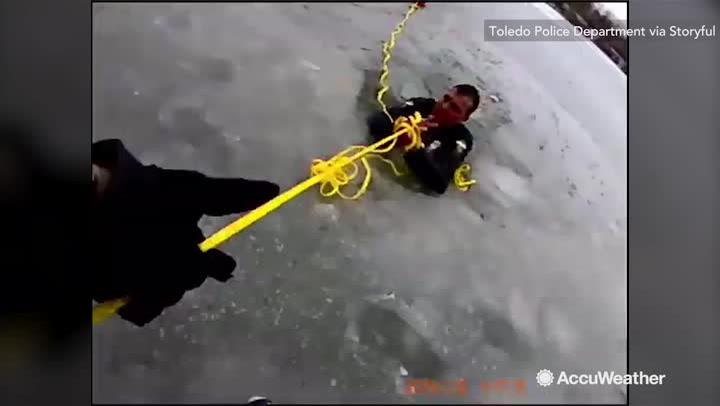
Again.
The dog slipped lower.
Szarek didn’t hesitate.
He handed the rope back, stripped off his heavier gear, and looked at the trooper beside him. There was no discussion. No debate. Just a shared understanding that time was gone.
They went into the water.
The shock of the cold was violent, like a blow to the chest. It stole breath, burned skin, locked joints. The canal was deeper than it looked, the edges unstable, ice cracking and breaking as they moved.
They fought their way forward, arms numb, boots heavy with water. The dog barely had strength left to paddle when Szarek reached him. He grabbed fur and skin, fingers digging in as the dog whimpered weakly, collapsing into the first solid hold he’d felt since the ice gave way.
“I’ve got him!” Szarek shouted.
Together, the troopers turned back, pushing through water and ice, muscles screaming, lungs burning. Hands reached from the bank—firefighters, officers, strangers—grabbing collars, shoulders, arms, anything they could hold onto.
The dog was lifted first.
Then the troopers.
The Labrador mix hit the ground coughing, water pouring from his mouth as his chest heaved. Someone wrapped him in a blanket. Another responder rubbed his sides, urging warmth back into his shaking body.
The woman who owned him watched from a nearby ambulance, tears streaming down her face as she reached out.
“He’s alive,” someone told her.
She broke.
The dog lifted his head weakly, eyes searching until they found her. His tail moved—just once—but it was enough.
Trooper Szarek staggered back, soaked to the bone, hands red and trembling from cold and adrenaline. He didn’t smile. He didn’t pose. He simply watched the dog breathe, watched life return where seconds earlier there had been nothing but water and ice.
Later, officials would say no one was seriously injured. The rescue would be described as “successful.” The footage would spread online, people calling the troopers heroes.
But standing there in the cold, none of that mattered.
What mattered was this:
A dog had fallen through the ice.
A woman had nearly lost everything.
And when the rope failed, when the cold threatened to take one more life, someone chose to step forward instead of back.
Winter in northern New York is unforgiving. Ice does not care who you are or what you love. It breaks without warning and gives nothing back willingly.
That morning, though, something broke the other way.
Training met instinct.
Fear met resolve.
And compassion outweighed the cold.
The dog survived because people refused to let him disappear beneath the surface.
Because when the ice gave way, they went in after him.
October 6, 2025 began like an ordinary fall day for Hanna Bell. It carried no sign that by evening, her life would be divided forever into before and after.

That afternoon, her nine-year-old son, Jaxon, was doing what kids do—playing in the basement of his father’s Lancaster home with another child from the neighborhood. Laughter echoed through the house. Adults were nearby. Nothing felt dangerous. Nothing felt urgent.
And then, in a single irreversible moment, a gun went off.
By the time Hanna received the call, the words barely made sense. Someone told her there had been an accident. Someone told her to come quickly. She drove to the house on Summitview Drive, heart racing, mind struggling to keep up with the fear flooding her body.
“When I pulled up, it was just everybody,” she later recalled. “Paramedics. Neighbors. People everywhere. It felt like in the movies when a bomb goes off and everything goes quiet. Just ringing in your ears.”
Jaxon had been shot once in the head.

First responders rushed him to Nationwide Children’s Hospital in Columbus. Hanna followed, clinging to hope with everything she had. At the hospital, she watched doctors and nurses move in and out of his room—more than she could count—faces tense, voices urgent, steps fast.
“They were looking at me like they knew something I didn’t know yet,” she said. “And my heart already knew.”
Four days later, on October 10, Hanna Bell made the decision no parent should ever have to face. Jaxon was taken off life support.
He never turned ten.
His birthday—January 26—now arrives each year as a reminder of a future that will never unfold. The cake that will never be baked. The candles that will never be blown out. The boy who should still be growing, laughing, running.

Jaxon was not reckless. He was not careless. In fact, his mother says he understood gun safety better than many adults.
“He would correct people,” Hanna said. “He’d say, ‘Safety on. Put it down. Don’t point it.’ He treated every gun like it was loaded, even if it wasn’t.”
He was the kind of child who noticed others. If a kid was alone on the playground, Jaxon would go sit with them so they wouldn’t feel lonely. He loved hiking and fishing, camping trips and BMX bikes at the skate park. He was curious, gentle, and deeply loved.
“There was a running joke in our family that he was my favorite,” Hanna said softly. “And he was. He will always be my favorite little man.”
After his death, Jaxon became an organ donor. In his final act, he saved four other children—kids who will grow up because of him. For Hanna, that knowledge is both a comfort and a heartbreak.

“He just had so much love,” she said. “Even at the end, he was helping others.”
No charges have been filed in connection with Jaxon’s death. Authorities have not confirmed who pulled the trigger. What remains clear is the truth Hanna repeats again and again:
Her son’s death was entirely preventable.
“There are so many ways to keep your guns stored safely,” she said. “It takes a little effort. A little thought. But one mindless mistake—you can’t undo it.”
She does not speak with anger alone, but with urgency. With the raw clarity of someone who knows exactly what a single second can cost.

“Owning a gun is a huge responsibility,” she said. “It just takes one little moment of access. One time not putting it away. And it’s irreversible. What’s done is done.”
Hanna now lives with a grief that never leaves. She describes it not as something that shrinks, but something life grows around—awkwardly, painfully, forever present.
“Grief doesn’t get smaller,” she said. “Time just gets bigger.”
Her message to gun owners is simple and unyielding.
“If you have a child, put your hand on their chest,” she said. “Feel their heartbeat. Love them. Cherish them. Because they can be gone in a second.”
She urges parents and caregivers to lock firearms in safes, use trigger locks, and stop relying on hiding places.

“Not on the nightstand. Not under the mattress. Not under the pillow. Not on the top shelf of the closet,” she said. “Kids are kids. They explore. They find things.”
She has grown weary of hearing that people need “quick access” to their guns.
“They make safes you can open quickly,” she said. “There’s no excuse.”
Jaxon’s death is not an isolated tragedy. From September through the end of 2025, six children in Central Ohio were accidentally shot. Five of them did not survive. Each case carries its own details, its own heartbreak—but the pattern is the same.
Unsecured firearms.
Momentary access.
Permanent loss.

In another recent case, a two-year-old girl named Va’Nyiah Mason was fatally shot inside a home after a gun was left loaded in a bag. Her grandmother later said the mistake was needless. “Now,” she said, “we can’t bring her back.”
State Senator Hearcel Craig says these stories are far too common. He recently introduced Senate Bill 96, designed to incentivize gun owners to purchase safe storage devices.
“It’s not a complete solution,” Craig acknowledged, “but it’s an immediate step to reduce these preventable tragedies and protect our children.”
For Hanna Bell, legislation matters—but awareness matters more.
She speaks because she has no other way to protect the child she lost. She speaks because if even one family changes how they store a firearm, one child might live.
“One moment of access,” she said. “That’s all it takes to turn a normal day into a lifetime of loss.”
Jaxon’s room still holds his things. His laughter still echoes in Hanna’s memory. His name still stops her breath when she hears it spoken aloud.
She cannot go back to October 6. None of us can.
But she hopes that by telling her story, others will stop before it’s too late. That they will pause. Lock the safe. Secure the trigger. Think twice.
Because somewhere, right now, a child is playing.
And the difference between another ordinary day and another unbearable loss may be just one small decision.