Where the Ferns Went Quiet. – Daily News
The trailhead parking lot had been swallowed by the forest.
Weeds pushed through cracks in the asphalt, and moss crept up the wooden sign like it was trying to erase the words carved into it. No other cars sat beneath the towering pines. No voices echoed. Just the soft crunch of gravel as Ethan pulled in, killed the engine, and sat for a moment, breathing in the damp, earthy air of the Oregon woods.
He liked places like this—quiet, forgotten, untouched by crowds. Solo hikes were his way of resetting, of reminding himself that the world could still be simple if you let it be.
He was halfway through lacing his boots when the sound came.
Not a bark.
Not a howl.
A low, broken growl—ragged, strained, wrong.
Ethan froze.
The woods went still in that way they do when something is watching. Birds paused mid-song. The air felt heavier. He stood slowly, heart ticking louder than the silence, and reached for his flashlight.
“Hello?” he called, softly.
No answer. Just a rustle from the brush, ten feet off the trail, followed by a sharp, pained whimper that made his stomach drop.
He pushed through the ferns.
The beam of light caught mud first. Then fur. Then eyes—wide, white-rimmed, wild with fear.
A lab mix lay pinned beneath a fallen branch, thick and splintered, wedged at an angle like it had been dropped there deliberately by the forest itself. One hind leg was trapped beneath the weight, twisted unnaturally. The dog’s chest heaved in panicked bursts, breath coming too fast, too shallow. Mud caked its coat. Flies hovered despite the cold, drawn to the smell of pain.
The dog snapped once as Ethan stepped closer—teeth clicking just short of skin—then immediately whimpered, the sound collapsing into itself.
“Hey… hey,” Ethan said quietly, dropping his pack. “Easy, buddy. I’m not going to hurt you.”
The dog trembled violently, eyes locked on him, body trying and failing to retreat from the pressure crushing its leg.
Ethan crouched low, keeping his movements slow, controlled. Years of hiking had taught him one thing above all else: panic spreads fast. You had to be calmer than the moment demanded.
“I know,” he murmured. “I know it hurts.”
He examined the branch. Heavy. Waterlogged. Wedged deep into the mud and braced by rocks. This wasn’t something the dog could have escaped on its own. Not without breaking something worse. Not without giving up.
“How long have you been here?” Ethan whispered, more to himself than to the dog.
There was no collar. No leash. No sign anyone was coming.
Ethan slid his pack beneath the branch, using it as a makeshift fulcrum. He planted his boots in the mud, muscles tensing, and looked back at the dog.
“Okay,” he said. “On three. I need you to stay as still as you can.”
The dog didn’t understand the words—but it understood the voice. It went quiet. Too quiet. The kind of silence born from exhaustion rather than trust.
“One,” Ethan breathed.
He pushed. The branch didn’t move.
“Two.”
His arms burned. His boots slipped, sinking deeper into the muck.
“Three.”
He heaved.
The wood groaned—an awful, splitting sound that echoed through the trees. The branch shifted an inch. Just one.
The dog cried out, a sharp, broken sound that cut straight through Ethan’s chest.
“Shh—shh—almost there,” Ethan gasped, sweat beading on his forehead despite the cold air. “You’re doing great. Stay with me.”
He reset his grip and pushed again, pouring everything he had into the movement. Muscles screamed. Breath stuttered.
This time, the branch rolled free.
The weight released suddenly, sending Ethan stumbling backward as the dog dragged itself clear, scrambling through the mud before collapsing a few yards away. It lay there, sides heaving, too exhausted to run, too shocked to react.
For a moment, neither of them moved.
The forest resumed its breathing.
“It’s okay,” Ethan said softly, hands raised as he approached. “We’re good now. You’re free.”
The dog watched him warily, body shaking, but it didn’t snap again. When Ethan knelt beside it and rested a hand gently against its flank, the dog flinched—then leaned into the touch.
That was when Ethan felt it.
The trembling wasn’t fear anymore.
It was relief.
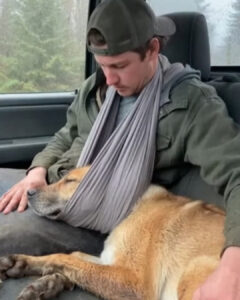
He pulled off his hoodie, tearing it down the seam to fashion a sling, working carefully around the injured leg. The dog winced but didn’t resist, eyes never leaving his face, as if memorizing it. As if afraid he might disappear.
“Yeah,” Ethan whispered, voice thick. “I know. It’s bad. But you made it.”
He lifted the dog carefully, its weight awkward but manageable, and began the slow walk back through the trees. Birds called overhead, indifferent to the quiet miracle unfolding below them. The trail looked the same as it always had—leaves, roots, shadows—but for Ethan, it felt changed.
Everything does, after moments like that.
At the truck, he laid the dog gently across the passenger seat and cranked the heat. The dog’s head slid into his lap, heavy and trusting, eyes fluttering shut for the first time since he’d found it.
Ethan rested a hand behind its ears.
“You fought hard out there,” he said quietly. “You didn’t give up.”
The dog’s tail thumped once against the seat. Weak. But real.
Ethan started the engine, already planning the route to the nearest emergency vet, already rehearsing what he’d say, how he’d explain, how he’d make sure this wasn’t the end of the dog’s story.
Outside, the forest closed in again, swallowing the trailhead in green and shadow.
But somewhere between the ferns and the front seat of a dusty truck, two lives had intersected—briefly, fiercely, exactly when they needed to.
Sometimes, rescue doesn’t come with uniforms or sirens.
Sometimes, it sounds like gravel crunching.
Boots lacing.
A man who hears a growl and chooses not to walk away.
And sometimes, that choice makes all the difference.
The first thing Luna noticed was the air.
It wasn’t the thick, stale darkness she had breathed for months. It wasn’t heavy with rot, fear, or confinement. This air was warm. Open. Alive. It carried the scent of grass and dust and something unfamiliar yet deeply remembered—freedom.
Golden pasture light spilled across the Arizona sanctuary as the trailer doors opened. For a moment, everything stood still. The world seemed to hold its breath.
Inside the trailer stood Luna.
She was once a giant in every sense of the word. An elephant built for long walks beneath open skies, for dust baths and deep rumbles that carried across the land. But starvation shrinks even the strongest beings. Months locked inside a dark barn, deprived of proper food, water, and care, had hollowed her frame. Her skin hung loose against her bones. Her eyes, once curious and calm, flickered with confusion and fear.
Dr. Lena Morales stood just outside the trailer, heart pounding so hard she could feel it in her throat.
She had seen cruelty before. She had treated abused animals, rescued wildlife pulled back from the edge of death. But nothing prepared her for the moment when Luna shifted her weight forward, testing the ramp with a trembling foot.
“Take your time,” Lena whispered, though she knew Luna couldn’t understand the words—only the tone. Gentle. Steady. Safe.
Luna stepped onto the ramp.
Her trunk lifted, wavering, tasting the air. Grass. Sun. Space. The sensation was so foreign it seemed to overwhelm her. She took another step, then another, finally placing her massive foot onto the pasture itself.
For the first time in months, Luna stood on grass.
And then her legs gave out.
It happened fast. Too fast.
One moment she was standing in the light, and the next her knees buckled beneath her. The weight of starvation, dehydration, and exhaustion came crashing down all at once. Luna’s body tilted forward, gravity pulling her toward the ground.
“Luna!” Lena shouted.
She didn’t think. She didn’t hesitate.
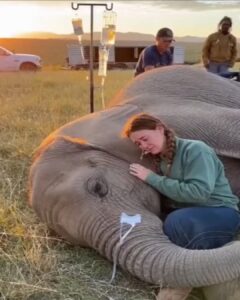
Lena dove forward, sliding through the grass, dropping to her knees beneath Luna’s massive head just before it struck the earth. The impact knocked the breath from her lungs, but she held firm, arms wrapping around Luna’s thick neck, her cheek pressed against warm, rough skin.
“I’ve got you,” she cried. “I’ve got you, easy, girl. Easy.”
Tears streamed down her face, soaking into Luna’s gray hide.
Luna’s breathing came in shallow, rasping gasps. Her eyes were wide, whites showing, panic flooding through her body. She had fallen before—in the barn, alone, unnoticed, left to struggle back up or stay down. In her mind, falling meant danger. Falling meant pain. Falling meant no one came.
But this time was different.
This time, someone had caught her.
The rescue team rushed in around them, moving with practiced urgency. IV bags were brought forward. Lines were placed carefully into Luna’s veins, hands steady despite the weight of the moment.
“She’s crashing,” one of the technicians said quietly, fear edging their voice.
Lena didn’t move.
She stayed on her knees in the grass, arms still wrapped around Luna’s neck, her body pressed close despite the sheer size difference. Lena spoke constantly, her voice low and firm, the way you speak to someone you refuse to lose.
“You’re safe,” she murmured over and over. “No more fighting alone. No more darkness. I’m here. You don’t have to be strong right now.”
Luna’s trunk twitched weakly.
Her breath stuttered.
Then something changed.
Luna let out a long, trembling sigh—the kind that releases something held far too long. Her massive body softened, not collapsing further, but settling. Leaning. Trusting.
She rested her weight against Lena.
For the first time in who knew how long, Luna stopped bracing for impact.
Minutes passed. Then an hour.
The sun shifted slowly overhead, casting long shadows across the pasture. The team rotated quietly, monitoring vitals, adjusting fluids, whispering updates. But Lena stayed exactly where she was.
Her legs went numb.
Her arms ached.
Her throat burned from speaking through tears.
Still, she did not let go.
Every so often, Luna’s eye would shift, finding Lena’s face. Each time, Lena met her gaze, nodding gently, grounding her.
“I’m not going anywhere,” she promised. “Not today. Not ever.”
In that open field, something profound unfolded—not a miracle cure, not instant healing, but the beginning of something equally powerful.
Trust.
Luna had been starved of more than food. She had been starved of touch, of safety, of the simple assurance that her pain mattered to someone. And now, fallen in the grass beneath a wide sky, she was finally being held instead of ignored.
As the IV fluids worked their way through her body, small signs of strength returned. A deeper breath. A slight shift of weight. A low, barely audible rumble that vibrated against Lena’s chest.
The team exchanged glances.
“She’s stabilizing,” someone whispered.
Lena closed her eyes, sobbing quietly into Luna’s neck.
Hours later, when Luna was strong enough to lift her head on her own, Lena finally eased back—slowly, carefully, as if afraid to break the spell. But Luna did not pull away.
She stayed lying in the grass, bathed in golden light, eyes half-closed, breathing steady. The pasture stretched around her, open and endless. Birds moved through the distance. Wind stirred the grass.
This was not a barn.
This was not a cage.
This was not darkness.
This was the world.
Luna had fallen—but she had not been abandoned.
She had been caught.
In the days that followed, Luna would take her first tentative steps across the pasture. She would learn what it felt like to eat without fear of scarcity, to drink clean water, to rest without pain. Recovery would be slow. There would be setbacks. Healing a body starved for months takes time.
But something essential had already returned.
Hope.
Because on that first day—when her legs failed her and the weight of suffering pulled her down—someone ran toward her instead of turning away.
And for an elephant who had spent too long fighting alone in the dark, that changed everything.
Sometimes rescue doesn’t look like standing tall.
Sometimes it looks like falling into the light—and discovering, for the first time, that there are arms strong enough to hold you when you do.