WAYLON JENNINGS GAVE UP HIS SEAT ON THE PLANE THAT KILLED BUDDY HOLLY. THE LAST THING HE SAID TO BUDDY WAS A JOKE. HE SPENT 43 YEARS WISHING HE COULD TAKE IT BACK. February 3, 1959. The Winter Dance Party tour. Buddy Holly chartered a small plane to escape the freezing bus. Waylon, just 21 and playing bass in Buddy’s band, gave up his seat to J.P. “The Big Bopper” Richardson, who was sick with the flu. Before boarding, Buddy teased him: “I hope your ol’ bus freezes up.” Waylon shot back: “I hope your plane crashes.” Hours later, the plane went down in an Iowa cornfield. Buddy was gone at 22. Waylon never publicly forgave himself. He carried that sentence — five careless words between two friends — until his own death in 2002. Some jokes become life sentences. – Country Music
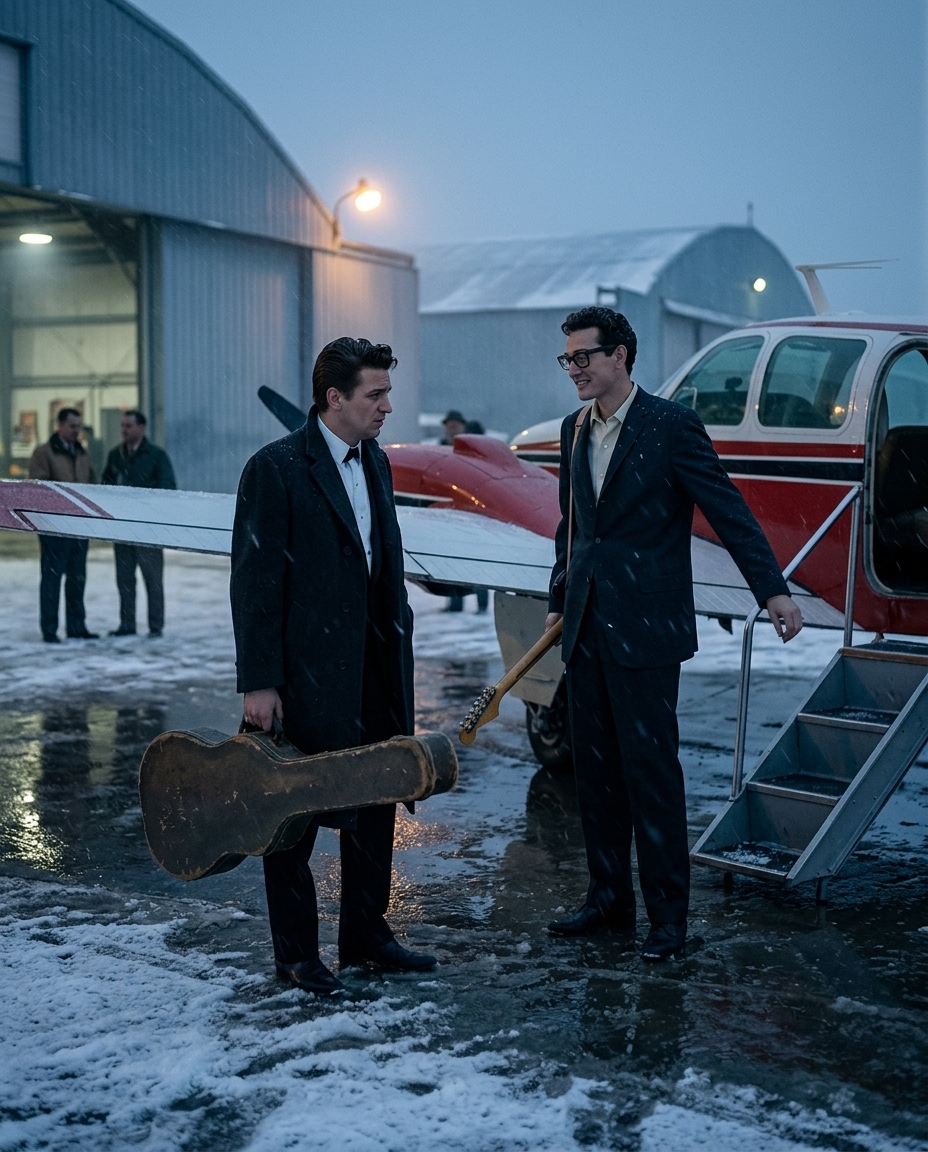
Some stories in country music feel larger than life. This one feels painfully human.
Long before Waylon Jennings became one of the defining voices of outlaw country, Waylon Jennings was a 21-year-old bass player on the road with Buddy Holly. It was the winter of 1959, and the tour was already becoming a test of endurance. The buses were old, the Midwest weather was brutal, and the miles seemed endless. Musicians were riding through snow and wind, trying to make it from one show to the next with numb hands and exhausted bodies.
On February 3, 1959, that exhaustion changed everything.
A Seat on a Small Plane
The Winter Dance Party tour had turned miserable. The heating on the bus barely worked, and the cold cut through everyone on board. Buddy Holly, tired of the freezing conditions, arranged for a small plane after a show in Clear Lake, Iowa. It was meant to be a practical decision, nothing more dramatic than trying to get ahead of the next long ride and catch some rest before the next date.
Waylon Jennings was supposed to be on that plane.
But plans shifted in a moment that seemed ordinary at the time. J.P. “The Big Bopper” Richardson was sick, worn down by the flu and the punishing travel. Waylon Jennings saw how bad J.P. “The Big Bopper” Richardson looked and gave up the seat. It was the kind of choice a person makes quickly, almost without thinking. One man looked worse off, so another stepped aside. No grand speech. No sense of fate. Just a quiet act of kindness on a cold night.
That should have been the end of it.
The Joke Between Friends
Before Buddy Holly boarded, the mood was not heavy. It was casual, almost playful, the kind of exchange that happens between young men who have spent too many days together on the road. Buddy Holly reportedly teased Waylon Jennings and said, “I hope your ol’ bus freezes up.”
Waylon Jennings answered with a joke of his own: “I hope your plane crashes.”
It was not said with anger. It was not a curse. It was the kind of careless, quick-tongued line people throw at each other without ever imagining the words might echo for the rest of a lifetime.
Hours later, the plane went down in an Iowa cornfield.
Buddy Holly was dead at 22. Ritchie Valens was gone. J.P. “The Big Bopper” Richardson was gone too. In one night, music lost three young stars, and Waylon Jennings was left standing outside a tragedy that could have taken him as well.
The Weight of Five Words
For the public, the crash became part of music history. For Waylon Jennings, it became something more personal and much harder to outrun. He did not just remember the night. He remembered the last thing he had said.
That is what made the pain so sharp. It was not only survivor’s guilt. It was the unbearable feeling that the final words between two friends had been a joke that turned into a nightmare. Rationally, Waylon Jennings knew words do not cause a plane to fall from the sky. But grief is rarely rational, and guilt has a way of ignoring facts.
As the years passed, Waylon Jennings built a towering career. He became one of country music’s most recognizable voices, a rebel artist with scars, swagger, and honesty in every note. Yet even after the fame, the records, and the legend, that old moment stayed with him. It followed him through decades. By many accounts, Waylon Jennings never fully forgave himself for saying it.
Some moments last a few seconds. The feeling they leave behind can last a lifetime.
A Memory He Carried Until the End
Waylon Jennings lived another 43 years after that night in Iowa. He became older, tougher, and wiser. But there are some regrets that do not soften with age. They settle deep inside a person and become part of the story they tell themselves in silence.
That may be what makes this story endure. It is not just about a plane crash or a famous tour. It is about how fragile ordinary moments really are. A seat exchanged. A laugh in passing. A sentence spoken without thought. Then, suddenly, nothing is ordinary anymore.
Waylon Jennings spent the rest of his life carrying the memory of Buddy Holly and the joke he wished he could take back. That does not erase the friendship, and it does not define everything Waylon Jennings became. But it reminds us that even legends are haunted by very human things: timing, memory, and words they never expected to matter so much.
Sometimes the deepest wounds are not caused by cruelty. Sometimes they come from a moment that was never meant to hurt anyone at all.
Post navigation
Townes Van Zandt Never Needed a Number One to Become a Legend
Townes Van Zandt never had a No. 1 hit with his own name on it. Not once. No gold-rush chart moment. No big Nashville coronation. No polished image built for country radio. And yet, decades after Townes Van Zandt drifted through bars, back rooms, and borrowed stages, some of the most respected songwriters in American music still speak about Townes Van Zandt with something close to awe.
That says everything.
Steve Earle once made one of the boldest declarations in modern songwriting lore when Steve Earle called Townes Van Zandt “the best songwriter in the whole world” and said he would stand on Bob Dylan’s coffee table in cowboy boots to prove it. It was a line that sounded half funny, half dangerous, and fully sincere. Because for the people who understood what Townes Van Zandt was doing, the argument was never about sales. It was about truth.
The Artist Nashville Could Not Quite Understand
Townes Van Zandt did not fit the usual mold. The voice was weathered, fragile, and sometimes almost unsettling in its honesty. The songs were not built to flatter listeners. They carried loneliness, regret, beauty, and silence in equal measure. There was poetry in them, but not the kind that showed off. Townes Van Zandt wrote like someone trying to survive his own thoughts.
That was never going to be easy for commercial country music to package. Nashville saw a man who could seem distant, wandering, even mysterious. Stories followed him everywhere. He might show up with a tape, offer a song, then disappear again. He played small rooms, half-empty bars, and spaces where the audience sometimes looked too thin for history to be happening. But history was happening anyway.
Because even when the crowds were small, the songs were not.
The Songs Traveled Further Than the Man
The strange twist of Townes Van Zandt’s life is that while Townes Van Zandt rarely found broad fame as a performer, the songs themselves kept escaping the room. They found bigger voices, bigger stages, and wider audiences. Willie Nelson and Merle Haggard took “Pancho and Lefty” all the way to No. 1 and turned it into one of the defining country recordings of its era. Emmylou Harris recorded “If I Needed You” and helped make it a standard that still feels intimate every time it plays.
That pattern repeated again and again. Songwriters recognized the depth immediately. Guy Clark openly credited Townes Van Zandt as a major influence on his own writing. Bob Dylan reportedly kept every Townes Van Zandt album he could get. Among artists, Townes Van Zandt became the kind of name spoken with respect before the song even started.
Townes Van Zandt did not need a hit to prove the songs mattered. Other artists proved it for him every time they sang one.
Born Into Comfort, Drawn Toward Something Harder
What makes the story even more fascinating is where Townes Van Zandt came from. Townes Van Zandt was born into wealth and Texas legacy, part of a family important enough to have a county named after them. The easy road was sitting right there. Respectability was available. Comfort was available. Stability was available.
Townes Van Zandt walked the other direction.
Instead of building a life around prestige, Townes Van Zandt chose a stripped-down existence that felt almost like a statement. A tin-roofed shack outside Nashville. No heat. No plumbing. No phone. It was not glamorous rebellion. It was closer to a refusal. Townes Van Zandt seemed uninterested in polishing life into something presentable. Fame did not appear to be the prize. Truth was.
And truth, as Townes Van Zandt understood it, was rarely clean.
A Legacy That Outlived the Charts
Townes Van Zandt died at 52 on New Year’s Day in 1997, a date that carried its own haunting echo because Hank Williams had died on that same calendar day 44 years earlier. By then, Townes Van Zandt still had not charted a major hit under his own name. On paper, that might look like a career that never fully arrived.
But paper cannot measure influence very well.
The writers who came after Townes Van Zandt knew. The musicians who chased honesty instead of fashion knew. The listeners who heard one Townes Van Zandt song at exactly the right moment knew. Some artists build fame first and legacy later. Townes Van Zandt built legacy almost by accident, one uncompromising song at a time.
That may be why the story still lasts. Townes Van Zandt never gave the industry what it wanted. Townes Van Zandt gave music something harder to find: songs that felt completely real. And in the end, that is why Townes Van Zandt never needed a No. 1 hit to become unforgettable.