MARRIED FOR 6 YEARS, DIVORCED, BUT THIS DUET STILL SOUNDS LIKE THEY NEVER LET GO. Kris Kristofferson and Rita Coolidge weren’t pretending when they sang “Loving Arms.” You can hear it — that quiet ache between two people who knew each other too well to fake anything. His voice carries the weight of a man who wandered too far. Hers wraps around his like she’s been waiting at the door the whole time. No dramatics. No big vocal runs. Just two people breathing the same melody like it was the most natural thing in the world. The marriage ended. The music didn’t. And something about the way Rita closes her eyes on that last note tells you everything words never could… – Country Music
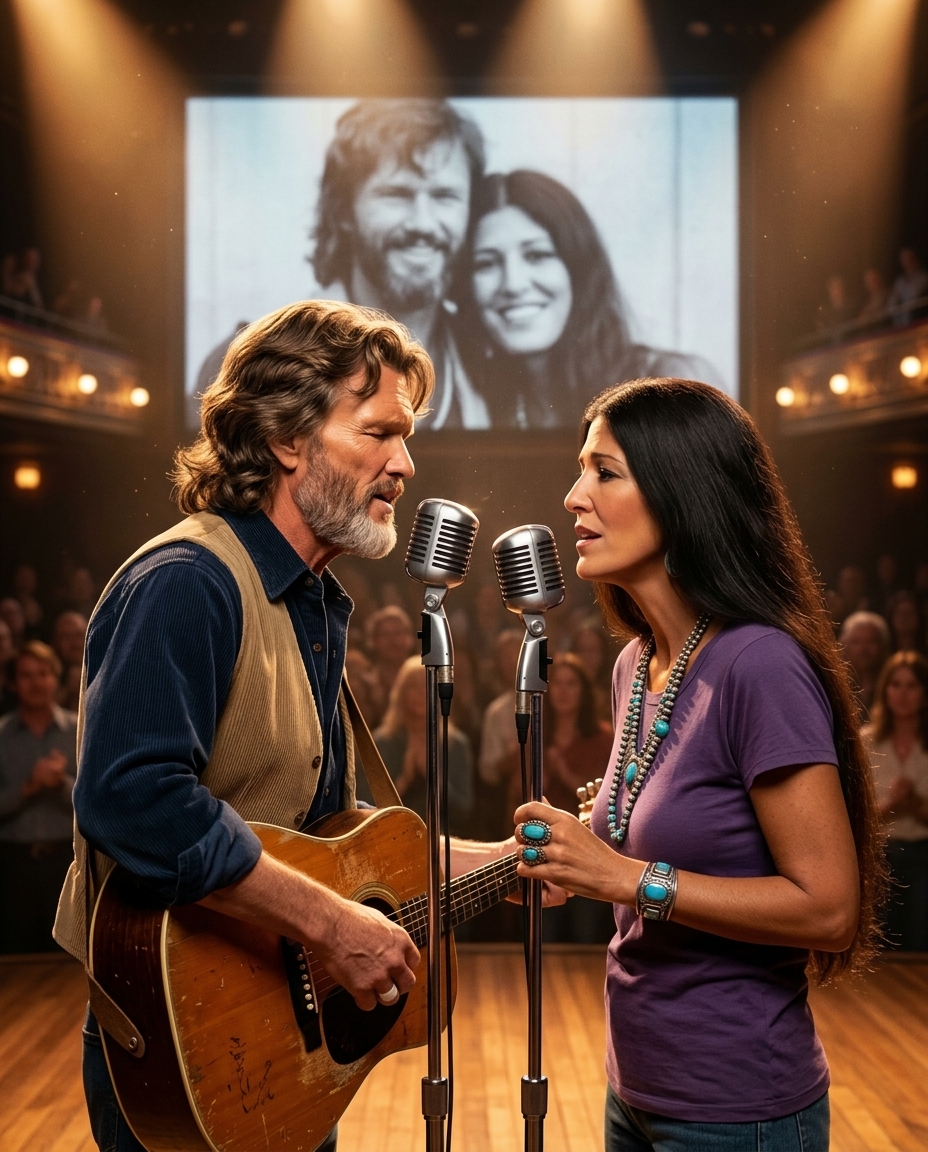
Some performances feel polished. Some feel rehearsed. And then there are the rare ones that feel almost too personal to watch, as if the microphones happened to catch something never meant to be explained out loud. That is the feeling Kris Kristofferson and Rita Coolidge leave behind when they sing Loving Arms.
The song itself is already built on longing. It is quiet, wounded, and deeply human. But in the hands of Kris Kristofferson and Rita Coolidge, it becomes something even more intimate. It stops sounding like a standard duet and starts sounding like a conversation between two people who once built a life together, lost it, and somehow still recognized each other in the silence between lines.
More Than Just a Duet
There is no need for dramatic staging or oversized emotion here. Kris Kristofferson does not force the sorrow. Rita Coolidge does not decorate the melody with unnecessary power. That restraint is exactly what makes the performance so moving. Every line feels lived in. Every pause feels earned.
Kris Kristofferson sings like a man carrying miles behind him. There is dust in the voice, a little regret, and the kind of weariness that comes from learning too late what mattered most. Rita Coolidge answers with warmth, but not simple comfort. There is wisdom in her tone, and something more difficult than forgiveness. There is memory.
That is what makes the duet linger. It does not sound like two singers trying to impress an audience. It sounds like two people standing in the same emotional room, even if life had already taken them in different directions.
A Marriage That Ended, a Connection That Didn’t
Kris Kristofferson and Rita Coolidge were married for six years. The marriage ended, as many do, with time, strain, and the kind of distance that can grow even between people who once seemed impossible to separate. But music has a strange way of preserving what everyday life cannot. It catches a tone, a glance, a breath, and keeps it there long after the relationship itself has changed.
That is why this performance feels so revealing. It is not about pretending the past never happened. It is not about acting as if pain did not leave its mark. It is about what remains when the paperwork is finished, the headlines fade, and two voices meet again inside a song that asks for honesty.
When Kris Kristofferson leans into a phrase, there is a sense of someone reaching across more than melody. When Rita Coolidge joins him, it does not feel like an answer rehearsed for television. It feels instinctive. Familiar. Almost unavoidable.
The Quiet Power of “Loving Arms”
Loving Arms was never a song that needed volume to break your heart. Its strength comes from simplicity. It is about return, about weariness, about wanting refuge after too much time spent drifting. In the wrong hands, that can sound sentimental. In the voices of Kris Kristofferson and Rita Coolidge, it sounds painfully real.
There is one particular kind of sadness that belongs only to people who once knew each other closely. Not the sadness of strangers. Not the neat sadness of fiction. A more complicated one. The kind made of affection, disappointment, history, and the stubborn fact that love does not always vanish just because a chapter ended.
Sometimes the most unforgettable love songs are not the ones about staying. They are the ones sung by people who could not stay, but never fully stopped feeling.
That is why the duet continues to move people. Listeners are not just hearing a beautiful song. They are hearing the tension between what was lost and what was never entirely gone.
The Last Note Says the Most
By the time the performance reaches its final moments, almost nothing needs to be explained. Rita Coolidge closes her eyes on the last note, and the gesture says more than any interview ever could. It is not theatrical. It is not exaggerated. It feels like someone stepping, just for a second, into a place memory still keeps open.
Kris Kristofferson is there too, steady and unguarded, letting the song end without forcing a conclusion it does not need. That may be the most beautiful part of all. Loving Arms does not offer a reunion. It does not try to rewrite the ending. It simply allows the feeling to exist.
And maybe that is why the duet still hurts in the best way. Kris Kristofferson and Rita Coolidge may have divorced, but in this song, they sound like two people who once belonged to the same story and never completely left it behind.
Post navigation
There are missed chances in every life, but some feel heavier than others. Some do not fade with time. They stay in the back of the mind, quiet but permanent, returning in certain songs, certain rooms, certain late-night thoughts. For Alan Jackson, one of those memories was tied to Keith Whitley — and to a song they were supposed to write together.
In the late 1980s, country music was filled with strong voices, but only a few could make a listener feel as if the singer was speaking directly to them. Keith Whitley had that gift. Alan Jackson had it too, though Alan Jackson was still finding his place in a fast-moving Nashville that demanded patience, hustle, and more waiting than most outsiders ever understood.
They came from similar ground in more ways than one. Both carried the sound of home in their voices. Neither sounded polished in a way that felt artificial. There was weight in the way they sang — not dramatic weight, but the kind that comes from living close enough to heartbreak, hope, and ordinary struggle to recognize the truth when it appears in a lyric.
A Conversation Backstage
According to the story told and retold through the years, Alan Jackson and Keith Whitley crossed paths backstage at the Grand Ole Opry in early 1989. It was not one of those grand, movie-like encounters. It was simple. Two artists talking in a place where music was always moving around them.
Keith Whitley reportedly told Alan Jackson they should write something together. Not something flashy. Not something built to impress a label meeting. Something real. Something that sounded like where they both came from. That kind of idea would have meant something to Alan Jackson, because the best country songs were never just songs to him. They were memory, accent, heartbreak, front porches, old roads, and things people did not know how to say any other way.
Alan Jackson said yes.
And then life did what life so often does. It crowded in.
The Delay That Never Got Fixed
There were demos. There were sessions. There were label conversations. There were the endless practical details that can make even sincere intentions feel like they can wait one more week. Alan Jackson, like so many young artists trying to hold on to momentum, kept putting the call off. Not because the idea did not matter. Because he believed there would still be time.
Next week can feel harmless when you say it to yourself. It sounds responsible. Temporary. Manageable. But sometimes next week never arrives the way you expect it to.
On May 9, 1989, Keith Whitley died at the age of 34.
Just like that, the unwritten song became something else. It was no longer a postponed session, no longer a napkin note, no longer a conversation Alan Jackson could return to after the schedule calmed down. It became a silence. And silence has a way of growing louder when it carries regret inside it.
The Number He Could Not Throw Away
One of the most haunting details in this story is the image of Alan Jackson keeping a folded napkin with Keith Whitley’s number in his wallet for years. Maybe it was small. Maybe faded. Maybe the ink softened over time. But objects like that are never just objects. They become evidence of a moment when the future still looked open.
Throwing it away would have meant admitting what could not be changed. Keeping it meant holding on to the last physical trace of a promise never fulfilled.
That is what regret often looks like in real life. Not speeches. Not breakdowns. Just one small thing a person cannot let go of because it connects them to what should have happened.
The Tribute That Hurt to Sing
Years later, Alan Jackson recorded Keith Whitley’s signature song “Don’t Close Your Eyes” for a tribute project. By then, Keith Whitley’s place in country music was already secure, but the loss still felt deeply personal to the people who knew him and to the artists who understood how much more he might have given.
For Alan Jackson, singing that song was not just a performance. It was a return to unfinished business. It was a reminder of a conversation cut short by time, and of a collaboration that never got the chance to become real. A lyric can hit differently when it carries memory with it. A melody can feel heavier when it reminds a singer not only of another artist’s talent, but of something left undone.
Some songs become hits. Some become classics. And some never make it onto paper at all. Yet those unwritten songs can leave their own mark, especially when they stand for friendship, delay, and the hard truth that not every chance waits for us.
That may be why this story still lingers. It is not only about Keith Whitley’s loss, or Alan Jackson’s regret. It is about the fragile space between intention and action. It is about how easily people believe there will be another phone call, another week, another moment to finally do the thing that matters.
But sometimes there is not. And the silence left behind says everything.